
T
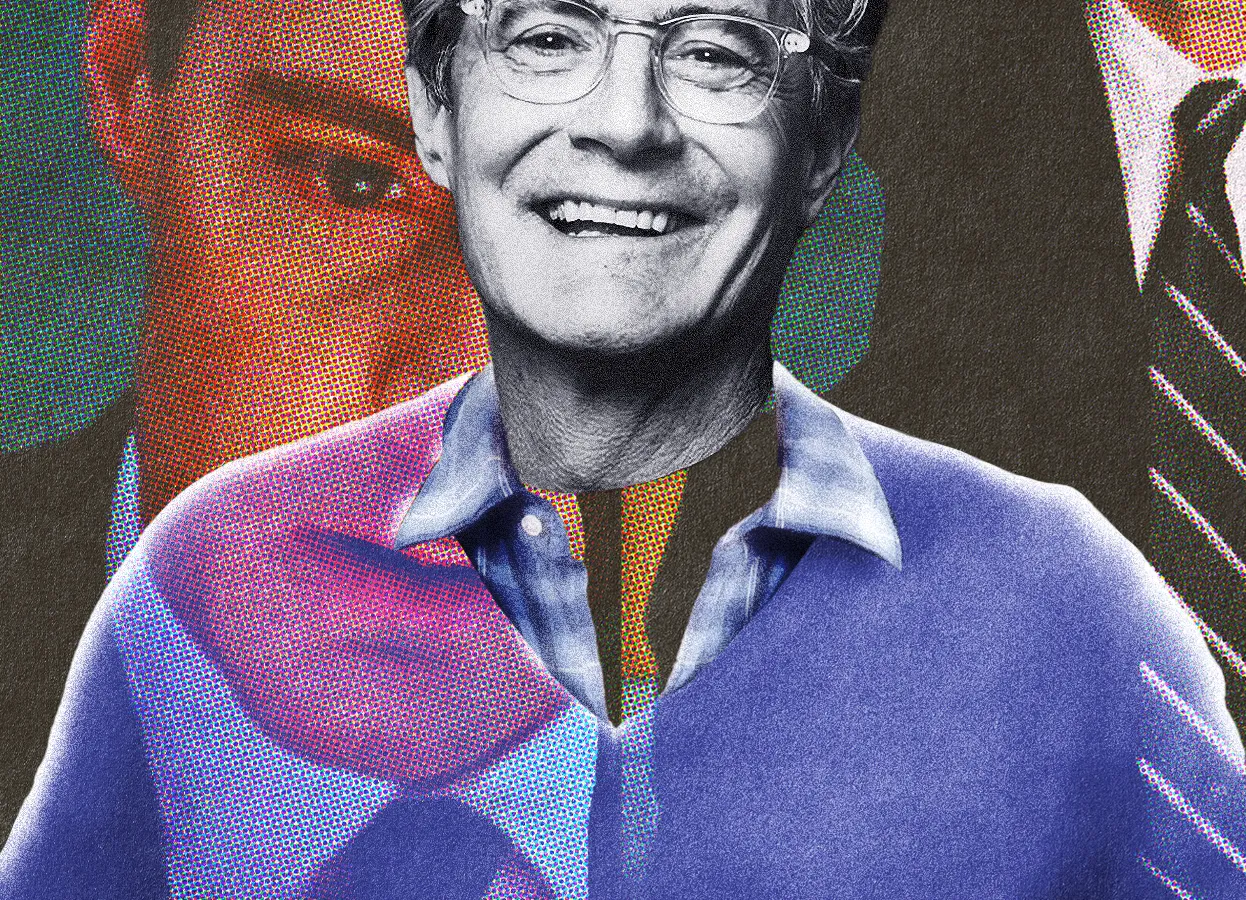
hough he’s now 67 years old, the boy-next-door energy Kyle MacLachlan projects has never fully left him. He’s remained the go-to guy to play handsome, trustworthy, and often reserved men over his four decades in Hollywood. That’s not to say the journey has been without bumps.
The ink on MacLachlan’s University of Washington acting degree wasn’t even dry when, at 23, he was cast as Paul Atreides in David Lynch‘s ambitious Dune adaptation. The idea was that he would be the face of a new epic universe. Then the movie flopped. “You emerge from nothing, and suddenly, boom! You’re in the spotlight and doing this dance,” MacLachlan says. “It came, went, and then I was like, ‘Well, I’m kind of back to where I was before.’”
Lucky for us, the failure didn’t stick. In the wake of Dune, and thanks in part to his long creative partnership with Lynch, MacLachlan flexed his chops in a number of roles that mined dark and weird territory. He was once describe in the pages of this magazine as the “boy next door, if that boy spent lots of time alone in the basement,” a description MacLachlan has become fond of. “It was on my IMDb page for a long time, and I kept thinking, ‘Oh, I should probably change that.’ It’s very funny,” he says. “As time has gone on, I’ve been really fortunate to be able to play characters that seem to have an inner life or they’re wrestling with some kind of dilemma. Is he good? Is he bad? That’s become my thing, I guess.”
Now, he’s written a memoir that digs into it all. Out Sept. 29, Fictional Selves charts MacLachlan’s path from young theater aficionado to the freaked-out men he’s played in everything from Twin Peaks and Blue Velvet to Sex and the City, Desperate Housewives, Portlandia, and Fallout. And it doesn’t pull punches. “It would be very easy to walk through and tell all the good stuff,” he says from his home in California, dogs Elvis and Bailey gleefully braying in the background. “But it wasn’t about that. It was about my experience. It was important for me to be honest. Because that’s the journey.”
For Rolling Stone’s Last Word column, MacLachlan talked about spending his first Dune paycheck, his Lynchian career, and why he’s OK with people on the internet calling him babygirl.
What led you to write a memoir?
I was spending a lot of time thinking about my dad. He’s been gone since 2011, and I find myself repeatedly thinking, “Oh, I’d love to ask him this.” Maybe this is a chance to bring some insight to my son [who’s 18]. He’s not going to be interested right now. But there might come a time when he wants to hear some stories.
You attended the University of Washington for acting, where you focused on theater. What’s your favorite play from Shakespeare?
I did Romeo and Juliet three times and I love the play. I always end up going back to “But soft. What light through yonder window breaks?” I did that [monologue] with Stephen Colbert — that was really fun. I did that play when I was right out of school. It was my first professional job after I got out of my training. I did it at the Oregon Shakespeare Festival on the main stage. It was profound. I loved every minute of it.
Your first screen role was playing Paul Atreides in David Lynch’s Dune in 1984, which was a notorious flop. What was that like for your first Hollywood gig?
I’m working in the theater. I’m making nothing every week, 185 bucks, and suddenly I was paid $50,000 for this movie. I had nothing to compare it to. I had never been in front of a camera before.
Dune’s reception wasn’t great. People were confused by it, and I was unaware of what was happening. I assumed we were going to go forward [with sequels], and then it all came to a screeching halt.
How did you handle that?
I just kept plugging along. When you’re 24, 25, you’re optimistic. At least I was optimistic. The despair came as I slowly realized the perception people had was different. The rejection starts. People weren’t interested in me because of the movie. David picked me up out of that, and we did Blue Velvet [in 1986]. I couldn’t have been happier to be working, not only with my friend, but on a really cool film.
What was it like watching Denis Villeneuve’s Dune films with Timothée Chalamet?
It was an odd feeling to revisit. It was nostalgic for me [and] strange to watch a different version. I was intrigued and I really enjoyed it. I saw Timothée a couple times, just out and about, and we connected immediately over this role. It’s very hard to make Paul active. I have tremendous respect for him as an actor.
Do you have any prized possession you’ve taken from sets?
I got one of the signet rings from Dune. That was really cool, but I didn’t get one of the knives. I didn’t really want a stillsuit because those things are so uncomfortable. With Blue Velvet, I kept some of the clothes, believe it or not. I wore those for a while. But I’m not much of a collector like that. I think the only thing of any significance I took was one of the costumes from The Flintstones. It’s one of Cliff’s suede outfits that were wonderful — really comfortable. I have a Paul Atreides action figure, but it would have been really fun to have the whole set.
What was your first extravagant purchase from your Dune money?
My Jeep, my first car. My mom was like, “What about the Honda Prelude?” I was like, “That’s not going to happen.” I think it was $10,000. I called it the Spoils of Dune. I had it for a long time and when I finally sold it, it was pretty beaten up. I got my money’s worth out of that one.
What do you think made Blue Velvet such a cult classic?
The thing that I took away from it was that I was working with an actress [in Laura Dern] who was bringing out the best in me. I’ve always said she’s very in the moment. So whatever’s happening feels immediate.
After Blue Velvet, you and Laura Dern dated. But did you really cheat on her with Lara Flynn Boyle while on the set of Twin Peaks?
Yeah. We all have moments in our life where we’re not proud of ourselves. [Laura and I] are now very close friends. It took time and maturity and some forgiveness. My apology wasn’t in public, but with friends — owning a time period when I was really an ass. Getting older [is] looking back, understanding people do things and people can change.
You shot the Twin Peaks pilot on location near Snoqualmie in Washington state. How did the landscape help build the show’s Lynchian feel?
We shot a two-hour pilot in 23 days. So having the rush and the need to to move forward quickly also gives an energy to the pilot, but it had more to do with the environment. Shooting up there — in a particularly difficult winter — brought with it so much dimension and had such an impact on the feeling. I mean, think about that image of Laura’s body in plastic, the giant log on that water, and the lodge. You’re there in the space and it really added a lot to that opening episode. When you remove that and put it into a sterile warehouse in Van Nuys, it’s just not the same.
Over the years you auditioned for some major projects like Some Kind of Wonderful, Platoon, Top Gun, even Grey’s Anatomy for the part of Derek Shepherd. Were there any you think you could’ve nailed?
I wasn’t offered [them] by any means. I just auditioned. These things were percolating around the time. But it’s fun for me because of how awful [my auditions] were. Every actor has those stories. In my case, more often than not, I’ve sort of stunk up the place.
What was the most difficult part of returning to Twin Peaks for that much-belated third season in 2017?
It was a simple question of “Can I do it? Can I still play Cooper? It’s been over 25 years.” That was challenging, exhilarating, frightening, and I had a lot of uncertainty. But I’m working with the all-time-great David Lynch, who’s going to be right there for me every step of the way. I just gave in to that and said, “OK, we’re gonna find it together.”
When you’re younger, you take things for granted. You’re not as aware — at least I wasn’t. But when we came back, I recognized immediately that this was something special. I’m going to work on one of the great projects with one of the great directors, one of the great casts, doing amazing characters that he’s asked me to to bring to life. Enjoy this.
Lynch died last year, days before his 79th birthday. He was one of your most frequent collaborators and supporters. How do you begin to grieve a relationship like that?
I never saw [David] when he was really suffering. He always projected this kind of “everything’s under control.” He was always upbeat. We were talking about more projects we were going to do, ideas that he had. So when it happened, it was a shock, because I was feeling, “He’s going to be around for a while.”
I think about him a lot. There’s still an emptiness. I can’t pick up the phone and call him. I can’t just swing by his house for a cup of coffee. But he’s very much alive in my brain. And he’s very much alive when I get together with Laura or Isabella [Rossellini]. There’s a lot of laughter. I guess that’s how we fill up that hole — with the memories.
What’s the role you get recognized for the most?
The unexpected I really enjoy. They’ll say, “Excuse me?” and then something really obscure, like, “I loved you in The Trial!” The Trial? Really? More often than not, it’ll be Cooper. Or Trey or Orson, from Sex and the City and Desperate Housewives. The impact of those shows is pretty impressive. People still watch them. They’re superfans. It’s fun to be part of things that are still around.
You and your wife are about to celebrate your 25th anniversary. What’s the key to a good marriage?
I was old. I was more mature, thank God. I married someone who has a tremendous patience and understanding of human nature. She’s very smart, very inspiring. And she’s a terrific mom. Callum, our son, [is] an amazing young man, but her energy, her intelligence, her strength, her smarts — he carries all of that in him, and it’s awesome to see.
You’ve become a bit of a star on TikTok — both for your own videos and clips from your podcast, What Are We Even Doing? What itch do those videos scratch for you?
I get to let my silly side out, which is a big part of who I’ve always been, and that’s really fun. I’ve also been able to learn about a younger generation and what they’re up to. I get this dose of inspiration and creativity from the people that I talk with, and it’s just fun to hear stories from a different perspective. That’s my happy place.
Was there a learning curve for Gen Z language? I imagine it’s hard to wake up one day and have your comment sections filled with people calling you “babygirl.”
I was like, “Tell me about that!” I Googled it. There’s a lot of play in the younger generation; not taking yourself too seriously. That’s pretty cool. I like that feeling a lot.
What has been the proudest moment of your career?
Laura and I presented David with an Academy Award at the Governor’s Awards. I was so happy and proud to be up there to present something that I knew meant a lot to him. I’ll never forget that moment and just how happy he was. He was really affected by the outpouring of love that night.
What are some rules that you’ve prioritized throughout your career?
Bring joy. Create joy. Be present with everyone, and be prepared. I come to work fully prepared and ready to go. In the past, where I’ve been cavalier or maybe shot from the hip in certain situations, it’s just too disconcerting. So I’m always prepared.