
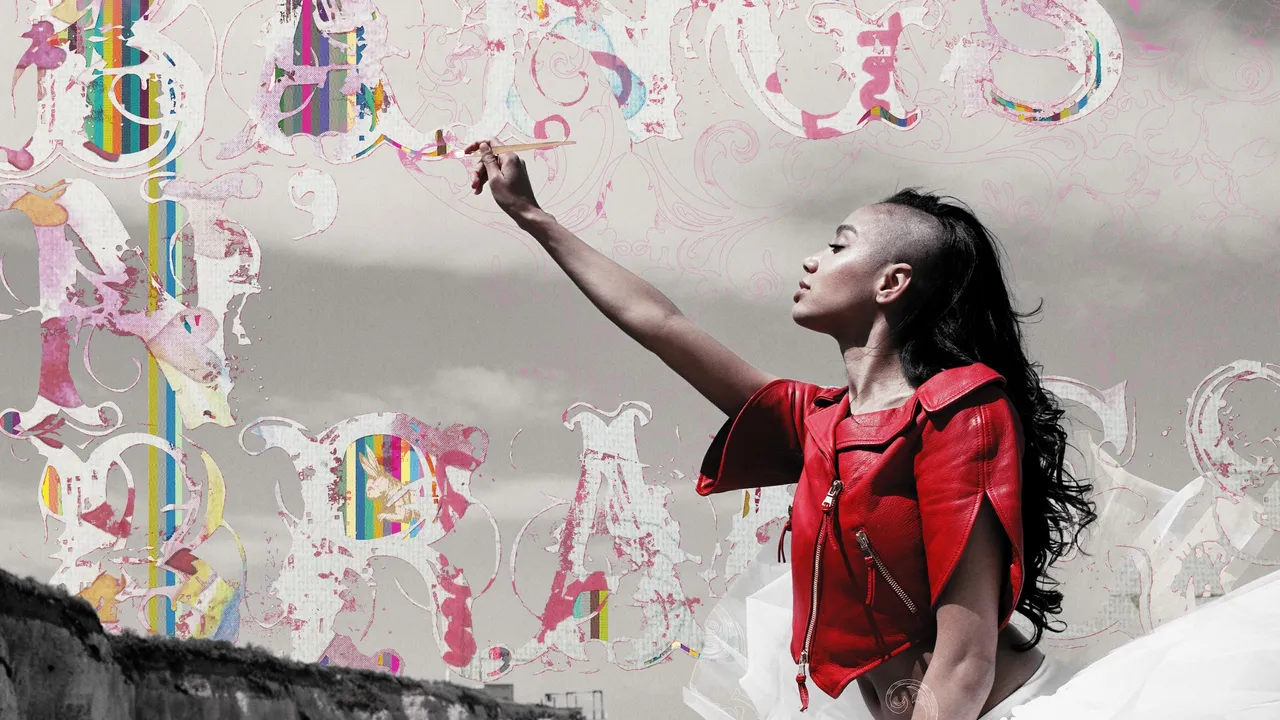
iKeda’s music conjures images of Day-Glo leggings, plastic shutter shades, and early Photoshop collage: an eternal summer 2007. The singer is a familiar face on the London scene, opening for PinkPantheress, collaborating with Babymorocco, and holding her own among the city’s rising class of cool girls. Her debut EP, 2024’s Pretty Little Problem, made a quick study of the sounds of late-aughts electronic music, piling up layers of references and knocking them down as it swerved from dubstep to bassline, speed garage to UK funky. Its strobe-lit glare sometimes seemed to outshine iKeda’s own personality, a fatal flaw when staking a claim to M.I.A. and Santigold’s attitude-forward corner of the club.
On her second EP, Bangs N Braces, iKeda reunites with producer Tailtiu and goes a long way toward making herself known. Weirder, brighter, and more purposeful than anything she’s released to date, it’s a transitional record that wrestles with the limits of its influences. Genres like dubstep and bassline were typically geared for belters who amped up the melisma as producers dialed up the chaos. iKeda’s more limited range presents its own opportunities, allowing her to command the song’s cool center. You could imagine a powerhouse singer matching the chainsawing wobble on “Red Red” with overblown volume and emotion; iKeda dials everything back, ducking and weaving through the lava flow of molten bass and running circles around her lover in a seductive, Auto-Tuned deadpan.
No score yet, be the first to add.
Bangs N Braces has a lot of fun playing into its star’s eccentricities. In “Tiger Tiger,” probably the only rave banger to have been inspired by the children’s books of Judith Kerr and Enid Blyton, she sets the stage for a quintessential English teatime scene before smashing the china in a stampede of drums, rave whistles, and SOPHIE synth shrapnel. “Go!” calls for an all-girl dancefloor takeover and boasts one of the strangest hype-ups in recent memory: “I wanna channel my confidence into one little hair/I wanna use that hair to clone myself 30 times/I wanna send my me-army out-out onto the front lines.” iKeda has called Lily Allen her “favorite songwriter ever” and the influence of Allen’s pen is most strongly felt on “Mapz,” in which iKeda uses location sharing to track the faithless guy who’s been stepping out on her all over London. When she finally catches up to him, she holds onto the line “You said no more going out… but you’re going out” with such theatricality that you almost expect her to follow up: “…and who the fuck is Madeline?”
As fun as these moments are, Bangs N Braces presents the unmistakable sense that iKeda has taken the retro-millennial stylings about as far as they go. When a beat feels too overloaded her spritely vocals can fade into the background, and Tailtiu’s packed productions don’t always leave much room to breathe. The buried percussion on “Pyramids” shifts with the direction of the synths, so that despite their frenzied action they seem both shapeless and overstuffed. “Red Red” feels studied rather than spontaneous, its triumphant coos and surging breakdowns following the blueprint of a dubstep rollercoaster from 2008. Even an undeniable earworm like “Go!” took a moment to come around to: Flinging punchy, gated drums like projectiles, on first impact it mostly just hit me how much it sounded like an M.I.A. rip.
It would probably be more accurate to say that iKeda is borrowing some back. The singer, who is of Jamaican descent, has described her take on dancehall as “bubble riddim,” a phrase evoking how she marries the genre’s nonstop flow with a fresh gloss of hyperpop antagonism. But she’s also invoked the term to refer to an overlooked moment of cultural exchange, when European producers in the early 2010s furnished Jamaican singers with avant-garde beats and performers (like M.I.A.) took cues from the swagger and sultriness of artists like Ce’cile. It’s a fascinating pocket of music history and a creative approach that, if properly honed, wouldn’t just distinguish iKeda’s work in the pop field but also place her in conversation with other cutting-edge diaspora experimentalists. The proof is in her effervescent presence on “Meoww,” chasing and outrunning the beat as she narrates a frisky stream of consciousness over billowing synths, bouncing polyrhythms, and strategically deployed kitty samples. iKeda can channel the familiar sounds of the past better than most, but Bangs N Braces proves she’s ready to take her music to another level entirely.