
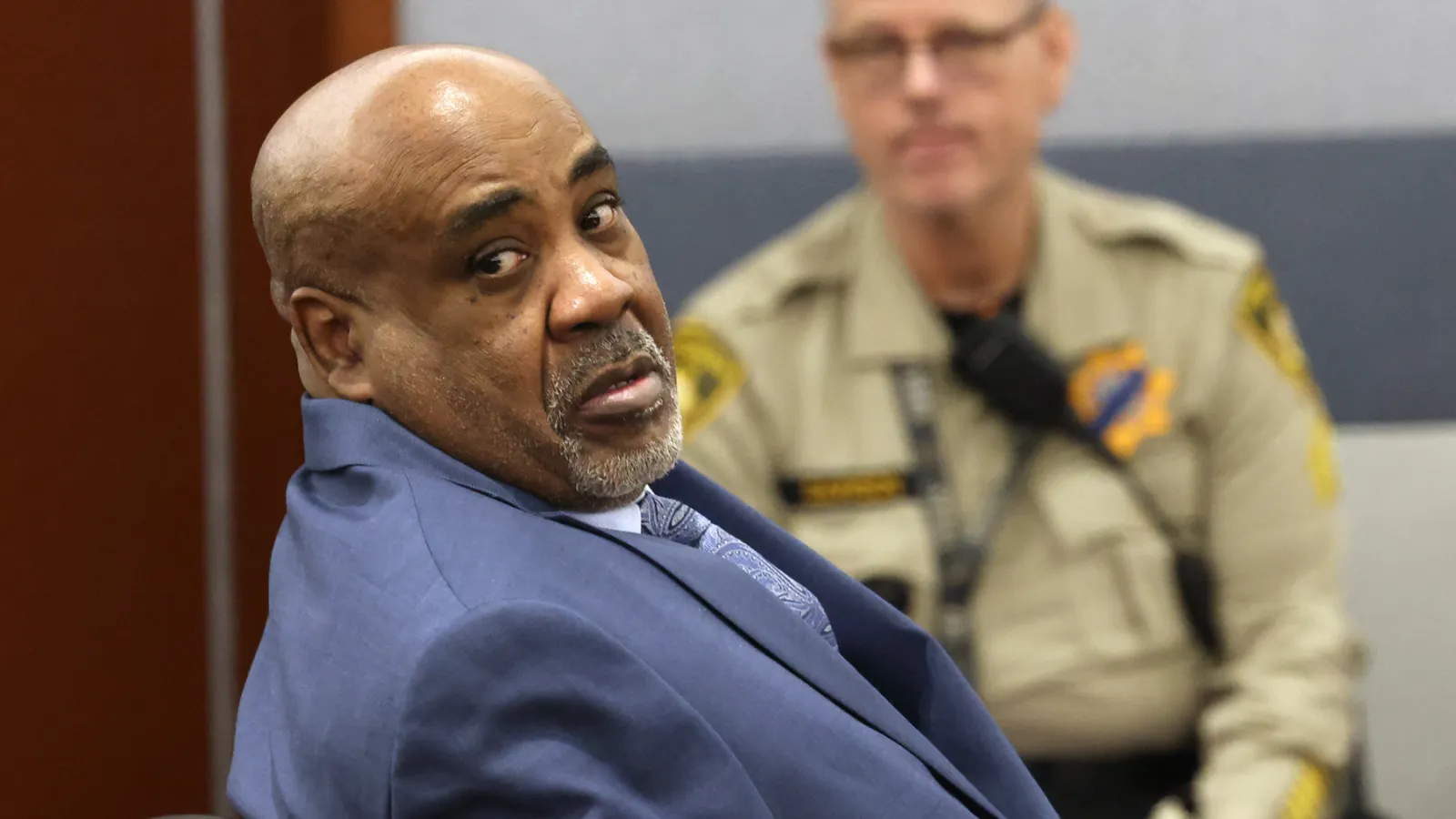
Three decades after the 1996 drive-by shooting of hip-hop legend Tupac Shakur in Las Vegas, a prosecutor gave jurors an unflinching account of the long-unsolved slaying on Monday, accusing Duane “Keffe D” Davis of organizing the attack as “an act of revenge.”
In his opening statement on the first day of Davis’ murder trial, Clark County Chief Deputy District Attorney Binu Palal told jurors they would not have to take the state’s word for it. Davis, he claimed, had confessed his own role in a “secret 2008 interview” with authorities, later public statements, and his 2019 memoir, Compton Street Legend.
Palal played snippets of the 2008 interview as Davis, dressed in a blue suit and tie, watched a screen in the courtroom. In the recording, Davis described his vehicle making a U-turn and pulling alongside a black BMW carrying Shakur and Suge Knight near the Las Vegas Strip on Sept. 7, 1996. Speaking in a low, mumbling voice, Davis said the driver, Terrence “T-Brown” Brown, pulled up on the BMW’s passenger side, leaving Davis, who was seated in the front passenger seat, without a clear shot.
“If he would have been on my side, I would have blasted,” Davis said in the recording, according to a livestream of the trial from CourtTV. Asked about the alleged murder weapon, Davis said, “I gave it to Dre,” referring to DeAndre “Dre” Smith, who was seated in the back seat behind Brown. Palal told jurors that Smith allegedly hesitated, prompting Davis’ nephew, Orlando “Baby Lane” Anderson, to grab the gun and open fire. (Before his shooting death in Compton in 1998, Anderson denied any role in Shakur’s death.)
Palal said the motive for the shooting was Davis’ “visceral anger” over a fight between Shakur and Anderson hours earlier inside the MGM Grand after a Mike Tyson boxing match. Davis believed “Tupac stomped Orlando,” Palal said. Jurors also watched security video of the brawl inside the MGM.
“Duane Davis did not pull the trigger. But what he did do was plan the retaliation for the beating of his nephew. You will learn that Duane Davis got the gun. You will learn that he got into a white Cadillac. You will learn when the opportunity presented itself for retribution, Duane Davis made sure that the shooters are armed and ready to execute their revenge. And remarkably, you will learn that from Duane Davis himself,” Palal said.
In his dueling opening statement, Davis’ defense lawyer Michael Sanft asked jurors why his client was never charged after his alleged confession to authorities in 2008. “It’s because they knew he was full of crap, otherwise they would have. Why wouldn’t they?” Sanft said.
The lawyer questioned why investigators failed to conduct follow-up interviews to try to corroborate what Davis told them. “Is it because they just didn’t care about Tupac Shakur or his life? Or is it because they looked into it and realized, we can’t verify this information, we don’t believe this is even true,” he said.
Sanft then suggested Davis wasn’t even in Vegas the night of the shooting. He said investigators never recovered any receipts, credit card transactions, or even a picture of Davis at the MGM Grand that night, though he claimed in his book he was near the front of the Tyson bout, seated near celebrities. “When you look at this relevant timeline again, and you see the length of time, ask yourself what facts do they have to even put Keffe D in a car in Las Vegas on September 7, 1996.”
Davis, 63, has pleaded not guilty to a single murder count and has been held without bail since his arrest in September 2023. He and his lawyers claim he left gang life and the drug trade in 2008 and moved on to lawful employment as an oil refinery inspector before becoming a retired grandfather and cancer survivor living a quiet life with his wife in a Vegas suburb.
Prosecutors allege Davis orchestrated Shakur’s drive-by shooting by supplying the .40-caliber Glock pistol that also wounded Knight, co-founder of Death Row Records. Shakur was rushed to a hospital but died from his wounds six days later at age 25. His death became one of the most prominent murder probes in Las Vegas history, with investigators, fans, and even Davis linking it to the violent East Coast-West Coast rap industry war that pitted Knight’s label in California against Bad Boy Records and its CEO Sean Combs in New York.
Police never found the Glock or the rented white Cadillac. Rival hip-hop star Christopher Wallace, known as The Notorious B.I.G. or Biggie Smalls, was killed in a subsequent drive-by shooting in Los Angeles in 1997.
In his memoir, Davis detailed his rise as a gang kingpin and acknowledged signing a federal cooperation agreement tied to a drug case in Los Angeles. During the 2008 interview, he claimed Combs had offered $1 million to have Knight and Shakur killed amid a feud. (Combs has vehemently denied the allegation.) Davis said he was never paid any money for the shooting and that he obtained the gun from an associate named Eric “Zip” Martin.
In his opening, the prosecutor sought to untangle the East Coast-West Coast rivalry by explaining Knight was affiliated with the Mob Piru Bloods in Compton, while Davis was a powerful and respected drug trafficker associated with the South Side Compton Crips. He said Martin, the alleged source of the Glock used in Shakur’s shooting, was based in New York and was the link who introduced Davis to Combs.
According to Palal, Davis agreed to provide “unofficial security” for Combs and his artists when they traveled to the West Coast, particularly to prevent problems with Mob Piru and Death Row Records.
Palal said the arrangement intensified gang hostilities, and in the months before the Vegas shooting, “tensions boiled over” in a Compton shopping mall. He said Anderson allegedly was part of a confrontation with Mob Piru members at the mall when a Death Row medallion allegedly was snatched from the neck of Mob Piru member Trevon Lane.
The prosecutor said Trevon Lane was in Las Vegas when the dispute flared again at the MGM.
While prosecutors allege Davis’ tell-all memoir and interviews clearly implicate him, the defense insists Davis’ words were pure showmanship. His lawyers say they were “entertainment” meant to generate profit. In filings, they compared the public’s cultural fixation on Shakur’s death to the assassination of John F. Kennedy, arguing it was easy to see why someone might falsely place himself at the center for personal gain.
The first witness called after the openings on Monday was Garry Dale, a former Las Vegas Metropolitan Police officer who was on bike patrol the night of the incident. Dale recalled stopping Knight and Shakur earlier that night because their vehicle did not have license plates and how he later rushed to the scene after the shooting. He said Knight was standing outside the vehicle with what appeared to be a “chunk of shrapnel in his head.”
“He was bleeding, and when I went up to talk to him, he was adamant that we needed to go and care for Mr. Shakur,” Dale recalled. Dale said he then accompanied Shakur in the ambulance to the hospital. When he asked who the assailants were, Shakur refused to say, he testified.
“No, we’ll take care of it,” Shakur allegedly responded, according to Dale.
“I couldn’t get him to talk to me further than that,” Dale testified. “That was repeated a couple of times.”
Daniel D`Amico for SANREMO.FM