
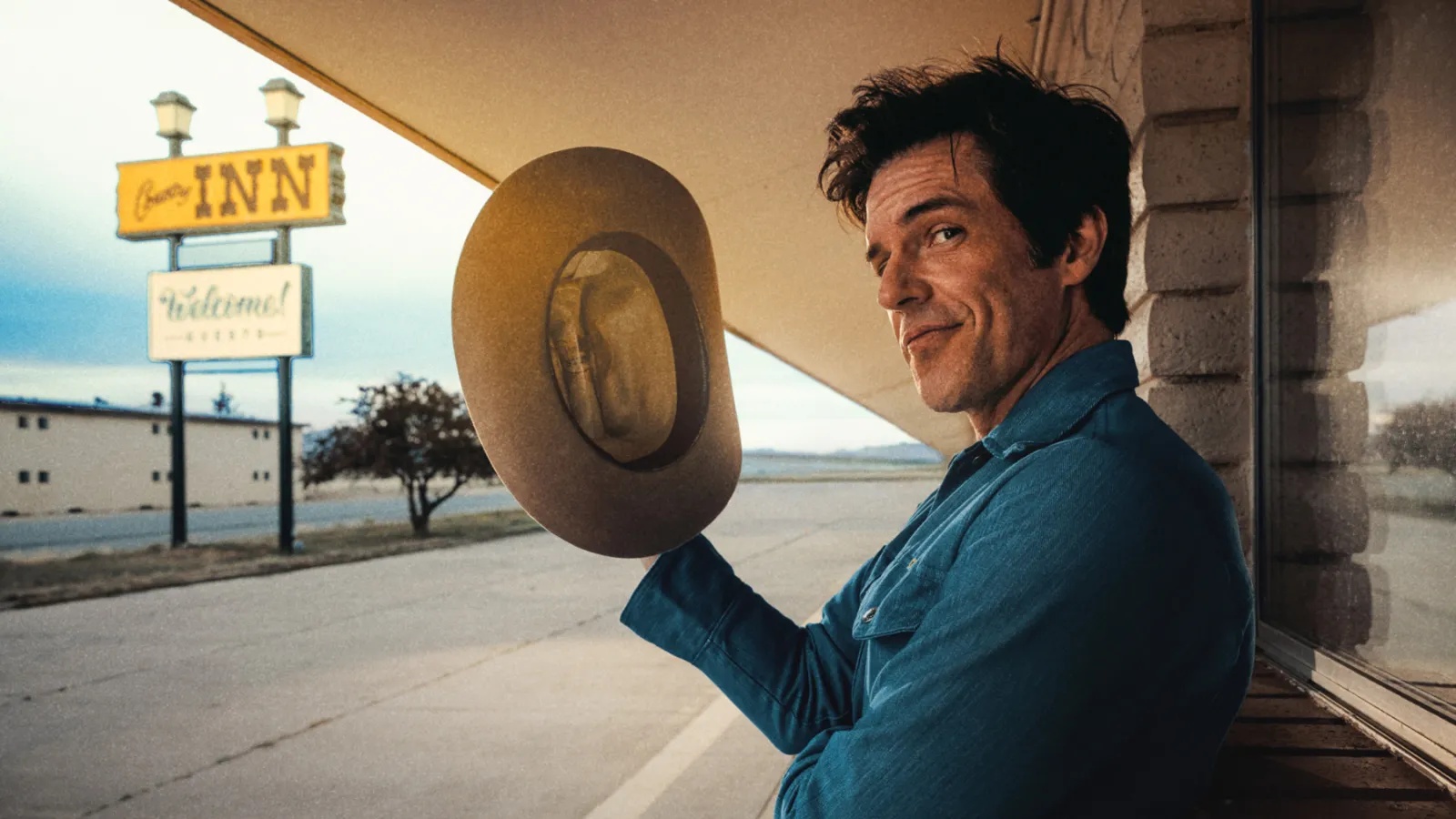
When Brandon Flowers lets his mind wander, he often imagines a Sliding Doors version of his life, one where he didn’t form the Killers, write “Mr. Brightside,” and spend the last quarter century fronting one of the biggest bands on the planet. “My goal was once to be a valet [parking attendant] at the Bellagio or the Wynn,” he says. “I thought that that was the road that was laid before me. I can’t help but wonder now that I’m 45 and my hip hurts and my knee hurts, what it would have been like if I was running, chasing cars all day.”
“Look, people are going to trash me if I say this,” he says, pausing for a moment before he decides to follow through with the thought. “But sometimes I see mechanics or something, and there’s a part of me that…I romanticize it and I’m reaching for them. There’s a part of me that wants that life for myself.”
That doesn’t mean he’s going to disband the Killers and start parking or fixing cars for a living. But his new solo record Thrasher, his first effort outside the Killers in 11 years, shines a spotlight on people very close to him, including his own siblings, and the difficult lives they navigated over the years, roads he could have easily walked down himself in a slightly alternate universe.
Flowers recorded the album in Nashville with longtime producers Jonathan Rado and Shawn Everett, and even though it might not sound much like a modern country record, many of the songs harken back to the vibes of country icons like George Jones and Waylon Jennings. “I think when people heard that I was possibly dipping my toes into country, I think they assumed the worst,” he says. “They thought I was going to write Morgan Wallen songs or something like that.”
Flowers is going to support Thrasher, out Friday, with a tour that kicks off Aug. 28 in Salt Lake City, and a companion solo record is slated for next year, even as the Killers are working on a new album of their own, and have a one-off date Sept. 26 at the Ocean Way Festival in Santa Monica, California.
Right now, however, the singer is seated at a secluded restaurant table at a trendy hotel in lower Manhattan. It’s lunchtime, but he orders nothing but a cup of black coffee as we chat for an hour about Thrasher, the followup record already in the can, his solo tour, the future of the Killers, the status of guitarist Dave Keuning and bassist Mark Stoermer in the band, and the incredible afterlife of “Mr. Brightside.”
When you made your first solo record in 2010, did you do it because the band wanted to break, or because you wanted to do music that you felt wasn’t quite right for the Killers?
It was 100 percent the band wanted a break. It was the first time I’d heard the word “hiatus.” It was being spread around. And it sounded kind of serious, but I didn’t think we were going to break up. I just knew, “Okay, it’s starting to wear on the band, the amount of touring that we were doing.” And it’s the amount of touring that you need when you’re introducing yourself to the world like that. But I’m about five years younger than the other guys and I just had this…I was just cooking, I was still going. And so I just wanted to keep that ball rolling.
How was that experience? It’s often very hard for fans to accept a singer away from their band. Even someone as famous as Mick Jagger found it nearly impossible.
I wasn’t so concerned. I was really just working on the craft, and I saw it as a continuation of that. I can’t believe it was so long ago, but it was a fruitful time for me. I got to work with Brendan O’Brien. I got to work with Daniel Lanois, Stuart Price. So that was a funny combo. Talk about yin and yang. Stuart Price and Daniel Lanois is a really wild pairing. And then I finished off the last couple songs with Brendan O’Brien, and was really impressed with him because obviously he had done [Bruce Springsteen’s] The Rising shortly before that, and he was a hot-ticket producer.
But yeah, I had so much fun and learned a lot from those producers. It was a time that I looked back on fondly, and on [the single] “Crossfire.” That would have been a big Killers song. That’s my only regret.
You went on solo tours back then. What was it like walking onstage for the first time without the others?
There’s a level of vulnerability just to going onstage, period. But when you aren’t with your gang anymore, I really did feel like I was on the spot. They were different kinds of songs. They weren’t as physical, and didn’t have as much heat. So there was a beauty to it. These were slower songs, and I had to feel what that was like to sit with the audience and deliver. That was an interesting exercise.
For the past decade, all of your work has been with the Killers. Did you eventually just realize you didn’t need all four of them at once for the band to move ahead?
Yeah, I think we came up with an arrangement within the group that was working, and that it didn’t seem like there was going to be any long breaks in between records. And then I found myself in this peculiar place where we wrote Pressure Machine, and I was changed.
Changed how?
I’ve never written something like that. We’ve had great success. I’ve had these magic moments where the unicorn enters the room or whatever you call it, lightning striking. That’s amazing. But Pressure Machine was just different. It was a simmering, creative time for me that I didn’t want to leave.
I was stunned when I first heard it. It was such a left turn, so cinematic. But then I thought, “How can they tour this?”
Yeah. It will not work.
Bruce didn’t even try to tour Nebraska.
I know. He’s smarter than me because I was hoping that some of this might work. But it’s not meant for the big rooms.
Did that frustrate you? You can sell out multiple nights at Madison Square Garden, you have this amazing new collection of songs, but you can’t really break them out besides one or two?
Right. It’s a conundrum for sure. Because I want people to know about this thing, and there still might be people that are casual Killers fans that don’t even know that Pressure Machine exists.
Did you ever think about booking small venues to play it?
We do. [Drummer] Ronnie [Vannucci] talks about it, and we really should do that.
You could book the Beacon and a bunch of other great theaters. The show could be the album straight through.
It’s a good idea. It’s just what’s happened is there was this pent-up demand for the communal experience of concerts after Covid. So 2022, 2023, we’re touring, and then it butted right up to the 20th anniversary of Hot Fuss and the band. So then it was [the compilation album] Rebel Diamonds, then it was a Vegas residency. And now, it’s 2025, and there’s still some shows and there’s some writing going on and it just hasn’t presented itself. It’s going to happen. I think that there will be a small theater Pressure Machine tour one day.
About three years ago, you spooked a lot of fans by saying you were in a “crisis.”
Yeah. I’d now say “quandary” instead.
Tell me about it.
Well, first of all, there’s this bit of sensationalism with the U.K. and their press, which is no secret. So I did this photo shoot. We had some great pictures. I saw some of the photos, and I was happy with it. And they took one where it wasn’t the best and they just surrounded me with red.
Anyway, it’s kind of a difficult thing to talk about, I guess. It’s pretty personal, but it’s just I’ve reached that age where everything’s just starting to get real. My kids are preparing to leave the house. My dad is going to be 82 soon. My mom’s already been gone for quite a long time, and you start to lose people.
I have a new focus and a new understanding of how little time we have on this earth. And I’ve had a tough go of it kind of, I haven’t quite wrapped my head around it. In [my new song] “An American Dream,” I ask Elvis if it was all worth it and I don’t know if it is. I don’t know if I would do this for another 25 more years at this level because some people do that, U2 and Rolling Stones.
Three years ago, you released the new Killers song “Your Side of Town.”
Totally underrated synth-pop song.
Agreed. But then you said you didn’t want to keep making songs like that.
Right. Again, it went back to Pressure Machine. There’s so many different roads that you can go down, and I have a great appreciation for synth-pop and for that craft. We had fun making those songs, but it wasn’t fulfilling me as deeply as something like “In Another Life” [from Pressure Machine] did.
It’s a pretty unique dilemma since you have enough big songs to tour arenas forever without doing anything new, like Billy Joel.
Right.
Most bands would sell their souls for that. But then the question becomes, “Now what?”
Yeah, it’s tough. I think there’s this desire to keep growing. And I know what it’s like now. I mean, again, I just keep going back to Pressure Machine. There’s not a word out of place on that album. And so I know what it’s like to fool you, or at least try to fool you. And I got away with a murder in the early days of the band. It’s like there’s almost no going back now. I’ve got the taste for blood now. I know what that feels like. I don’t need a critic to tell me it’s good. I know it’s good. And I’ve never felt like that before.
Let’s move on to Thrasher. What country music did you like as a kid?
It’s funny because my dad listened to what he called Country Western. But it was Waylon and Willie and Merle and Johnny Cash and things like that. But he also listened to John Conlee a lot; I would suggest anybody check out some of John Conlee. That was the stuff that I was hearing from him.
And then I was hearing more mainstream stuff in the Nineties just because I was in Nephi, Utah, and that was what was on the radio. That was what was on in people’s stereos on the way to lunch. And that was at school dances. I didn’t realize it at the time, but I was appreciating it, the storytelling and the craft. I just had chosen my path.
Did you realize immediately these were solo songs or did you think at any point they might be for a Pressure Machine-style Killers record?
It started off on the heels of that writing. I took everyone to Nephi, Utah, and then I just didn’t want to leave because I loved doing it. There’s a song called “Tiger’s Blood” that just feels very much like it’s part of Pressure Machine. As they developed and [producers] Shawn [Everett] and [Jonathan] Rado kept talking about going to Nashville, and I think just planting that seed, something shifted a little in the writing. “If I’m going to go to Nashville and we’re going to assemble a band….” The songs just started to shape-shift into that world.
And it felt like a solo record?
Yeah. We haven’t made a Killers record with all four of the members for a while, so the goal [for the next record] has always been to do that again. I knew that if I was going to write another album that was similar to Pressure Machine, that’s not something that should involve all four of the Killers.
Before I saw the credits for Thrasher, when I knew you were doing a country album in Nashville, I just figured you were using country producers. That’s not what you did.
No. I think that’s a nice way to keep my own control a little bit, working with my trusted team. Shawn is just…I don’t think it matters what genre he’s working in. He’s just got this enthusiasm for music and appreciation for it, and Rado. So they were my anchor.
What was it like recording in Nashville at a famous country studio? Did it put you in the mindset of the music?
I think so. I genuinely didn’t know what I was getting into. I didn’t know how serious the musicianship was. I didn’t know about the number system. I didn’t know…I mean just the competency. And I was blown away by the musicianship.
Tell me about working with Charlie McCoy.
Obviously, my favorite of the bunch. He’s sort of the star of the record. His playing is incredible. We would read through the lyrics on every song on my phone before we went to cut the song. He wanted to fortify what I was singing about with what he was playing or back up what I was saying or represent it in his way. It was like, “Nobody in my band ever asks about that.”
It’s insane he was on Blonde on Blonde and John Wesley Harding, and he’s still going.
I know. It’s wild. And he’s got Leonard Cohen stories, he’s got Simon and Garfunkel stories. It’s amazing.
You have David Rawlings on this too.
I heard of Gillian Welch, and I love [the 2018 Coen Brothers movie] The Ballad of Buster Scruggs and stuff like that, but I didn’t know who this guy is that’s a part of this stuff. He embodies music in a way that reminded me a lot of Daniel Lanois.
Working with Nashville pros is such a different world.
It is. You might have them for four hours and they’re planning on going to play with Chris Stapleton after you. So, you’ve got to get it done.
Let’s go through the songs, starting with “An American Dream.” I love the imagery of you talking with Elvis Presley.
I’m more front and center in this song than I’ve ever been on any song. My very first thing is I’m watching the fool’s gold flake off, and I think it’s going back to that thing that I’m just wondering, “What am I chasing?” The one thing I can tell you is it’s true, money just doesn’t do it. It doesn’t do it for your life. It’s not where I’m happy.
Elvis had everything, and his life was a total disaster by the end.
I love that he just says, “We’ll just put it on Jesus.”
He says he’s not sure it was all worth it.
Yeah, that’s a genuine question. That’s what I’m going through right now. And I know there’s so much beauty, so many beautiful moments of bringing people together. I feel like I’m a conduit sometimes for something that’s an amazing thing to be a part of. But there are significant life experiences that I’ve missed out on. In the Gospel of Mark, “for what shall it profit a man if he shall gain the whole world and lose his own soul.” It’s like I don’t want to lose my soul.
People will be very surprised to read that. It’s not hard to argue the Killers are the most successful rock band that formed after the turn of the century. And you’re saying you’re not sure it was worth it.
I have those moments where I am grateful for the work and I’m grateful for the experiences. And it’s been amazing. It has been amazing.
Is there a part of you that thinks you’d be happier working a 9 to 5 job and living in total anonymity?
I never thought I would quit this, but I wanted desperately to go work again. There was a time where I was struggling right before [the 2017 Killers album] Wonderful Wonderful. My manager at Spago in the [Caesars] Forum Shops was still there [Flowers used to bus tables at the restaurant]. His name is Carlos. Me and my wife would go every now and then, and he would take care of us and put us in the back. We had our spot. My wife was about sick of hearing it, but she was like, “Just go.” I was thinking of going and busing tables again. But this is about 10 years ago.
I get it. But you went through a one-way door once Hot Fuss came out. There was no going back.
I was so young. I didn’t have a lot of other experience.
Let’s move on to “Angel.” You sing, “It don’t matter how far you’ve come/Or how well you ran the race/You’re gonna have to come face to face/With the thing that you’ve always known to be true.”
It’s the same vein as Pressure Machine. The cinematic storytelling of these people. And this one is just specifically about my brother-in-law. It’s funny. Pressure Machine was very centered on Nephi, on that town. And I’ve taken it even further, and I’m sort of [writing about] my inner circle during that time that I spent in that town. So “Miss America” is my sister. “One of Us” is my sister and my brother-in-law.
The album gets more uplifting with “Does It Ever Cross Your Mind?”
That’s an answer to a line on “In Another Life.” In “Another Life,” I say, “Am I the man of your desire or just a guy from your hometown?” That question seemed to really hit home, too close to home for a lot of guys that were fans I noticed. They were questioning their relationships. Is my wife just with me because I was born down the street, and people were talking about breaking up, and I wanted to fix it. And so I wrote this song about the beauty of being born next to someone that you can go through life with.
What’s the story behind “In a Heartbeat?”
That is the only one that I think isn’t a real story.
What inspired it?
Kris Kristofferson, basically. I’m just doing my best Kris. It also reminds me a little bit of Tom Waits before he got all Tom Waits.
“Miss America” is devastating. What inspired that?
It’s my sister, Shelly. She used to be in beauty pageants in the malls. Her and my sister April were in them. There’d be pictures in our photo albums. It’d just be like family pictures and school pictures. And then there’d be pictures of Shelly and April onstage in the beauty pageants.
She got caught up with a guy at a young age. She had three girls with him. It was an abusive relationship. And my parents moved. I mean, maybe it was just the right time because they moved to Payson, Utah. It was just far enough away for her to be able to escape. And this is her writing a letter to him when he comes home from work and they’re gone.
How does she feel about a song being written about her?
Well, she’s not with them anymore. She’s 14 years older than me, so she’s quite a bit older than me. When there’s that big of a separation, it sometimes feels like an aunt/nephew situation. I just empathized with her and felt a closeness to her that I had never felt before.
“One of Us” is a much warmer song about your brother-in-law.
Yeah. He passed away a few years ago unexpectedly. He was from Canada. I love that first line that separates him from us is that he’s from the true north, strong and free. That’s in the Canadian anthem. “But it didn’t bother us, he was always one of us.” And he’s just been there. He married my sister when I was six or seven so he’s always been there my whole life.
“Paradise” is about a valet parker in Vegas.
Yeah, my cousin.
“Plans” is another song about youthful dreams.
I think it’s pretty autobiographical. We all make ourselves promises. And I think you come to a point where you realize that you weren’t able to make good on a lot of the promises that you made to yourself, and there’s a little bit of a melancholy that comes with that. So I say “hold me in your arms,” it sounds like a romantic line, but I’m asking for help.
“Red Ground” is about accepting your life.
Yeah, wanting to go home. I guess it’s more romantic than the others, more romantic leaning. I have an album of life songs, and an album of love songs. This is the life songs. And one love song crept its way in, and that’s “Red Ground” because it just felt right at home on this record.
“Tiger’s Blood” is pretty bleak.
It’s about me moving to that little town and being an outlier. But then I’m making these friends, and I’m coming to that age again that we talked about where some of those kids that I jumped on the trampoline with are now buried in the cemetery in that town. So it’s sort of an exercise of just remembering them.
You live in Utah now. Most people in your position would be in the Hollywood Hills or some other glamorous place.
I always feel more at home at home, I guess. As you get older, I think the need for validation and recognition slowly gives way to this quiet contentment and confidence, and it’s like now the work is the reward.
You’ve gotten plenty of validation these past 25 years.
I saw a Peter Buck quote, he’s talking about ego and he’s like, “I’ve had enough applause for 10 lifetimes. I don’t need anything.”
You’re going on a solo tour soon. What’s that going to be like?
It’s going to be pretty similar to what we’ve done before. It’s just going to be a bigger band. We got a slide player, we got a harmonica player, and we’re going to try to do justice to these songs, and I’m really looking forward to it.
Are you using members of the Killers touring band?
A couple guys. Robbie Connolly is going to go from auxiliary guitar to lead guitar. Jake Blanton is going to be on bass. He’s always been on bass for me. I’ve played more shows with him than I played with Mark. We got a different drummer from the Howling Bells.
What are you going to play beyond the new record?
I think a few selections from each of the other solo records, and a couple Killers songs and a couple covers.
Do you know which covers yet?
We have a couple worked out. We got “Forever and Ever, Amen” by Randy Travis. What a beautiful song.
What Killers songs?
Because I’m playing smaller rooms, we’re going to play more selections from Pressure Machine. We might throw in…I’ve been known to sprinkle “Read My Mind.” I can’t help but play “Read My Mind” sometimes.
In the middle of the tour, you’re playing a festival with the Killers. Will it be strange to have to suddenly put your brain in Killers mode?
No, I’ve got pretty good at juggling these worlds. Shouldn’t be too difficult.
Are you booking more Killers shows this year or it’s just that one festival?
That one just came out. I think what happened was Paul McCartney pulled out or something and we’re just filling in. There’s not any more really planned. I think there’s one in Singapore, there’s Santa Monica, and then I think that’s about it. I looked at the calendar, it’s like, “Damn, it’s been five years.” We’ve got to stop booking gigs. It’s time to do another record. So we have been in the studio with Shawn Everett and Ariel Rechtshaid.
It’s all four of you?
Yeah.
What’s the record like?
So far, so good. It’s a little bit too early to say too much, but we’ve had some really nice moments and some good breakthroughs. The goal is just really for everyone to take some ownership and get their hands dirty. It’s the first time with all four of us since Battle Born.
Dave and Mark are totally recommitted now?
Yeah, I think people’s perspectives change, all four of us. And it may not be 100 percent. But it’s definitely going to be the first record since 2012 that we all four just recorded on all the songs. That’s pretty significant.
I’m sure it was healthy for them to take time off, and come back refreshed.
Dave’s son is now in college, and Mark has gotten married. And so there’s a new, I think, a fresh look on their career and moving forward.
You built a setup where they can step into the band when they like, and step back when they like. That’s pretty rare.
Yeah. I think it’s a testament to our adultness. We found a way to make it work. And I think the way it’s going now, you’ll probably see Dave a lot more at the live shows. Mark, same thing. It’s just like whenever he wants, it can work.
Do you want to tour less yourself as you get older? Do you like going out every single year, as you’ve been doing?
I don’t know how. Being a showman and being on tour, it’s a part of my identity, but I don’t know how much I need it. I just want to see how the songs go and how much… I think that you get a lot of energy from that and a lot of determination comes from that. We’ve got some really good ones cooking, and I think that might be enough to propel me into touring.
Do you want to be touring in your 70s like Springsteen?
I see it being a possibility. I tell you though, it’s funny… When I come home from a tour, I don’t think of him or Bono, I think of Mick Jagger. It’s just like these contemplative moments that I’ll have. I’m not saying I’m like Mick Jagger, but maybe closest in steps onstage, I’m closer to him than Springsteen. And so I’ll sit at the edge of the bed after a tour. I’m just thinking about what I just put myself through, and wondering how he kept doing it or why.
I think Jagger devotes a lot of his offstage time to making sure he can still physically do those shows.
Yeah, we’ll see. I’m also carving out this other road with these country songs that I feel like will give me a little bit of a respite.
Tell me about the love song record. It’s also country?
Same band, but a little bit different. It’s a little more, I don’t know, Americana rock.
When is that coming out?
We don’t know when that’s coming out. We’re mixing it. It’s been done.
Did you think at all about releasing them at the same time as a double album?
We did talk about that, but I just thought it would be too much. The way that they do things there [in Nashville] was pretty incredible to me. So I’ve written more country songs. I mean, if you have a batch of songs, let’s say you have 10 songs, you can go to Nashville and record them in a week. You can do two songs a day and go home and have a record like this. So I’ve got six or seven cooking and I’m just like, “Maybe in November I go for a week.” I mean, it’s an amazing way to record.
Are you still in the situation where you feel some obligation to make synth-pop songs you can tour?
Not so much. I’m okay with making music that I want to make and that the band wants to make. I don’t feel obligated to have a certain amount of synthesizer in a song or anything like that.
Is it tough to go back to the democracy of the band when you have the experience of being the sole decider?
It comes with its challenges, but that push and pull in a band is what makes it unique. There are views that you’ll get from other guys that you wouldn’t have thought of yourself, and that’s what makes the Killers the Killers, I guess.
How did it feel to get onstage at MSG with Bruce and sing “Badlands?”
It was amazing. I was in this hotel getting ready for that day. We had been rehearsing it, those songs, more than we’d rehearsed anything. We were so ready to do that encore. I don’t know if you know this story, but our tour manager got Covid that day. And so Bruce is 73 and I have to tell him. I’m in this hotel. I’m up in my room. And I wake up to a picture of a Covid test that tested positive. I’m like, “Are you kidding me?” We’ve been rehearsing for weeks.
So I text Bruce, and you’re watching the bubbles, wondering what he’s going to say. He’s got the text and he’s responding. And it felt like an eternity. And he just put, “I’m coming.” And I was like, “Oh God, thank you.”
And so he came, and it was amazing. I think he hadn’t played in a while. I don’t think he had played at all since Covid had shut everything down. And he was just ready. So I’d been on the road a little bit, and he came and we sang in soundcheck. I’m a little bit protective of my voice during sound check. But it was like a duel. We were giving it in soundcheck, spitting in each other’s faces. And he was like, “Show me that you know this thing.” But it was so great, and it came across really well.
I got married a few years ago. We didn’t tell the DJ anything to play. He just asked for the general ages of people coming. And at the end, you can guess what song he played.
Oh, yeah.
I watched my sister light up. I highly doubt she knows your name or much of anything about the Killers. It’s just not her type of music. But she knew every word of the song and screamed along to all of them. It was remarkable to watch the entire place do that. That song has somehow just seeped into the DNA of everyone on the planet. It’s pretty remarkable.
It is. Yeah, I just kind of forget that I wrote it. It just exists. I remember bands talking about that. I remember Depeche Mode talking about “Enjoy the Silence” like that, or Duran Duran talking about “Rio,” or Bruce and “Born to Run.” Every band that gets in a garage is dreaming of having that happen, and it’s wild that it really did. It happened.
It took Bruce 10 years of work to write “Born to Run.” You wrote yours the second the band formed.
Yeah, it’s pretty crazy. I had a vocal delivery which was a little bit Lou Reed. I saw it as Lou Reed. I’m 20 years old. And it was just this monotone, relentless delivery that I was working on already on other songs, and I just slapped it on Dave’s verse and pre-chorus. And then I just put a chorus on it, and it’s pretty wild.
You had that song. But to really push through, you guys did just an absurd number of shows in the early days.
And it took its toll, but we did feel grateful and lucky to be in this position. But I remember Win [Butler] from Arcade Fire saying, “I don’t envy the Killers.” It was like the first time I had felt a little bit of animosity towards him. But he was just saying, he understood how many shows we were doing even compared to them, and they were probably still doing quite a lot of shows.
I always just thought this came with the territory. As much as I had already resigned to the fact that I was going to work at a casino, I didn’t want to. And so I was doing what I had to do.
To start wrapping up, you spoke earlier of this “quandary” you’re in regarding your future. Can you elaborate a little more on that?
I don’t know, I think I’m having a bout of just melancholy. I’ve seen what real depression looks like with my wife and things like that, but I think I’m just having a little bit of a… There’s a little bit of a filter on everything is the best way that I can describe it.
What do you think is driving that?
I don’t know. I don’t know if it’s just being a man of a certain age or coming to the, I feel like Tony Soprano in episode one. You know what I mean? It’s just, the kids are getting older. I just started watching Sopranos with my family, so it was just funny watching it and being like, “Oh, I’m really identifying with Tony right now.” I’m just somewhere in that zone.
They say there’s an arc to men, like a U. [Flowers forms a U with his fingers and points to the bottom of it.] And so you’re here, and then around 40 you’re down at the bottom, and then everything starts looking up. So I’m somewhere around, I’m waiting to start looking up again pretty soon.
Back to the Sliding Doors version of you, if the band never took off and you were parking cars at the Wynn for a living, do you think you’d still be feeling this way?
I wonder about this. No, I would’ve had a whole new set of problems. I think a lot of the best things in my life come down to some of the choices that I’ve been lucky enough to make with who I married, and the kind of kids that I have, and the foundations that I have from my religion and things like that, I think have really been a blessing with my life.
You never regret starting the band and pursuing this life?
No. I don’t wish that. It’s more of a daydream.
Living where you do must keep you grounded.
I’m back in Utah and I’m close to that town. And my sister still lives in Nephi. And I take little road trips with my wife and we go, my dad lives down there, and go eat at the places that I ate at growing up. Those little things… I forward to that more than about anything.
What’s the timeline of the next Killers record? You think it’ll come out in 2027?
If it comes out in ’27, it’s the very end, but I would say it’s more likely early ’28.
And then a big tour?
Yeah, if we do it, we’re doing it.
Will the Killers do any dates in 2027 or are you taking time off?
Oh, I think that we need to take time off. I could see it wouldn’t be a group of shows. It would be a date here or there. But there’s no plans for a tour until we have an album.
When is the love songs solo record coming?
Next year.
Will you tour that one too?
Maybe, but maybe it’ll just be a few shows.
You seem to have found a nice balance where you can put the Pressure Machine-style songs on your solo albums, still make Killers records, and have both trains running at the same time.
Yeah. I’m spoiled rotten.