
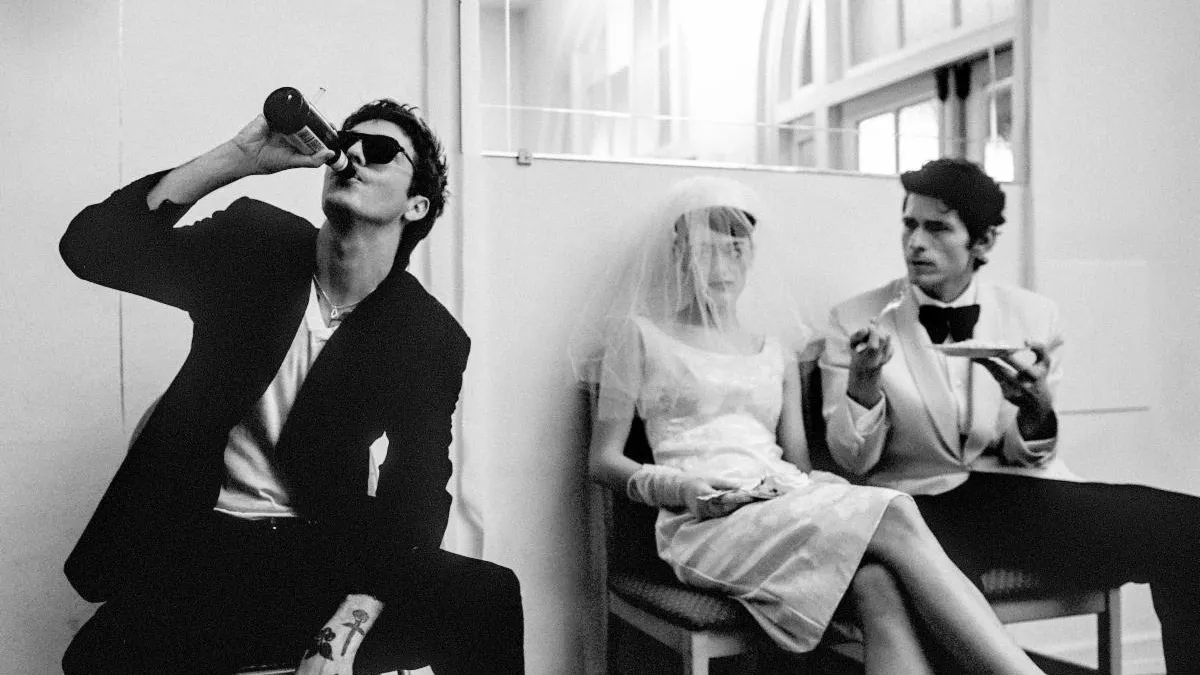
Tucker Pillsbury says he’s playing a character called Chuck Timely on his new album, and it’s not the first time he’s had an alter ego. To promote 2024’s Kansas Anymore, the singer usually known as Role Model maintained a second social media presence, a crass imposter named Saint Laurent Cowboy who described his record as “a dude who just blew your fucking back out” and said things like “if you see a guy wearing a wool sweater on this app singing Gracie Abrams, just know he’s manipulating you, and he’ll probably give you some sort of a UTI.” This caricature of a TikTok douchebag seemed to come easy to Pillsbury, whose profile has risen over the past couple of years through a combination of inoffensive music and chronically online energy that splits the difference between bravado and nonchalance. With arms covered in patchwork tattoos and a choppy haircut that would look ridiculous on someone even five percent less handsome, Pillsbury is a perfect modern softboy, as comfortable perching on the couch of the excitable podcast host Jake Shane as he is gently swiveling his hips onstage.
His breakout moment last year was “Sally, When the Wine Runs Out,” a mild hoedown about falling in love with a drunk girl at a dive bar that got its viral juice from celebrity cameos at live shows. That pushed Role Model into the “Wait, Who’s That White Boy?” Class of 2025 alongside Alex Warren and Sombr, and it validated his turn from lo-fi hip-hop and e-boy bedroom pop toward the crunchier realms of folk and country. Now with his third studio album, he’s channeling a fictional time-traveling session musician he described as “pathetic in a charming way.” On the moodboard: names like Bruce Hornsby and Don Henley, album-oriented artists that mark a considerable change from earlier influences like Mac Miller and Kacey Musgraves.
No score yet, be the first to add.
Pillsbury tapped two session musicians to lead production on Chuck Timely & The Hourglass: guitarist Mason Stoops and keyboard player Taylor Mackall, both longtime collaborators of the indie-folk artist Lizzy McAlpine (who appeared on the last Role Model record). The sound brings to mind an antique honky tonk full of patrons with prominent belt buckles and a jukebox that doesn’t play anything recorded after 1990—or, more accurately, the kind of place that opened three months ago but aims to look like that. Amid boot-scooting rhythms and saloon piano, Pillsbury sounds relaxed and pleasant, playing the part of a hapless but hopeful barfly who is happy to dust himself off and try again after a series of romantic entanglements that all end a little too soon.
His dalliances are often fueled by alcohol and tend to slip through his fingers. On the clearest Hornsby nod, “Song Is All You Get,” he gets misty about a gal who makes a big impression at a bar then skedaddles; on “Love I You,” which sounds, not unpleasantly, like a Jason Mraz deep cut from 2002, he begs his lover (played on a cutesy spoken bridge by his current girlfriend, Dakota Johnson) to stick around for last call; on the dreamy “Chasing Midnight,” he gets an invite to grab a glass with an old one-night stand who probably will make herself scarce soon: “Won’t be the first but it might be the last/I’ve been trying to make peace with that.” The great success of “Sally” has perhaps trapped Pillsbury in a dive bar of the mind—having connected to a wider audience through a story-song about a boozy hookup, he’s committed to pounding his beers and wiping his tears, running through fickle divas like it’s his job.
Daniel D`Amico for SANREMO.FM