
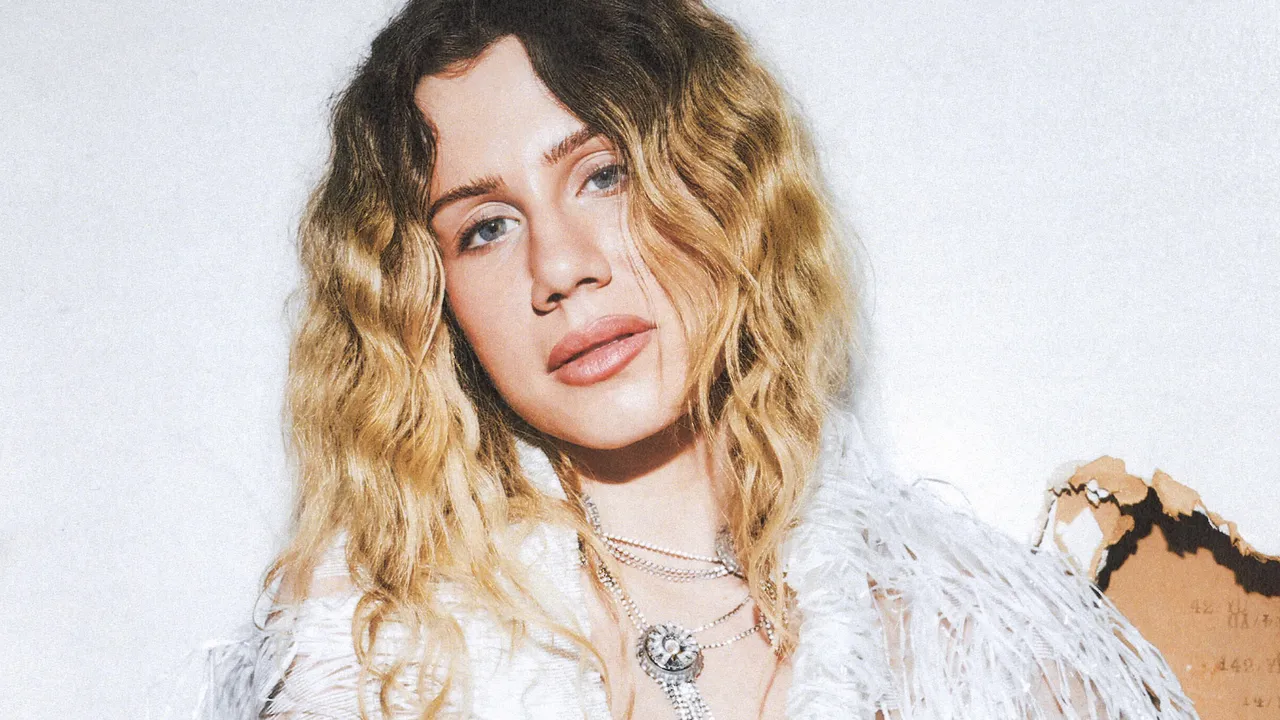
The pop stars Garner grew up with in the late ’90s and early aughts were the products and, often, victims of exacting major-label machinery. But over the last two decades, the serrated steel of the star machine has rusted, forcing young artists to effectively develop themselves. So Slayyyter’s a pop star, yes, but also her own creative director and, occasionally, an auteur filmmaker. Garner directed four out of WGIA$’s five proper music videos on her own, and makes most of her stage costumes. “It’s all glue,” she winks. She carefully considered every aspect of the album’s packaging, down to where the side-A, side-B split—between “YES GODDD” and “UNKNOWN LOVERZ”—would fall on vinyl copies: “It’s such a needle scratch of the hardest electronic song, and then you flip it and it’s like, burn you a CD,” Garner coos, slipping up a half-octave into an uncanny Britney Spears.
After several years spent uploading lo-fi laptop pop to SoundCloud while working a day job as a hair salon receptionist, Hurricane Slayyyter broke containment into the gay internet with 2018’s “BFF,” a Juicy Couture joyride with a beat she bought off the Tumblr-infamous Ayesha Erotica. So Garner adopted a tits-forward, Y2K-throwback aesthetic, not because it felt integral to her artistic ambitions but because “you have to do what you have to do until you can do what you want,” and sucked it up when her music was called “hyperpop,” which she calls a “horrible micro-term.”
Garner felt no urgency to leave St. Louis, but the choice was made for her when COVID hit while she was in Los Angeles taking meetings with songwriters. In an apartment in Beverly Hills, she began work on the songs that would become Troubled Paradise, which came out on the FADER Label. The album was scattershot in both quality and vision—Garner has since called it “a sack of shit”—and tainted by the arduous process of recording over Zoom. 2023’s Starfucker zeroed in on a caricature of a bottle-blonde, surged-up Hollywood starlet, but its Swarovski synth pop lacked a distinct personality. By then, Garner was already thinking about quitting music. She confesses, “I felt so depressed during that time that I was like, Maybe it’s my last album because I don’t wanna be here anymore.”


The stakes for WGIA$ were, therefore, both very high and very low. That gave Garner licence to tap into her inner “Cookie Monster Pajama Pants Girl,” an image that will be instantaneously evocative to anyone who attended public high school during either of the Obama administrations. Her term of art for the album’s collective influences is “iPod music,” which ties it to a particular era as well as a decidedly personal approach to taste and curation. After all, “with iPods, you had to be so specific about what music you wanted to listen to at school that day.” Portions of WGIA$ are like Rorschach inkblot tests for your graduation year. Class of 2008? “GAS STATION” is guaranteed to induce acid flashbacks of the first Crystal Castles LP. 2012? “$T LOSER” is a Death Grips song. 2007? “$T LOSER” is a SebastiAn song.