
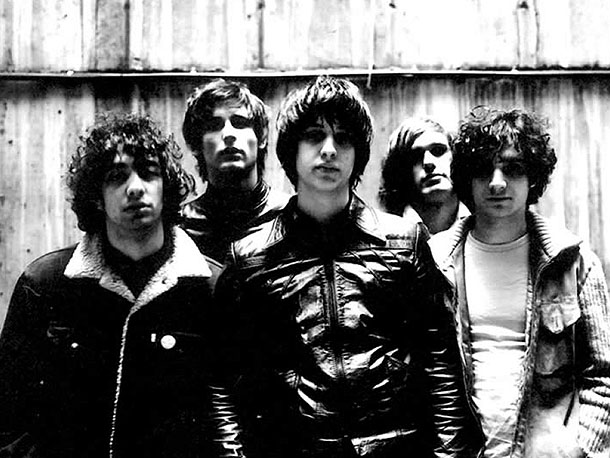
It's from albums like this that legends are born. Recorded in a studio in the basement of a building on Avenue A, in Manhattan, with the air thick with cigarette smoke and three photographs torn from a Victoria's Secret catalog hanging from a locker as an unlikely source of inspiration, the Strokes' debut is New York rock'n'roll in its pure state: aggressive as the gray asphalt of the city, but wrapped in an elegance of black leather. Less than a year ago they were handing out flyers at Weezer concerts, ignored by almost everyone. Today they end up on the covers of magazines, drive young girls crazy (provided they know the right ones) and already arouse the envy of those who consider themselves part of the scene.
At the center of all this attention are five boys who grew up in privileged and cosmopolitan contexts – the oldest is twenty-three, the youngest twenty – with a marked habit of kissing in public. For them, the more confident you are in your masculinity, the more language comes into play. In the last two years they have refined an unmistakable sound: a sound mixture that has its roots in punk and New Wave of the Seventies, but which above all recalls a band of British mods – the Yardbirds or the Who, for example – launched to play Chuck Berry and James Brown with a hunger for freedom and possibilities that they don't seem to find elsewhere. Their songs tell, with nervousness and irony, chases and escapes from New York girls: girls who are too intelligent, girls who exaggerate or never give themselves enough, girls who have everything you want and nothing you really need.
So, what does America's best young rock band sound like? First of all, hectic. The eleven songs of Is This It they run in just over half an hour and are constructed with such precision that even the ballads seem to be going at hundred miles per hour. The Strokes live by rhythm and, at times, their approach is more reminiscent of that of a soul or funk band than a rock band. Each musician — including the drummer — approaches the melody from a different rhythmic angle, until there is nothing left to explore.
The guitars of Albert Hammond Jr. and Nick Valensi intertwine relentlessly, leaving bassist Nikolai Fraiture the space to embellish songs like Someday, Last Nite and the title track with elegant melodic lines reminiscent of Motown. In The Modern AgeHammond Jr. and Valensi push everything to the limit: they double the rhythmic parts, continuously play on the tempo and then, in the chorus, they make the melody take off with a circular progression of increasingly higher chords, until it gives the sensation that the only possible direction is to go even further. The solo takes off like a rocket, leaving a trail of distortion in its wake, before dissolving back into the incessant dialogue of the guitars.
The surface of the record has something cold, almost scientific, very British, but underneath it boils a profoundly American passion. The dry and broken riffs and the drums, which recall the sound of bottles breaking on the pavement, recall the punk of New York and London, but Is This It proceeds with the energy of a boogie band going full speed towards the end of the concert, eager to have a cold beer and the warmth of a girl.
Like John Lennon, who doubled his voice so he could scream across that artificial distance, or Bryan Ferry, who always seemed to sing a few steps behind to draw the listener into his songs, Julian Casablancas also uses distance to convey emotion. Half the time he seems to be singing through an intercom, as if he's asking to come into your life. His strong point is that nuance in his voice, almost a plea, which allows him to continuously switch from one register to another: one moment he whispers, the next he winks cheekily, immediately after he explodes in a scream that seems to tear his throat out.
His message, ultimately, is simple: I will try to do more, but don't walk away; in fact, I'm the one walking out the door. Or, as he sings in Take It or Leave It: “Girls lie too much / Boys are too tough / Enough is enough.” Casablancas hides his vulnerability behind a braggart attitude, a bit like Mick Jagger did in the beginning, but throughout Is This It continues to talk about relationships that lead nowhere and that, despite everything, can't end. At times, however, he remains far too enigmatic: he can concentrate all the emotional charge of the album on a line with a completely private meaning (“Why don't you wear your new raincoat?”), or write one destined to remain imprinted (“Alone we resist, together we fall to pieces”).
At the beginning of Last Nitea woman tells Casablancas: “Oh baby, I feel down. I lose my desire when I feel left out.” What he excluded her from is never entirely clear, even if he is hardly talking about a quiet dinner with friends.
Is This It is crossed by a constant sense of decadence: bedrooms transformed into the theater of unusual scenes, boys on their knees invited to dedicate time to a girl, memorable pick-up lines like “Life doesn't seem real. Can we go to your house?”. All this creates an electric atmosphere, but when the effect wears off almost every song returns to the same terrain: the push and pull of complicated relationships. The theme is always the same: women, impossible to understand even if you offer to become their slave.
For now the Strokes have found an impeccable stylistic signature. What's still missing is a narrative depth worthy of their music. There is no doubt about the music, however: it is the most joyful, intense and exhilarating thing I have listened to this year. And, as a starting point, I would say that this is enough.
From Rolling Stone US 2001.
Daniel D`Amico for SANREMO.FM