
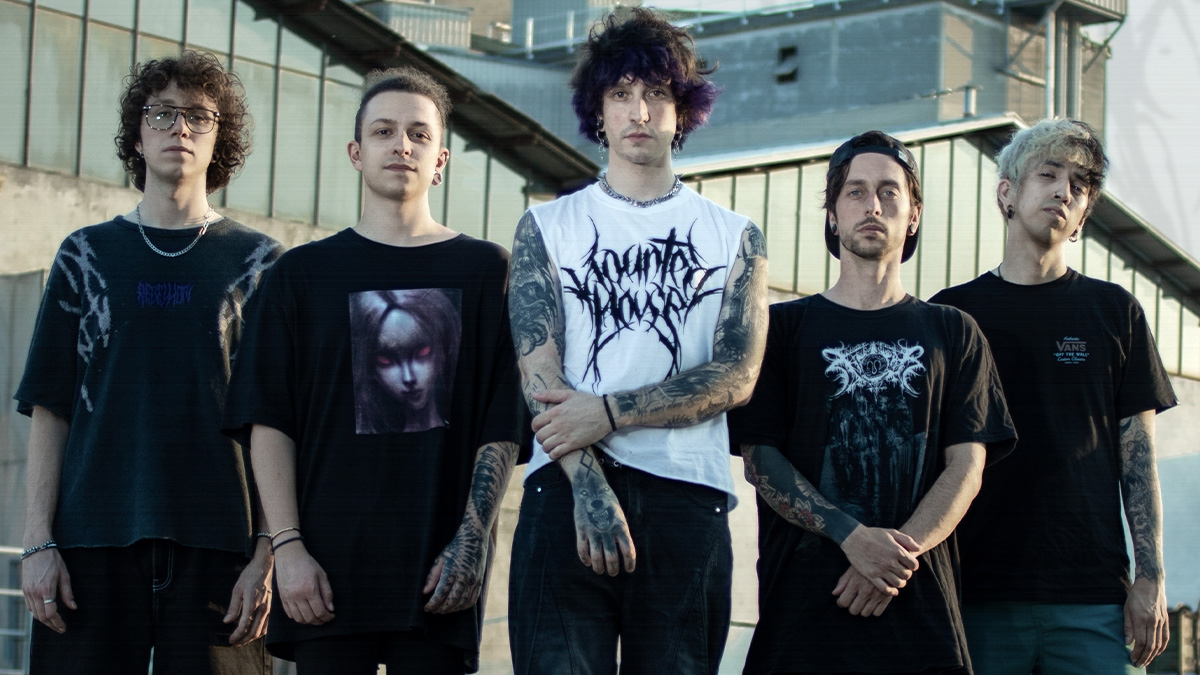
Anxiety, depression, mourning, complex family dynamics and the constant search for an identity balanced between what we think and what we feel.
With “Mind//Soul”i What I Know Well make a courageous and visceral debut, capable of combining the sonic impact of alternative metal and post-hardcore with a disarming and accessible lyrical sensitivity.
We talked to them about the birth of this concept album, the catharsis of writing and how this story is about to take shape live on summer stages and in upcoming clubs. Here's what they told us.
“Mente//Anima” is a concept album, but also an emotional journey. At what point did you realize that these songs couldn't live separately, but needed to tell a single story?
At the time Cerberus was written we already perceived the need to enclose everything within a single scheme. Our singer (Andrea Wikw) proposed the concept of Mente//Anima immediately after starting to write the other songs, in which he told about his past and the vicissitudes he experienced first hand. All this became concrete when he completed the first part of the musical production: the sound was now defined, it followed a very precise direction and began to stand out. From that moment on we saw the concept album as a real necessity to tell all this.
Address issues such as anxiety, depression, grief and toxic relationships with great sincerity. How difficult was it to transform such personal experiences into something that could also belong to the listener?
Talking about certain issues is never easy if you haven't first completed a journey with yourself, facing everything you've experienced and feeling ready to talk about it. It's a complicated process, but one that came naturally when the need to write about it arose. Each of us has something to tell or that, if relived, hurts, a bit like an open wound. As Andrea always says, I think that in a certain sense, finding oneself in such personal texts is almost inevitable. We are all made of the same essence and often share much more than we think with others.
“The Shining (Room 237)” openly recalls the imagery of psychological horror. What fascinates you about this language and why do you think it is so effective in describing inner fears?
Shining was a necessary metaphor so that everyone could better understand what happens in the song. Psychological horror imagery was the perfect envelope for that type of text and sound. It talks exactly about how the dark things inside us are alive and, sometimes, how necessary it is to draw on even that “evil” to grow stronger, grow and become a better version of ourselves.
“Eclipse” and depression: In Eclipse you talk about the impotence of those who love someone who suffers from depression. How difficult is it to translate such an intimate and painful dynamic into music?
If I have to be honest (Andrea speaks), it was one of the most spontaneous texts I've ever written. Sometimes you really need to say something and I think that with this album I have found the key to reading myself and translating myself into music. Eclipse was an outlet, something personal that I really needed to get out, and it came naturally, without pain, because the pain had already been there before.
The tATu cover: In Aria you take up the famous All The Things She Said, placing it in a story of family abuse. Why did you choose this song to tell this drama?
We wanted to pay homage to the tATu and their battle in support of the weakest by telling something equally current and which is deeply close to our hearts: violence against women, in particular domestic violence, the most silent and subtle, experienced by a girl who is unable to escape from this circle of abuse until she finds the strength to fight.
Musically the album crosses alternative metal, emo and pop influences without giving up your identity. Was it a natural evolution or did you feel the need to break away from labels to better tell this story?
Our singer, who produced all the songs, has firm roots in these genres and the band has also always played post-hardcore, metalcore and melodic hardcore. It was therefore more of a vocation, a necessity: we felt we had to transmit our music through this language, the one we knew best and which represented us the most. We are very happy to be able to mix different genres and still remain in our niche, winking at pop. The main goal was to try to bring a heavier genre of music than traditional rock to the general public.
You will take “Mente//Anima” on tour during the summer. How do you translate such a narrative album live? Will it be a traditional concert or are you thinking of an experience that also recalls the universe described in the album?
This summer we will bring the album in full, with an introduction and some interludes that help contextualize and accompany the songs. However, we are working on an even more structured live show for what will be the autumn/winter tour, where we will enrich the show with visuals and other scenic elements, trying to involve the public even more in the universe of Mente//Anima.
Daniel D`Amico for SANREMO.FM
