
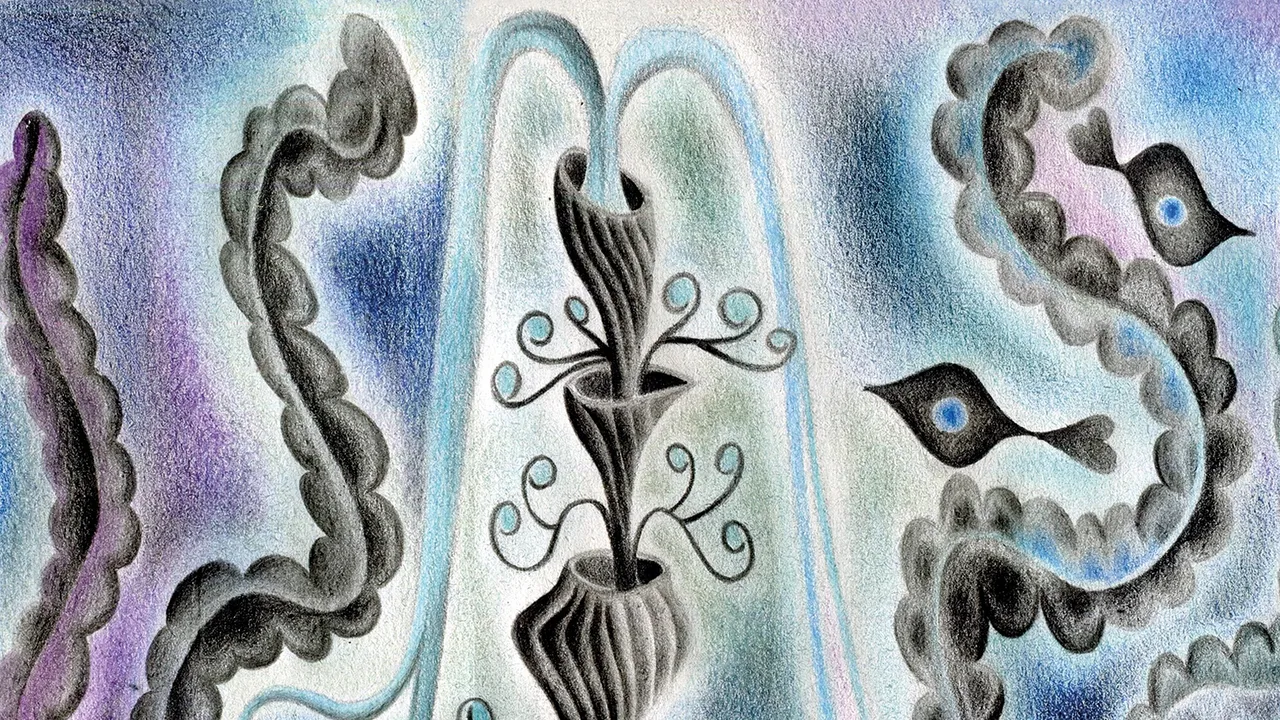
Three hours of music about water is an audacious proposition. But not, perhaps, for Slovak label Mappa, which for the past decade has made a habit of asking listeners to slow down and pay attention, releasing records that move between field recording, electronics, and idiosyncratic folk. Synthetic Water Music might be Mappa’s most expansive undertaking yet. The second installment in the label’s Synthetic series, following a 2023 collection dedicated to birds, it brings together several dozen artists whose contributions founder Jakub Juhás has arranged in a multi-layered journey through liquid states, aquatic environments, and drifting visions.
While Synthetic Bird Music focused on animals and their sounds, both real and imagined, its successor treats water more elusively. It might be recorded directly, imitated electronically, or merely suggested by a voice, drone, or reverb. Sometimes it can’t be heard at all. Across the compilation, water becomes both sonic material and a starting point for constructing imagined hydrospheres. The material is spread across two cassettes, and Juhás has given each side the name of a fictional aquatic world: Tlālōcān, Nephelora, Žaboglach, and R’lyeh. Two are drawn from mythology, R’lyeh from the cosmic horror of H.P. Lovecraft, and Žaboglach is the curator’s own invention. Each one emphasizes a slightly different soundscape: Tlālōcān is brighter and more electronic, while Žaboglach leans toward swampland, darkness, and mud, with field recordings, electronic synthesis, and melodic fragments constantly shifting. Together, the four sides trace a descent from the surface and the life it sustains into the depths of the unknown.
No score yet, be the first to add.
The compilation is most compelling when real sounds become building blocks for worlds that exist only in the imagination. Pauline Anna Strom’s “Emerald Pool,” from 1982’s groundbreaking Trans-Millenia Consort—one of a number of archival releases Juhás has tapped for the album, alongside new commissions—combines synthesizers with recordings of ordinary, everyday phenomena, transforming them into fantastical sonic environments. The result is a phantasmagorical world in which synthesized harp and artificial voice merge with delicate sounds of water, creating an idyllic landscape that draws us into the album’s aquatic narrative. In “Oh, to Be a Fountain” by Eva Sajanová, director of the documentary short How to Listen to Fountains, the relationship with water is already physical: The artist sings with it and to it, and her voice reacts to the splashing and resonance, at times resembling the calls of a waterbird. Here, the music is not superimposed onto the field recording—it is created through interaction with it.
Perhaps no selection better captures the compilation’s world-building impulse than Ursula K. Le Guin and Todd Barton’s “A River Song,” from 1986—an unusual collaboration featuring homemade instruments that Barton fashioned after the culture of the Kesh, a people invented by the science-fiction author in her 1985 novel Always Coming Home. Their collaboration exemplifies their practice of “imaginary ethnomusicology”—fictional anthropology and imagined geography, a record of something that never existed. Here, the boundary between documenting a world and inventing one almost disappears.