
The sounds returned unexpectedly last week. Sharp, staccato bursts from a bygone era of culinary entertainment, interrupting the quick-cutting shuffle of vertical videos that chronicle the creation of the next viral garlicky, citrusy, beany, herby, brothy whatever.
“Let’s kick it up a notch!”
“Forty-eight cloves of garlic!”
“Actually … we’re gonna add two beers!”
And loudest of all, “Bam!”
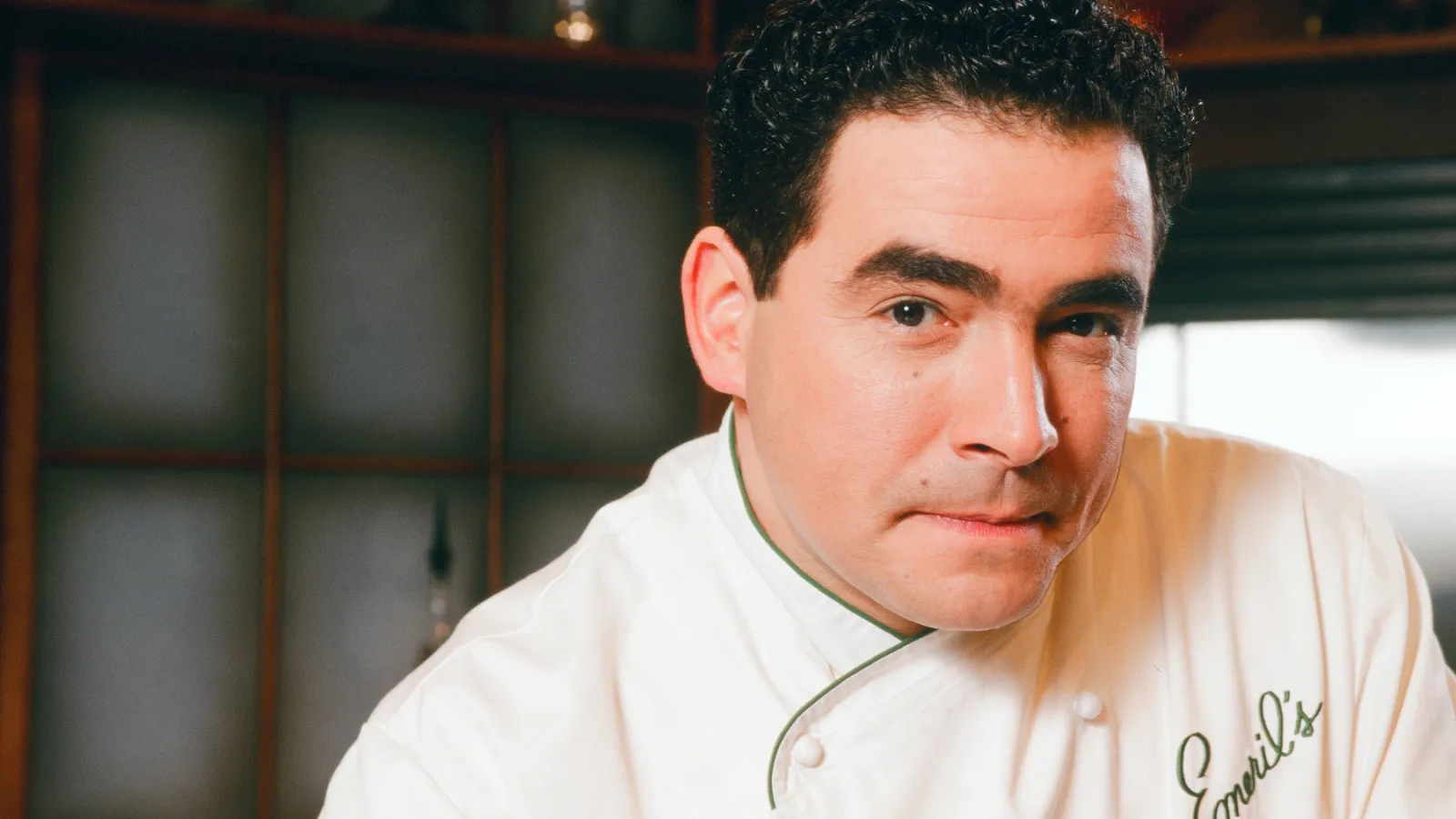
Emeril Lagasse, the chef, restauranteur, and onetime king of daytime-TV cooking, was going viral. Like all the most delightful internet phenomenons, this one appears to have been launched by a random poster, who simply opined, “I’m watching old Emeril Lagasse episodes and holy shit I’m devastated I missed out on being in that studio audience.”
An accompanying clip of Lagasse grating a potato racked up more than 3 million views and over 50,000 likes on X. Because it wasn’t just a video of Lagasse grating a potato. It was Lagasse grating a potato while expounding on the importance of starch, proclaiming in his thick Fall River, Massachusetts, accent, “You want the stahhch! You know they’re always saying, ‘Hey, no, we don’t want the stahhch’ — you want the stahhch.” The audience begins to hoot and holler in agreement — “Gimme da stahhch!” — prompting Lagasse to throw up his hands: “Well, let’s take a vote: Do we want the stahhch?”
The crowd goes wild.
More clips began to circulate as folks started digging through the robust archive on Lagasse’s YouTube. The chef himself even threw up a reaction video in which he cheekily watched a montage of himself, set to ABBA’s “The Winner Takes It All,” then deadpanned, “That’s some good shit.”
Chatting with Rolling Stone on Monday, Lagasse seemed both amused and excited by the resurgence. But he was also, with the confidence of a man who made more than 1,600 episodes of a hit television show, unsurprised.
“I think it’s pretty cool. I think that it’s certainly what people want,” he says. “You know, when I set out with Emeril Live, I just wanted to teach people how to cook. There’s a generation that watched the show and really learned, yet enjoyed the entertainment factor. And I think that went away for a while. Other [cooking] competition shows and food shows came in, but I don’t think there’s anything that was quite like Emeril Live, where there was music, there was food, there was the audience. I really fed off the audience and the band. I just had fun and did my thing.”
Lagasse has a point. There’s a gluttonous amount of food content out there waiting to be devoured, but none of it is like Emeril Live. You’ll find all kinds of cooking videos on TikTok, Instagram, and YouTube from professionals and amateurs alike, many of whom offer the engaging personalities and great recipes we crave. But, for better or worse, they create for the phone. And the phone’s not gonna compel you to grab that comically oversized pepper grinder and kick it up another notch.
Speaking from his longtime home of New Orleans, Lagasse reminisced on what made Emeril Live so unique during its heyday from 1997 to 2010, and why it still resonates today. He also discussed his evolution as a performer, his little-known history as a drummer who gigged with Aerosmith, his one-sided feud with Anthony Bourdain, and how he and his son, E.J. (short for Emeril John), have turned Lagasse’s New Orleans flagship Emeril’s into a two-star Michelin restaurant.
How would you describe the appeal of Emeril Live and what separated it from other cooking shows on TV?
At the time, there was no cooking show that had a live audience. There was no cooking show that had a band. And I think people got that I was just a regular guy, and my goal was really to have fun and teach people how to cook, or how to shop, or about wine and spirits. The guests that I had also had a connection to food, so it wasn’t like a movie star coming on and talking about their latest movie. We never went there. We always had either a music guest or a culinary guest that believed in the show and believed in the subject, which was to teach people how to cook.
How did you develop as a performer? Did you always have that quality in you, or was it something you learned?
Well, I don’t think a lot of people know that I turned down a full scholarship for music to go to cooking school, so I was kind of a performer in a young life.
What did you play?
I was a percussionist, and I played in various bands, from rock & roll to symphony to jazz. So, I was always sort of onstage. Maybe not quite as big, but certainly onstage playing in bands.
I played in a group called New England. In the very, very beginning days of Aerosmith, when they were playing in city parks, we were the backup band for them. And then there was the St. Anthony’s Band, which was a maybe a 40-, 50-person Portuguese marching band. So we would play in these weekend festivals in New England, and that was a big part of my life. That was a lot of fun playing in that sort of orchestra-type setting.
Do you ever still play?
I play occasionally. I don’t have a setup. I have a couple of tin bottles that are exposed that I bang on every now and then. But I don’t have a full setup and play like I used to.
I was going to ask about your relationship with your bandleader, Doc Gibbs. It all makes so much more sense now, because I’ve seen some clips where you just start banging on a few things, then all of a sudden you two are jamming together.
Doc was an amazing guy. He was not only an amazing musician, but he just knew the spirit of the show. He knew the spirit of me. He knew that I could be spontaneous. You’d never know when I was gonna go over and start messing with Doc Gibbs. Sometimes we’d just play a couple of riffs, but sometimes it would turn into a full-on song and then the band would join in. It was a lot of fun.
And we had a lot of guest musicians, from Sammy Hagar to Willie Nelson to Billy Joel. They had to have a connection with food, though. Like Sammy’s a really good cook. Billy loves Italian food, loves to eat. Willie’s a country boy and loves that country food, so there had to be a connection.
What do you remember about your first experiences on camera? Were you a natural?
No, I was terrible! When I first started, I did a couple of shows. One was called How to Boil Water, one was called Emeril and Friends — I got fired from both of them because I was terrible on camera. I was a typical chef. My head was down, people were looking at the back of my head instead of my face. And then when I started doing Essence of Emeril, I realized that there had to be this connection with the camera. And if I could connect with the camera, then I knew I was connecting with people at home. That was the whole turning point. Once I figured that out it became very much easier.
Did Essence of Emeril also have a live audience?
No, it was basically four camera people, a stage manager, the people in the control tower, and the culinary crew — four or five people that would be in and out of the studio from the kitchen. Because, you know, we really cooked. And it’s funny, people ask me where “Bam!” came from. I was shooting eight shows [a day] because of my restaurant schedule, and being a food show, the crew — particularly the camera people and the stage manager — they wanted to eat the food I was cooking. So all the food would go on a table, and we’d do four or five shows, break, and they would attack the food. And when they’d come back, they were in a food coma! So “Bam!” came from waking them up. It’s like, “Hey, people, we’re still working here!” I’d look at [a cameraman] and he’d be on the jib and you could see his eyes were rolling. You could see he was getting ready to fall asleep.
As you found your footing in front of the camera, and especially as Emeril Live hit its stride, did you ever feel like you were playing an Emeril “character?“
No, I was pretty much myself. I’d wake up, try to figure out how I was gonna do it better than yesterday, and just go and do my thing. We got to a point where we were shooting two Emeril Live shows a day, and it was a big production, a big crew, particularly managing the audience and what goes with that. Boy, I’ll tell you, it was a lot of fun. I absolutely had a blast doing it.
The audience participation element seems like it was a huge part of that. Was it something you wanted to incorporate from the start?
Yes. And I didn’t choose the audience. I didn’t plant anybody in row one or row two or in the back. It became very popular, so it was pretty easy. I mean, people waited a long time for tickets, so it wasn’t like we had a hard time getting an audience. People really wanted to be there and be a part of it.
And it wasn’t rehearsed. Like if I would say, “I’m gonna add a beer,” all of a sudden, God, they’re getting crazy out there! “I’m gonna add 20 more cloves of garlic!” Oh my God, it was like the roof came off!
Some clips appear to be from special episodes where the audience is made up entirely of men. Were those specific episodes you did, and if so were you hoping to achieve or showcase something with them?
I think that’s just the clips [being shared]. It wasn’t planned that all the shows were men, because even though there’s a great connection with firemen, policemen, etc., there was also a side where there were a lot of women. I think it’s basically those clips, and I don’t know who picked them. Whoever did, they sort of went for the more manly episodes.
Do you think your show helped change the way some men related to cooking?
In those days, I felt like guys were probably the weakest part of the cooking side of things. Like, they just didn’t get it, or maybe they didn’t want to get it, or maybe they wanted their spouse to do all the cooking. Then all of a sudden it became a huge interest with guys that wanted to learn how to cook. So that was a big segment of the audience. And then there were the teenagers, that was the next group. Those 12-, 14-, 16-year-olds that wanted to learn how to cook. And it’s funny, because all this time later, I run into people, they’ll come up to me and say, “Not only did I watch the show with my grandmother, but you taught me how to cook!” I get that, honestly, 25 times a week, at least.
Even today, besides being very serious in our restaurants, and particularly the flagship, I’m still trying to teach people how to cook. Even my foundation, [the Emeril Lagasse Foundation], the inspiration is mentoring young people. But the bottom line is that I’m still trying to teach people how to cook.
Emeril Live had a hugely successful run, but you did receive a lot of criticism, too, with “TV celebrity chef” thrown around as an insult. Were there moments where you doubted yourself, or was it tough to grapple with the criticism?
I just kept my head down and kept pushing to do what I loved to do, which was just connecting with people. And my connection is through food. I guess that’s life. In life, there’s always criticism. There’s criticism in my day-to-day life as a chef and restauranteur. Some people love it, some people don’t. Some people like sweetbreads, and some people don’t. It’s really just one’s opinion, and that’s the way I looked at it. I can’t let that get in the way of what I’m what I’m trying to do.
You famously had this sort of one-sided feud with Anthony Bourdain, who frequently called you out for being just a TV chef, not a real cook, but you did eventually become friends. What do you remember about getting to know him and watching him change his opinion of you?
Well, basically, I had called him out because there was a lot of talk about me from him, and then finally we were face to face. It was just like, “Hey, Tony, you don’t even know me. You haven’t even been to my restaurant. So I think before you continue to keep talking, maybe you should come and eat my food. Maybe you should come to the restaurant and see how I am as a chef and as a restaurateur.” And he did it. And it immediately stopped and went away, and we became friends.
Your 23-year-old son, E.J., recently took over your flagship restaurant, Emeril’s — it’s now got a tasting menu and has earned two Michelin stars. I read that you take on some shifts as a line cook every now and then. What’s it like working with and for him?
Oh, we’re having a blast. We planned this thing together after he did his training in Europe. I finally phoned him in London and said, “OK, it’s time to come home and we’re going to do what I’ve been wanting to do for 20 years.” He came back and we put our brains together, our heart and soul together, and we shut the restaurant down, totally gutted it, and rebuilt it the way that we both felt we wanted to rebuild it. That’s something I’ve been wanting to do for a lot of years, even starting back at Commander’s Palace [the legendary Louisiana Creole restaurant where Lagasse worked early in his career]. We went from like 32 tables to 11; tasting menu only in the dining room; we have the wine bar, which is a la carte. We have a great wine program, great cocktail program, I believe some of the best service in the South, if not the country. And he and I work together, but he and the chef de cuisine [Emilie Van Dyke] are basically running the show. I go in and I’m sort of like the coach, or they’ll stick me on the canapé station, or they’ll say, “Why don’t you just hang here?”
The flagship is really my love. Thirty-six years old and we’re still evolving, and that’s a really good feeling. And now having E.J. at the helm with our chef de cuisine, we’ve got a great team that he’s put together. It’s really great to see with these young people how dedicated and passionate they are.