

Even before the opening credits, we see Noga Erez in her home in Tel Aviv. It is December 2023, two months have passed since October 7, when Hamas men killed more than 1200 people and kidnapped another 251, taking them to Gaza. Erez has just come off stage after a concert in Jerusalem where she sang Fire Kites. The part of the text that says “we don't need bombs, we have fire kites” takes on a sinister meaning. Later, in the heart of that very black night, Erez looks at the sleeping city from the terrace and lets out a blood-curdling scream. Is it a cry for help? Of anger at the war? Does it express unbearable pain? Is it an artistic gesture?
The documentary premiered at the Tribeca Festival last month Noga it's as intense as that scream. It comes in a time of boycotts, increasingly polarized political positions and a rising tide of hatred. Artists are also targeted, even those who speak out against their governments' abuses. The singer/rapper and Ori Rousso, her partner in life and music, know this well. Just read what they write on her social media: «Child murderer… war criminal… death to the Zionists», «Zionist shit, don't come here or I'll make you into a bar of soap. Go back to Auschwitz.”
Noga However, it is not a political film nor the classic musical documentary that promises an unfiltered look at the creative process and ends up being a simple promotional tool. Instead, it is the concentrated story of three years in the life of a couple at the height of their rise, busy in a period in which their country is at war trying to keep together the ups and downs of their artistic and sentimental relationship.
Five minutes are enough to understand that Noga it's a powder keg that could explode at any moment. Whether he's spitting rhymes, jumping on the trampoline at home or on stage, with dark bangs framing his big brown eyes, hair tied in a bun that highlights his sculpted features, high-top sneakers, shorts and the ever-present oversized men's blazers, Erez dominates the screen.
“I liked men's clothes when I was 5 years old and I wore my dad's,” he tells me from his home in Tel Aviv. “They make me feel like myself.” However, it doesn't need padded shoulder straps to convey authority. She is a unique artist, you can tell from the first scenes. “The next few years will determine the rest of my life,” he says.
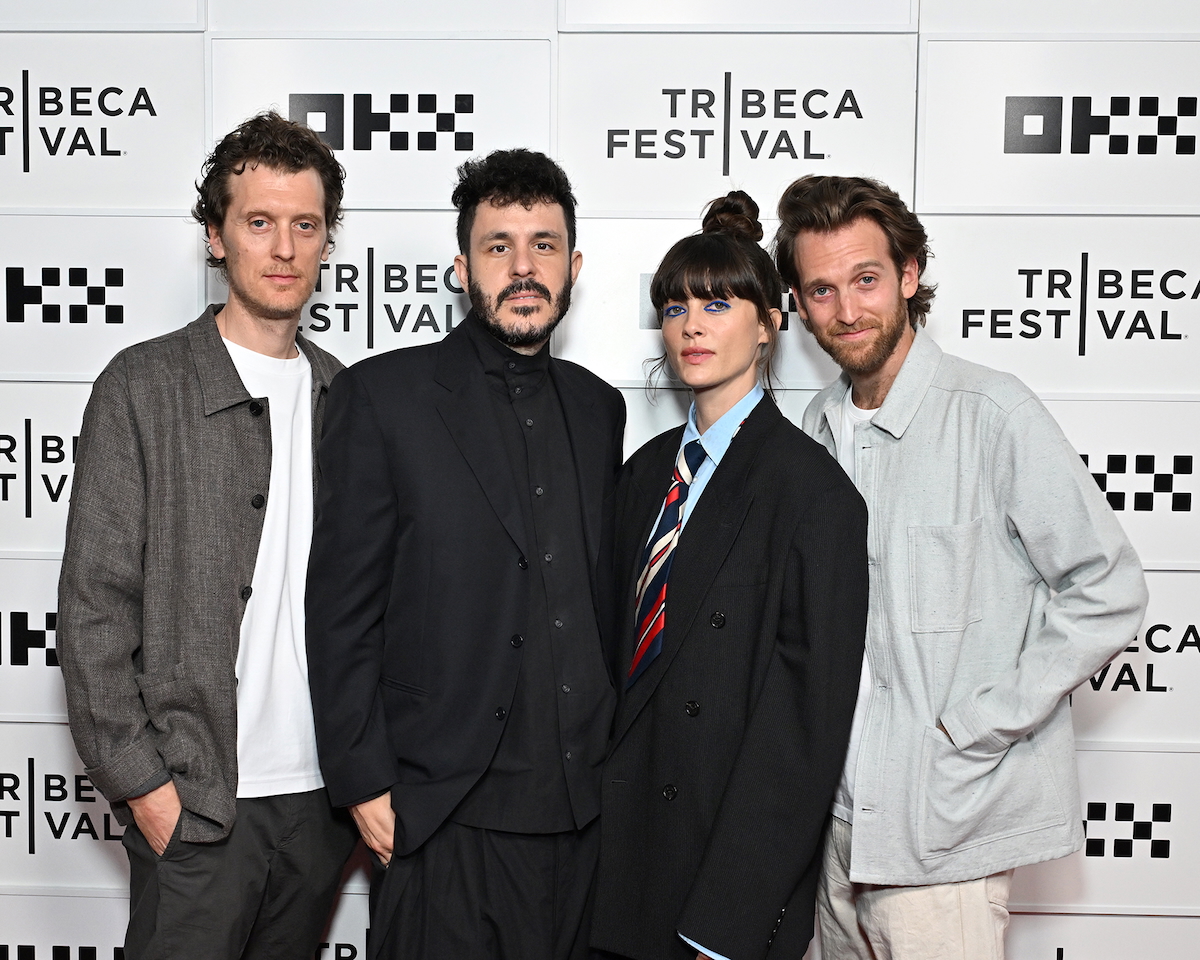
From left, Benjamin Bergmann, Ori Rousso, Noga Erez, Jono Bergmann. Photo:
Slaven Vlasic/Getty Images
The directors are the Austrians Benji and Jono Bergmann. They started filming in 2021, well before October 7th and the war in Gaza. They didn't know Noga Erez well, who many have compared to Björk and Doechii, is appreciated by people like Billie Eilish, Katy Perry and Robbie Williams (who appears in the documentary), opened concerts for Florence + the Machine and Pink. The Bergmann brothers were struck by the contrast of elements present in his music. “There are dance numbers haunted by death,” says Jono. «There are political and at the same time sexual songs that talk about geopolitics but also about personal emotions. Never heard anything like it.”
Benji was attracted by another aspect, namely the creative process as a couple, a theme that he and Jono deal with on a daily basis. “In some ways we reflect ourselves in them, in others things are completely different for the two of us,” says Jono. Erez was flattered and surprised by the brothers' proposal. «We accepted without knowing what making a documentary of that type really meant. And while they were producing it we regretted it several times. We gave them total control, we basically had no say in the matter. We trusted our instincts towards them.”
One of the Bergmanns' previous works is Camp Confidential of 2021, about European Jews who, after fleeing Nazism and taking refuge in the United States, joined the American army by interrogating Nazi war criminals in a secret camp. However, the two had never been involved in music. Further complicating the project was a detail they didn't know: when filming began, Erez and Rousso had temporarily broken up. “We are quite reserved,” says Rousso. They kept their relationship status a secret from even their closest friends.
“It was a big mess,” says Erez, whose direct way of expressing himself contrasts with Rousso's more measured nature. While he calmly reflects on the need to find his own space in the relationship, she says that she misses him and jokingly scolds him for not missing her. All those messy emotions end up in the music and those intimate sessions are film gold.
The lines between private and professional life are becoming even more blurred as pressures increase. In 2022 they leave for a tour around the world. They play Madison Square Garden, release the album Kidssign to Neon Gold and Atlantic, find out Missy Elliott wants to remix Nails (where Rousso uses Erez's fingers as a percussion instrument), they participate in the Jimmy Kimmel Live!begin recording in Los Angeles. It's the high point of their career, or so it seems.
“Remember that the only thing that doesn't change is that everything keeps changing,” Erez says.
Halfway through the film the screen goes black. We hear sirens, machine gun fire, a voice shouting “there are terrorists here… they are shooting at us, help us!”. Other recordings of October 7 with screams, desperation and massacres echo the primal cry from the beginning of the documentary, reminding us that Noga is the story of artists under siege.
Immediately afterwards here are Erez and Rousso talking with family members and preparing emergency plans. The camera lingers on a gun shiny and black as liquorice. Erez takes it in his hand, looks through the viewfinder while a voice on the phone explains how to hold it and shoot.
The Bergmanns explain that the film is constructed like a vinyl divided into two sides. Side A sets up personal, professional and political conflict. Erez is also criticized in Israel for declaring that the BDS movement has done “an important job in bringing people's attention to what is happening.” By spinning the album, the two find a path through music, but facing the most difficult test.
When the film returns to the Jerusalem concert, an Atlantic executive informs Erez and Rousso of the existence of a list circulating in Hollywood with the names of Jews believed to be complicit in the “genocide” of the Palestinians in Gaza.
“How are you?” asks the manager.
“Well, we're at war,” Erez replies. “It's something the heart can't understand.”
Then he asks him: “Do you think there will come a time when people no longer want to work with Israelis or Jews?”
While Erez and Rousso face the consequences of the international reaction to Israel's war in Gaza, she confesses to her partner that “this whole story has made me question the meaning of the life we live, I wonder if it wouldn't be better to simply cook and have children.”
Unlike other stories of couples in music, from Sonny & Cher to Fleetwood Mac, the two do not end up destroying each other either artistically or sentimentally. We see them perform a new song dedicated to the hostages and their families and take a stand against the war. While the world around them seems to be falling apart, they reach new artistic heights. They release the album Vandalistthey shoot a video in Ukraine and go on tour again in the summer of 2024. Awards, increasingly numerous audiences and finally an important slot at Coachella.
As they head to the stage of a festival they find themselves faced with a new threat: the organizer asks them to make a statement against “occupation and genocide”. Otherwise they risk cancellation of the performance. “It's not right, it's absurd,” Erez says in the film. “Most of us just want peace.”
The hope, he concludes from Tel Aviv, “is that people will be able to see us as human beings.”
From Rolling Stone US.