
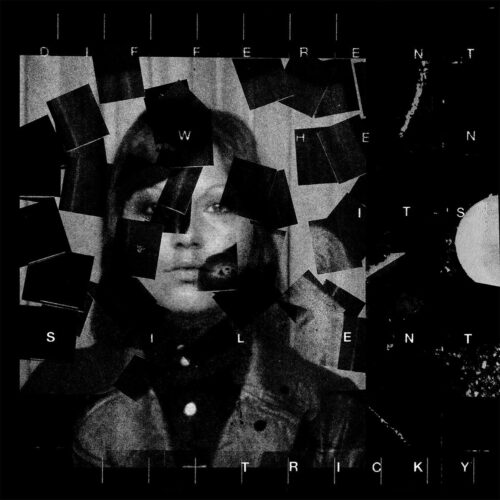
Some artists go through time chasing their legend, but Tricky does the exact opposite. Each of his albums seems like an attempt to disappear a little more into the music, to the point of letting the shadows of his life speak for him.
After thirty years spent redefining the language of trip-hop, the most oblique hip-hop and the most restless rock, “Different When It's Silent” is not a return, but a sort of reappearance.
The tragedy of the death of his daughter Mina in 2019 inevitably changed his relationship with the world. In recent years Tricky has “hidden” inside parallel projects, collaborations and productions, refusing the very idea of exposing himself. This album, initially conceived as another side projectexists only because someone reminded him that those songs inevitably bore his name. But the paradox is precisely this: “Different When It's Silent” is the album where our protagonist is less present as a voice but more present as a spirit.
The melodic weight is entrusted almost entirely to Mitch Sanders, a young singer from Bristol who does not simply interpret these songs but inhabits them. His luminous falsetto seems to pass through the industrial buildings of the city, while Tricky's voice remains a whisper that accompanies him like a ghost. If “Maxinquaye” was the diary of a man in conflict with the world, here the man in question observes that world after crossing the abyss.
We are in the presence of one of the most compact works of his recent career. The Bristol Sound continually resurfaces, but as a memory almost distorted by time. The trip-hop foundations remain intact, post-punk and alternative-rock are grafted on top to create a sort of skeletal blues accompanied by sudden electronic openings. “I Still See Me There” proceeds like a funeral march, “I'm Yours” is contaminated by calm rock but with unresolved industrial tensions, while “Because I Don't Know” brings everything back into an electronic fog in which pain and groove they live together. Each arrangement seems constructed to leave room for absence. Isolated pianos, ghostly organs, violins that never seek consolation but only a different form of restlessness.
Some will inevitably miss a more protagonist Tricky, closer to the “Pre-Millennium Tension” era. This is an understandable objection, but perhaps it misses the point. This album doesn't want to replicate an identity built thirty years ago. He wants to demonstrate that a voice can survive even when it chooses to retreat into the background. Tricky continues to remain an author impossible to imitate: not because he invented a genre, but because he continues to transform his scars into a language that belongs only to him.
07/22/2026
Daniel D`Amico for SANREMO.FM