
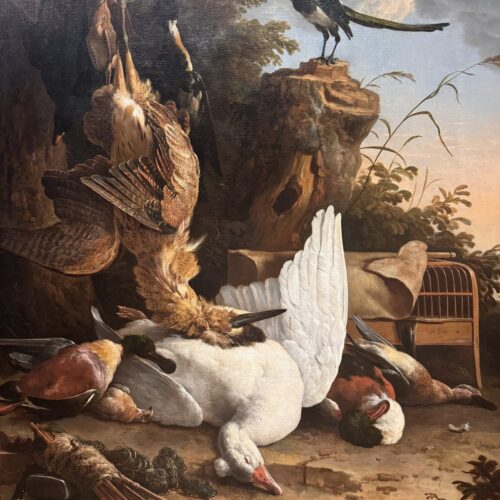
Some records try to tell a story, others instead build a mental space in which to get lost. “The Isle Of Skye”, the new work by Infinity Ring, does not resemble a collection of songs so much as a slow crossing where you can wander. A pilgrimage into a landscape that seems to exist simultaneously in multiple eras: a Scottish moor shrouded in fog, an abandoned cathedral and an Edenic garden haunted by its own ghosts. Everything seems familiar yet slightly off-axis, like a dream that keeps changing shape as soon as you try to focus on it.
Infinity Ring uses the language of neofolk as a ritual structure on which to graft something more restless. Acoustic guitars aren't looking for comfort. Melodies offer no refuge. Each deal seems to open a new room within a labyrinth. The compositions proceed like corridors that continually bifurcate. A minimal arpeggio introduces the scene, then the strings arrive. First as a discreet, almost invisible presence, then more and more invasive. Sometimes they caress the songs with a chamber-like melancholy, while on other occasions they deform into nervous dissonances that recall the sound of the wind against a window during a storm.
This is where “The Isle Of Skye” finds its identity: in the constant tension between beauty and threat.
Cameron Moretti's deep, cavernous voice sounds like a tired guide who knows every turn of the path but still doubts the exit. There are moments in which it recalls the sepulchral magnetism of Nick Cave, others in which it assumes the liturgical posture of a certain apocalyptic folk à la Current 93. They sound like Death in June assimilated by Neurosis.
The real surprise comes in the management of the dynamics. The songs slowly build until they reach emotional peaks of great post-rock crescendos. As if the Swans of “To Be Kind” (2014) had been deprived of electricity and forced to express their obsession through strings.
“The Isle Of Skye” treats darkness not as a destination but as a passage. The album talks about isolation, loss, shattered identities and interior worlds without a trace of satisfaction in pain. Every tension seems to push towards a possible liberation, as if the monster hidden at the center of the labyrinth was not something to fight, but something to recognize.
And when the journey ends, you don't have the feeling of having witnessed a tragedy, but a profound transformation.
07/19/2026
Daniel D`Amico for SANREMO.FM
