
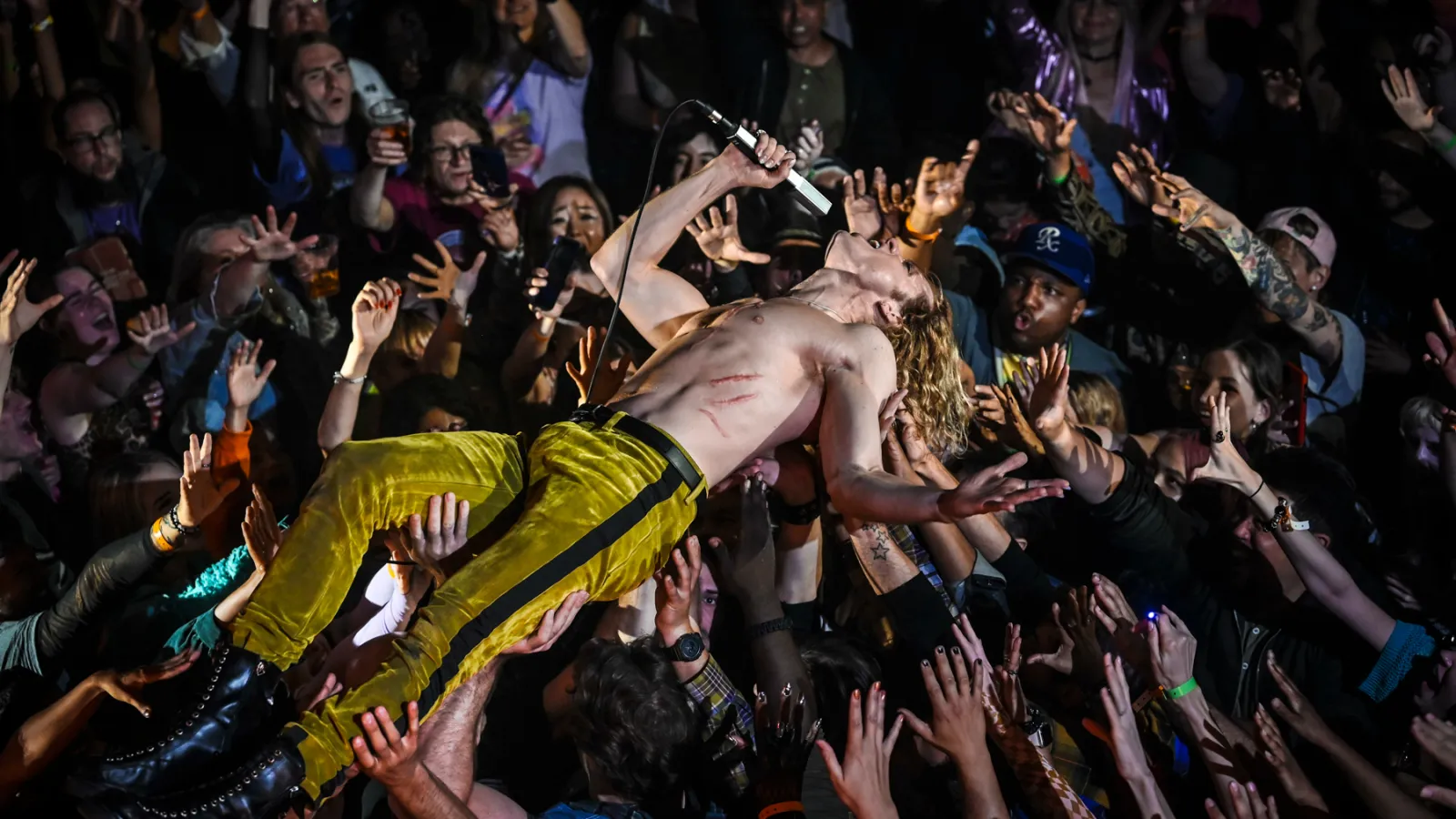
David Bowie. Freddie Mercury. Little Richard. Jimi Hendrix. Mick Jagger. Elton John. Now, Lestat de Lioncourt?
Based on the Anne Rice book series The Vampire Chroniclesthe AMC series Interview With the Vampire has built a die-hard fan base since its premiere in 2022. The show's main focus is the emotionally turbulent sexual relationship between vampire Lestat (Sam Reid) and his lover Louis de Pointe du Lac (Jacob Anderson), following the couple from their first meeting — and Louis' vampiric transformation — on the streets of New Orleans in 1910 to the present day. But the series made a bold choice for its third season, changing not only its narrator but its title to The Vampire Lestat.
Like the switch suggests, The Vampire Lestat takes its inspiration from Rice's 1985 novel of the same name, giving audiences their first taste of a show told entirely from the perspective of the dramatic, flashy, and murderous vampire Lestat. And with the new name comes a new arena. Tired of spending his days simply delighting in psychological torture and revenge, Lestat publicly chases the life of a famous rock star, writing and producing an album and performing in a cross-country tour while maintaining a fake vampire persona. Vampirism, thousands of adoring fans, and a cramped tour bus with a band completely unaware their frontman is a creature of the night — what could go wrong?
“The whole season, [Lestat] he is in a sort of protracted mental breakdown, and he leans into it. The more he plays music, the more it opens his mind, and the more he has to lose the facade and the bravado — the performances become more internal,” Reid tells Rolling Stone. “He starts out much more theatrical: a campy vampire character, a tongue-in-cheek nod back to his roots at the Théâtre des Vampires, where he's a vampire pretending to be a human pretending to be a vampire. But as the season goes on, the music starts to unlock things, and the way he narrates and discovers the world becomes more personal, more truthful.”
But for Reid to portray a believable modern rock star, it wasn't enough to give him a killer album and toss him onstage. He had to look the part. Along with Reid, Rolling Stone spoke to the designers, costumers, makeup artists, and hair stylists about the process of building a rock god from scratch.
Putting the Sex in Sex Appeal
This isn't the first time Rice's famed work has been adapted. The 1994 film starring Brad Pitt and Tom Cruise also told Louis and Lestat's story, but opted for heavily veiled subtext regarding the nature of their relationship. By contrast, AMC's adaptation straightforwardly depicts the messy, chaotic, and queer relationships the vampires have with each other — often intensified or twisted by the hundreds of years and countless battles they've lived through.
The series' open acknowledgment of queerness meant that when it was time to tackle the rock-star version of Lestat, the design team was able to draw inspiration from major LGBTQ+ artists throughout rock history as well as the show's modern-day setting. Many of the costumes directly imagine a world where a rock star can feel less burdened by the concept of appearing palatable — or passing for straight — to sell mainstream records.

Costume designer Lex Wood calls Lestat's style “quite cunty when he wants it to be.”
Sophie Giraud/AMC, 2
“There's an element of idealism and idolatry about a frontman,” costume designer Lex Wood tells Rolling Stone. “We wanted Lestat to feel slightly chameleon-like and slightly untouchable in other circumstances. We took some notes from the style of Bowie, that very changeful, laissez-faire nature, but very performative. There are clear nods to Freddie Mercury's style from the Seventies and early Eighties, whilst still trying to pull in things that feel familiar to Lestat from his 18th-century roots. I'd love to put him in a Bjork face mask, but I don't think Lestat is patient enough for that.”
One of the hallmarks of the series is its dogged attention to detail, an aspect of storyboarding infinitely complicated by the non-linear nature of the episodes and the vast number of years Lestat's life as a vampire spans. Reid says that he chimes in quite often when working with costume, makeup, and hair to decide what choices feel the most true to Lestat.
“I think fittings and makeup tests are some of the most [informative] spaces, where you really start to see the character form and get to play with everyone's ideas,” Reid says. “I have strong opinions about how Lestat looks and dresses and operates, but I'm always happy to be wrong.”
For Wood, this means thinking about everything from the designers she's sourcing to how Lestat is actually obtaining the costumes he's wearing.
“[Lestat] has got that quite slutty style going on when he wants it to be. He could just as easily take a coat that he likes from a passing stranger or from one of his victims. He could wear [something] and get rid of it,” she says. “Some pieces maybe stay, get thrown on the floor, and he picks it up the next day. But I think possibly there's another coach traveling along behind the tour bus that is just his wardrobe.”
'A Showy Character'
For Oscar-winning makeup artist Tami Lane, creating Lestat's onstage look was a true collaboration between the writing team, hairstylist Stefanie Terzo, and Reid.
When they originally approached the actor about plans for the season, he wanted to stay away from glitter and glam, referencing Michael Hutchence, Jim Morrison, and Robert Plant as inspirations. Originally, Reid didn't even want black eyeliner. “But I'm like, 'Well, hell.' That's gonna be a little boring,” Lane recounts.
They eventually settled on a look that embraced some of the modern aspects that Lestat would be most excited about — like copious amounts of glitter but with a chrome, reflective effect. In one light, it appeared that he was wearing nothing, but as soon as an angled spotlight hit him, the glitter emphasized the scars on his chest and mimicked tear tracks down his cheekbones.
“Lestat is a showy character, so we both learned in this process,” Lane says. “He needed to have a little bit of sparkle.”
Terzo's job, meanwhile, was to take the Lestat fans knew from the first two seasons and completely undo his aesthetic to match his emotional state. “It's about having his hair look undone,” she tells Rolling Stone. “Being bratty, being a rock star, becoming that person, that section of himself [meant] just working more natural textures into it. In this season it's not his 'hair,' it's his 'mane.'”
Makeup artist Tami Lane working on set with Sam Reid, far left, and Christopher Heyerdahl, far right, who plays Marius.
Sophie Giraud/AMC
Something fans might not realize is that Lestat's hairdos also serve as a cheat sheet to the emotional heart of his songs. When he's performing onstage, his hair directly correlates to the time he's singing about. “Watch his hair though the songs,” Terzo says. “Who they're about, what time frame or era the song is pertaining to, the hair changes and twists.”
A Bloody Good Guitar
The look is important, but no rock star is complete without his guitar. This is where celebrated guitar manufacturer Fender stepped in. Billy Siegle, a senior manager on Fender's artist relations team, worked with AMC to design four customized Stratocaster guitars for Lestat to use onstage. Called “the LeStrat: Petit Coup,” each of the four guitars was designed with the previous model in mind. But as the season progresses, the guitars are streaked with what is supposed to be an increasing amount of blood, an aesthetic reflection of Lestat's inner struggles.
“Inspired by the idea of residual energy, we imagined Lestat returning from doing vampire things, picking up his Fender Stratocaster, and the blood from his victims gradually transferring onto the guitar as he played,” Kelly Magrath, vice president of marketing operations and brand creativity at Fender tells Rolling Stone. “[It] felt like a genuine extension of Lestat himself, capturing both his style and raw musical journey.”
The team ended up making eight mockups, six refined versions, and then built five physical guitars, which were all hand-painted by The Vampire Lestat production designer Andres Cubillan. The final three versions were dubbed LeSTRAT “First Blood,” LeSTRAT “Medium Blood,” and LeSTRAT “Blood Bath.”
“Billy and the AMC team were committed to making the guitar really feel like it had lived through Lestat's journey,” Magrath adds. “And they really did kill it.”
Vampires Have FeelingsToo
Turning Lestat into this season's titular character also required building a rich and accessible musical legacy for him in a short amount of time. Reid recorded more than 20 songs written by the show's composer Daniel Hart, many of which lyrically relitigated the tricky emotional labor and fatigue of having to exist through centuries. It's a peek into a notoriously guarded character, purposefully complicated by giving a new perspective to scenes and relationships viewers already think they know.
“What we're seeing is the real Lestat,” Lane says. “It's a reintroduction of him to the audience.”
The songs informed the design, allowing Wood, Terzo, Lane, and others on the creative team to build this season's world with Lestat's musical journey at the forefront — and every detail carefully considered. “What the entire team has worked so hard to try and create is the [understanding] that there is meaning beyond the closed doors,” says Wood. “Every piece that you see, there's something else this [expands] out to. We have a fan base that is committed to delving into the meaning of every single tiny element, be it in the set, hair, makeup, costume, shoes. Everything is noticed, which is so fantastic and gives us all such joy. Because we're doing it to make [this world] as real and as tactile as possible.”