
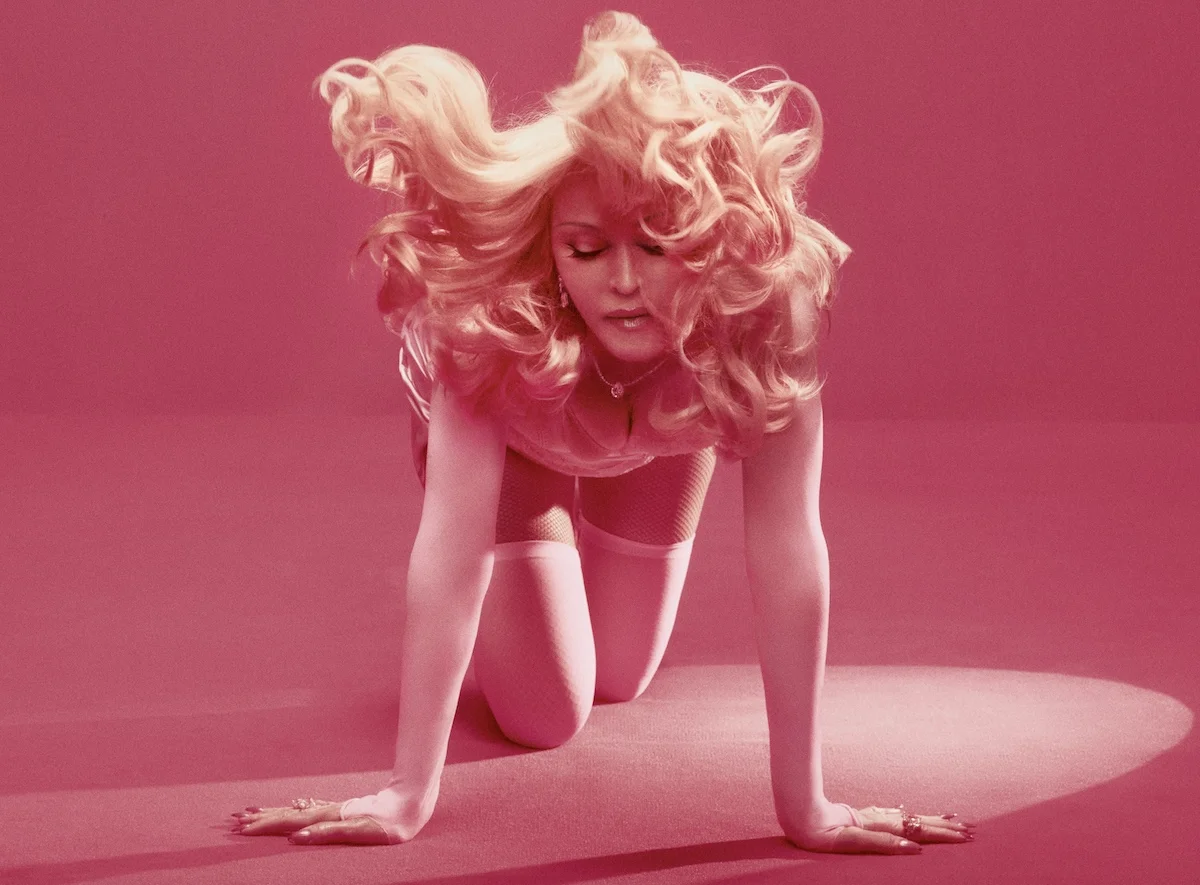
Over the last five decades, the career of the queen of pop of the 80s and 90s has experienced memorable ups and downs. If the pseudo-country turn with electropop inclinations of “Music” in the now distant 2000 was welcomed with enthusiasm, the same cannot be said of the vacuous “American Life”, in fact Ciccone's first real misstep, or rather: the first mutation as indecipherable as it is anything but visionary. Fortunately, a temporary stumble, given that in 2005 Madonna returned to occupy the top levels of the charts with the very successful “Confessions On A Dance Floor”, re-establishing with a masterful twist the pop hierarchies removed in the previous attempt. To do so, however, she had to reinvent herself as the star of the dancefloor, precisely in a historical phase that twenty years later appears as the last great epic of disco music; in short, Madonna exploded the last fireworks of a still visceral, carnal approach to the dance floor, for a pulsating and very sticky pop composed mostly to sweat both at a mega concert of the same American superstar and in a random summer camp.
The stroboscopic miracle, however, remained an isolated case in a pop context that is now mutating at a speed that is impossible even for Madonna herself to sustain, except for that “Madame
Between ailments fortunately resolved, confusing exits, equally unlikely outfits, Madonna arrived in 2026 artistically bruised, as she was increasingly crushed by an unbearable gravity for a singer on the threshold of seventy, and submerged by an almost incalculable mass of new queens of that thing called pop music. At the same time, it must also be said that the times in which Ciccone's face was illuminated by Vittorio Storaro like an escaped Marylin from a comic in that masterpiece of comic lights and gangbangers that was “Disk Tracy”, are completely unknown to the new generations. Yet, despite all the difficulties of the case, Madonna has somehow found her lost passion again. And to do so, she had to resume the discussion that was temporarily suspended in 2005, when she was the one who enraptured half the world with highly successful hits and mind-boggling shows.
“Confession II” was in fact born as a sequel to “Confessions on a Dance Floor” and also marks the return of Madonna to Warner and Stuart Price, the producer who supported her in the glorious mid-2000s.
Officially announced on April 15, 2026, the band's fifteenth studio album material girl was revealed with a manifesto published on the singer's official website which explains well the spirit at the center of the sixteen new songs: “We must dance, celebrate and pray with our bodies. These are things we have been doing for thousands of years: they are true spiritual practices. After all, the dance floor is a ritual space. It is a place where we connect: with our wounds, with our fragility. Raving is an art. It means pushing yourself beyond your limits and connecting to a community of like-minded people. Sound, light and vibration reshape our perceptions, dragging us into a state of trance. We don't just hear the repetition of the bass, but we perceive it, altering our consciousness and dissolving ego and time”.
It's an authentic commercial that turns dance music into a sort of oriental philosophy. Starting with the first track, “I Feel So Free”, which, between sample of Lil' Louis and self-sampling, has the ambition to immediately bring Madonna back to the center of the village, or into the heart of the “village people”, it's all the same. It's a song with a Tiga-like rhythm from the times of “Sexor”, wanting to make a first ad hoc parallel. So soft house supports a sensual tune with Moroder and Donna Summer on the horizon. The idea of appearing unexpectedly next to Sabrina Carpenter during the last Coachella, to launch the single “Bring Your Love”, says even more about Ciccone's promotional ambitions. It must be said at the same time that the song is very watered-down pop dotted with melodic pirouettes between one break and another, a passage from “Good Life” by Inner City, voices of an excited siren that intersect: one could say a kind of b-side fished out of a drawer closed twenty-one years ago. Nonetheless, by some strange law the song works, or at least does its lacquered duty.
Between surprise appearances in New York streamed on Grindr and YouTube to launch the second single, “Love Sensation”, Madonna however almost instantly returned the idea of having produced a conscious, non-changing and consequently unsettling dance music record, let's be clear, but honest, therefore a revival of her own revival, which is something new for a quick-change artist like her. It is no coincidence that “Love Sensation” is also the most successful house-pop track of the lot, and it is the one that radiates the most energy in a setlist conceived as a DJ set. And “One Step Away” is also appreciable, less pulsating and more lunar, but very calibrated in its circling beyond the floor with a perfect change of rhythm placed almost at the end, before the aforementioned duet with Carpenter enters and above all “Danceteria”, perhaps the most 90s moment of the lot, at least on a melodic level, with Madonna singing like a dancefloor diva tired of everything and everyone and so much sample of “Walk On The Wild Side” by Lou Reed.
In this open-door party, there is no shortage of the usual Latin blunders that have always been dear to Ciccone, such as the predictable “Read My Lips” in the company of Feid, or the vaguely French touch phrasing of “Everything”, which however changes very well in the second half, despite an overly predictable production. The presence of three little monsters like Martin Garrix, Cirkut and Andrew Watt can be felt: take the beat of “Bizarre” as an example, with the first from Cicero indomitable in console.
The presence of Stromae in “My Sins Are My Savior” is also curious and significant in its own way, which turns the clock back again not by twenty but rather by almost forty years, as demonstrated by the sample this time full-bodied with “My Army of Lovers” by Army of Lovers, an unforgettable single for fans of the most distant dance, and published, in fact, in 1990. And what can we say about a good part of the sad “Betrayal” melancholy entrusted to a melodic line borrowed from Erik Satie? Of course, there is also a decidedly boring moment like the duet with Lola Leon in the insipid “The Test”. But the final “LES Girl”, or the girl from the Lower East Side, closes the set like a music box placed at the end of the track before everything ends.
Apart from the dancing spirit, “Confessions II” has little in common with its putative father, being a less impulsive and more “thinking” album, longing for life but without overdoing it, and perhaps precisely for this reason in line with the desires of a pop star who rightly refuses to leave the firmament and returns to wear for the occasion a Versace which, like it or not, will never fade.
04/07/2026
Daniel D`Amico for SANREMO.FM