
TO
lex Amen knows a good documentary when he sees one. “I can watch a great movie and it can shape the way that I see the world,” the 26-year-old singer-songwriter says. “But a good documentary will change my life.” He means that literally. Several years ago, while in his first semester at Chapman University in Orange, California, Amen watched Long Strange Tripthe 2017 Grateful Dead doc that spans four hours. “It struck such a chord in me,” he says. “It's like, the ultimate sales pitch for anybody who wants to be in a band. I called my parents, literally the next week, and said 'I'm dropping out of school.' And I bought a van.”
His Dead awakening is just one of the many turning points in Amen's journey, from a stint in a historic commune in Anaheim to several years on a remote island in Washington's Puget Sound. It all leads to the release of his fantastic debut, Sun of Amenout now via ATO Records. It's a travelogue of sorts, featuring 10 tracks of stunning acoustic folk, best heard while walking around in nature — sublime summer listening at its finest. But getting here wasn't easy, and Amen doesn't hesitate when asked about the theme of the album. “It's heartbreak across the country,” he says. “I really struggled with, 'How do I get these heartbreak songs away from each other so it's not this giant bummer?' Towards the end of the record, you're like, 'All right, come on, get over it.'”
It's a late May afternoon in Brooklyn, and Amen is sitting at a booth at Montague Diner, slowly eating a turkey club sandwich. He's got sideburns and a mustache, and his blue flannel shirt is unbuttoned at the chest. He orders a half-calf cold brew. “I don't really drink caffeine at all,” he explains. “But there's this new Michael Pollan book [A World Appears: A Journey Into Consciousness] and he raves about caffeine in it. So I'm easing my way back in.”

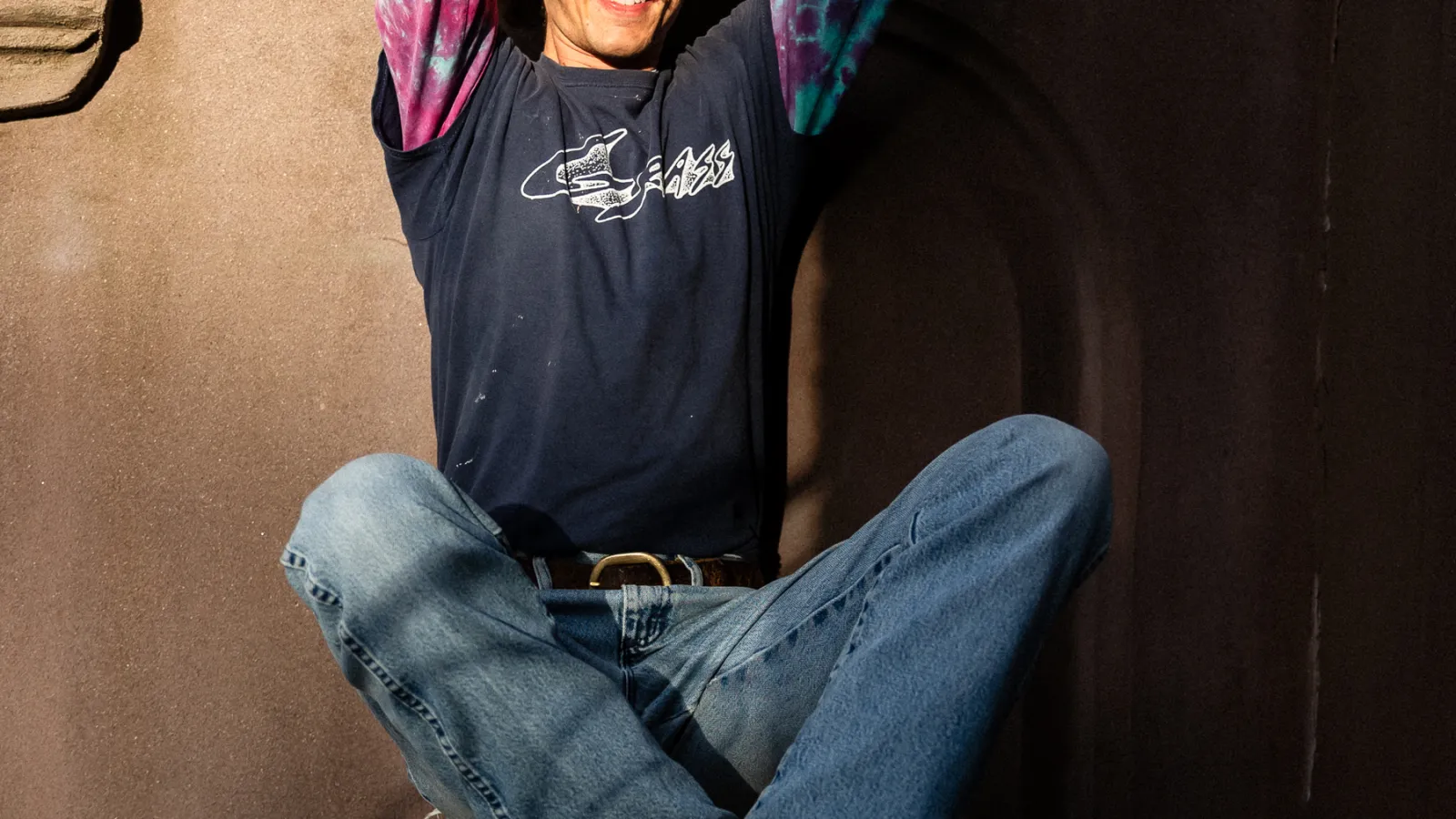
Alex Amen in Brooklyn, New York, May 2026
Griffin Lotz for Rolling Stone
Amen moved to the city six months ago. That van he bought, and lived out of while rock climbing in Yosemite (more on that later) isn't needed here, nor is the sailboat he bought and repaired in Washington (we'll get to that, too). He tends to bike around the city, and he's surprised by how much he likes his new home. “I had a stick up my ass about the East Coast until I came out here,” he says. “And I realized, this is way better. It was the first time I really felt like I really belonged to a place, which was a strange thing, because I wasn't expecting that at all.”
The title Sun of Amen isn't a playful nod to Harry Nilsson's 1972 album Son of Schmilssonbut the record has drawn comparisons to the singer-songwriter decade, both visually and sonically. The blissful opener “Diamonds” kicks off with a wave of acoustic guitar and lap steel that sets the tone for the rest of the album: “I've seen early mornings rising/Where the mountains shine like diamonds in the sky.” His voice is warm and familiar in the best way — a young artist clearly influenced by the past, particularly Harvest-it was Neil Young, yet he's carving out his own way forward.
Amen is used to being asked about the nostalgic aspect of his music; he almost expects it. “I don't intentionally try to make records sound old, because I'm born in like, the wrong generation,” he says. “I just don't think the modern ear sounds as good. It's not about trying to sound old, it's just trying to sound good. If you listen to Harvest or Joni Mitchell's Blueor a lot of Stevie Wonder stuff, it's unbelievably high fidelity. So I made it about as clean and hi-fi as I could.”
Sun of Amen was partially recorded at the historic Valentine Recording Studios in Los Angeles, using stellar vintage gear that sometimes required a lot of patience — like when the tape machine caught on fire. “The great thing about Valentine is that it's like a museum,” Amen says. “But it's also what's shit about it, because sometimes there's no workaround with an issue, or an issue takes like five hours. So it's a push and a pull and you just have to lean into it. You just have to accept that when you're there. And a part of it's nice because we live in a world where everything is so perfect all the time and I think the digital age has really rubbed a lot of the rough edges off of things. It's those rough edges that feel organic.”
That analogous spect even extends to the vinyl itself, with a cover that features Amen surrounded by nature, with the sun shining through the trees. He says it was pressed by hand, at the one plant in the United States that still does it. “It has that feeling to it, the type of paper they use and stuff that doesn't feel plasticky,” he says. “A lot of modern records I think feel kind of cheap or something. When you pick up an Allman Brothers record or something, it's like, 'Oh, why is this so nice?' It's just higher quality.”
The West Coast looms over Sun of Amen like a hazy hangover. Take the highlight “California Blues,” which has a euphoric melody that sits in stark contrast with the lyrics. “It's awful sunny, but watch out honey/This type of place can make you worn,” he sings, sounding like a true New Yorker. “Cabin By the Sea” is equally upbeat, about Amen's years spent on the Washington island of Vashon. He landed there after the Anaheim commune, where he spent nearly a year immersing himself in the counterculture that persisted well after the Sixties, and starting his first band, American Slang. “Washington made me who I am now, but it almost killed me,” he says. “And I don't say that to be dramatic. I think I really was dead.”
Amen moved there with his then-girlfriend in the early days of Covid, and stayed there for nearly four years. “There was a lot of beauty and a lot of love, but a lot of darkness,” he says. “Neil Young's “Journey Through the Past” couldn't be more on the [nose] for what I had experienced in Washington, and the person I was with. Their father died and had this very intense childhood dealing with other tragedies. And I loved this person very deeply, and they couldn't let go of where they came from.”
Amen ended up spending most of his time alone, practicing guitar for several hours a day. “I would go like weeks without really talking to anybody,” he says. “It was like an interesting look at life, and a lot of time in silence. It was almost like a meditation or something, a weird trance.” He also took up sailing at this time, restoring a boat with the help of a carpenter and taking it out to Canada. “I got into it to fill my time, and then I realized that I actually enjoyed it,” he says. “It's a total niche way of life, just like climbing, just like music.”
Amen fell into rock climbing at an early age. Growing up in Sugar Land, Texas, a town outside Houston he compares to “the Edward Scissorhands neighborhood,” he knew he needed something more. “You go to college and come back and have a corporate job,” he says. “And I just couldn't see myself doing that at all.” He saw an ad for climbing, and his world burst wide open. “To me, a lot of what people stress so hard for and work so hard for is so damn meaningless,” he says. “So it's like, why not just lean into it and make your own meaning? Like literally climbing a rock and living out of a car and letting your hair grow long.”
Climbing is what led Amen to attend school in California, where he initially wanted to make rock climbing films (another documentary that changed his life: 2014's Valley Uprising). The album centerpiece “Her Spirit Wanders” is about female hikers that inspired him in Yosemite, where he spent several springs and summers. “I came across a lot of people who were attracted to that same thing that I was in nature and in climbing,” he says. “I was just in awe of their dedication to their passions.”

Alex Amen in Brooklyn, New York, May 2026
Griffin Lotz for Rolling Stone
But Amen soon realized he didn't want to climb professionally. “It was going to ruin the purity of it,” he says. “And I also realized, 'I'm a lot better at music than I am at climbing.'” He began playing piano at age 4, then picked up the guitar as a teenager, inspired by Young, Nirvana, and indie rock — namely Mac DeMarco. “Through Mac, I realized you could be relevant in your own time with an instrument and have a unique approach,” he says.
After Washington, Amen recorded the 2025 EP The Zorthian Tapescut at the Altadena artist colony of the same name. He was signed to ATO in early 2026, just as he moved to Brooklyn. Like his friend and collaborator Haylie Davis, he finds the music scene more vibrant than on the West Coast. “I've been on a PR campaign to get everybody out here,” he says. “It's a lot better than a place right now to be musically for a lot of reasons.”
He already has a new album in the can, which he says is a lot lighter than Sun of Amen. But he has no ambitions of being a mainstream star. “I don't care about being on a stage with screaming people and millions of phones and trying to go out to eat afterwards and getting heckled,” he says. “If I can just coast and play cool ballrooms and my friends are in my band, and we can save a little bit of money, pay our rent, and eventually buy a little house somewhere, that's good for me.”