
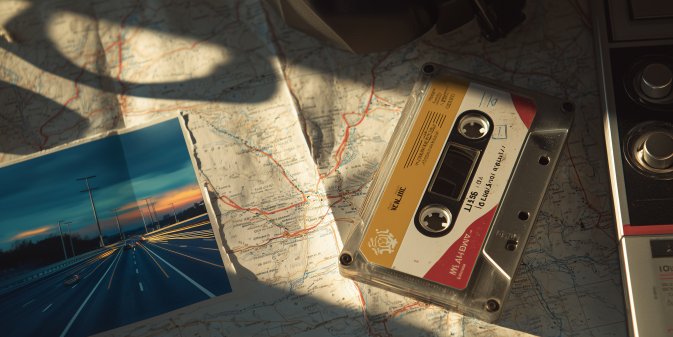
“One chord is ok. Two chords are borderline. With three you're already making jazz”, says a famous quote attributed to Lou Reed. But there is another option: if you have three chords, always the same three, IV-IV (the central one can at most be replaced every now and then by the relative minor), it is probably heartland rock.
It is plausible that the expression tells you nothing. It is not, in fact, part of the canonical musical lexicon of the Italian enthusiast. Yet the sound it identifies is more vital today than ever. Reverberates in the big music by Sam Fender and in the hits pseudo-synthwave by Taylor Swift; in recent releases by Killers and Ryan Adams; in the refined indie-rock of War On Drugs and in the choral impulses of Arcade Fire. In a much more transversal and pervasive way than the highly acclaimed post-post-punk reincarnations, it is in all respects one of the symbols of rock of our years. If the comparisons still disorientate you, perhaps one name will be enough to clarify the situation: Bruce Springsteen. The passionate and pressing sound of his albums between the Seventies and Eighties has its roots in New Jersey, but evokes images of the deepest United States – endless roads, deindustrialization, hopes and disappointments of the American dream – and represents for many European listeners the most quintessentially US soul of rock'n'roll of that era.
Yet, there is life beyond Bruce Springsteen, and this playlist is an opportunity to discover it. The Boss' voice is iconic (even if some may find it awkward), his songs have made history and not just that of rock. But confusing his personality with uniqueness would be a huge mistake. Similar images of deep America, aroused by a sound equally enthralling and grandiose, with similar but more colorful compositional structures, and often with the same identical chords, they are part of the repertoire of dozens of artists, both previous and subsequent. With some names that had already assumed at least comparable importance in the context since the end of the Seventies: Tom Petty, Bob Seger, John Mellencamp, Nils Lofgren.
Around the 1980s, the sound had earned a name of its own, heartland rockwhich took up one of the nicknames of the north-central area of the United States – the much-vaunted Midwest. Perhaps by contrast, over time a further label has also taken hold (to a much lesser extent): “Jersey Shore Sound”, used by artists from the north-east coast such as Springsteen, Southside Johnny & The Asbury Jukes, John Cafferty & The Beaver Brown Band. It is not clear when this last expression was born, but the first online attestations date back to the end of the 2000s.
From the Midwest to the Far East
Of course, sound and its constituent elements did not arise out of nowhere. Among the many influences highlighted by commentators (from Bob Dylan to Neil Young, passing through Joe Walsh), one comparison in particular is illuminating: that with John Fogerty's Creedence Clearwater Revival. In fact, that obsession for the reiteration of basic chords, with a free-range attitude that goes straight to rock'n'roll almost skipping the inspirations of British invasion and of Summer of loveshows a strong harmony with what, already in the Sixties and several miles further south, Fogerty had begun to do with his band. And the Californian training is also responsible for one of the most effective traits of the style heartland: his beat pounding and propulsive, sort of motorik before its time which draws its origins from Highway Americans and Delta blues instead of Autobahn German and by the echoes of Bohemian New Yorker of the Velvet Underground.
If we wanted to look for a “golden age” for the genre, this would certainly fall between the Seventies and Eighties – roughly in parallel with that ofarena rock. In those years the sound also infected artists and musical territories that were not too close: Billy Joel embraced it with “Storm Front” (1989), but in the decade there were also incursions by Cher, Bonnie Raitt, Kim Carnes, Melissa Etheridge. “Because The Night” by Patti Smith (written by Springsteen) is fully in the groove, and there are those who also include the songwriting by Tracy Chapman, more acoustic and intimate, but often similar in theme. Another habitue is Jim Steinman, author of songs that combine the theatrical emphasis of pomp-rock at the typical pressing pace heartland: the title track of “Bat Out Of Hell” is essentially that, but in the same vein we also find pieces for Bonnie Tyler and her solo production.
Correspondences abound even outside the United States: the assonance with the virtuosic and skeletal roots-rock of Dire Straits is evident, but ultimately also the big music of U2 shows a clear harmony, at least in some of its phases. In Canada the baton passes first to Red Rider, then to Bryan Adams, who takes up much of the trend of his iconic Aor-oriented pop-rock. But the contagion also goes beyond the boundaries of the Anglosphere, with the Swede Ulf Lundell, the Finns Eppu Normaali and even Cristiano De André's Tempi Duri (explicit right from the name in their reference to Mark Knopfler's band). With the second half of the Eighties, here is also the arrival in Japan, with the updated rereadings of Shogo Hamada, Sion and Motoharu Sano. In a different guise, suggestions can also be found in France, with the singer-songwriter productions of Alain Souchon and the enveloping sound of his historic collaborator Laurent Voulzy.
Beyond the mainstream
During the 1990s, the echo of the trend began to fade – at least on a level mainstream. Even in the American folk-rock context, the stylistic elements heartland they are gradually returned out of date from the affirmation of the synthesis of roots rockalt-country, bluegrass which will take the name of Americana.
On the alternative front, however, the energetic and heartfelt tone of the genre – combined with harmonic simplicity – finds new life among the bands coming from the hardcore punk circuit, in particular among those influenced by power pop and college punk of the Replacements. From this a loose and heterogeneous branch was born, now known to enthusiasts as “heartland punk”. Rough and direct, it has developed especially since the 2000s with artists such as Menzingers, Hot Water Music, Against Me!, The Gaslight Anthem, Titus Andronicus and, more recently, Spanish Love Songs. In the style of these formations, the harmonic repetitiveness of Springsteen and his acolytes is intertwined with the drumming pounding and the impetuous melodies typical of hardcore. The effectiveness of the union is also measured in the fact that, often, the influences of these two worlds are almost indistinguishable when listening.
In parallel – and with an acceleration starting from 2010 – the sound lexicon of the genre also begins to filter into indie rock. A series of artists who had made their debut in different contexts gradually adopt that pressing and melancholy triumphal step, which has now become an immediately recognizable trademark. Killers, Arcade Fire, Twin Shadow and the Swedish Håkan Hellström are examples of successful names who have followed this path, sometimes with tangents to the more stomp-rock anthemic. Other names, like the hyperprolific Ryan Adams or the cult band Car Seat Headrest, have approached these influences more recently in their continuous zigzagging between genres.
Then there are projects that have incorporated these elements into their indie rock DNA from the very beginning: the festive The Hold Steady, active since the early 2000s; superproducer Jack Antonoff's Bleachers, who take up many of the Boss's traits without following his rougher vocal style; the War On Drugs, who blend the rhythmic backbone of the genre with dream-pop and psychedelic suggestions. And above all Sam Fender, Newcastle's rising star, who has established himself as the most recognizable face of the new generation thanks to the energy and personality of his reinterpretation.
Crossroads, retromania and possible futures
Just the last few years, with their hybrid-genre centrifuge, have brought out even more unexpected mixes. Thanks to the usual Jack Antonoff, the recent productions of Taylor Swift and Bartees Strange (one of the names hype on the frontier between indie and hip-hop) have conducted more than one foray into territories heartland. Swift's pieces, in particular, have leveraged a combination that is as surprising as it is apt, that with synthwave. eighty-year-old. The sound born to tell the story of the suburbs of the Rust Belt, it fits perfectly into the groove synthetics and on the retrofuturist imagination of aesthetics outrun. The result is an evocative and hypernostalgic synth-rock, immediately renamed “heartland synth” by the fans most eager for classifications. A fusion that, in lands further away from mainstreamis also being passionately explored by artists like The Midnight and The Motion Epic.
There is something, in that regular beat on three chords, that continues to generate visions. Whether it's roaring guitars, highway ballads or melancholy neon-filtered synths, the heart ofheartland rock it never really stopped beating and keeping itself moving. This playlist follows him as far as he has gone – and maybe even a little further – thanks to its simple structure, tenacious energy and a never out of date imagery made of straight roads and complicated dreams.
Antonio Santini for SANREMO.FM
