
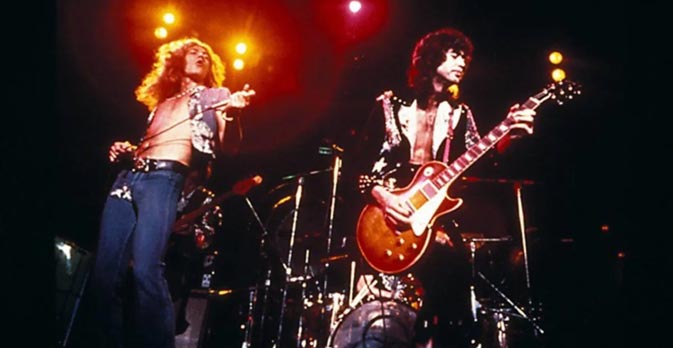
July 5, 1971 was supposed to be a historic evening. And indeed it became one, but for the wrong reasons. Led Zeppelin's only Italian concert, at the Velodromo Vigorelli in Milan, went down in history as one of the most sensational disasters of live music in our country. A story so emblematic that it inspired an entire book, “Led Zeppelin '71” by Giovanni Rossi, which reconstructs in detail a night that has become one of the negative legends of rock.
The presence of the English band was inserted in the context of the Cantagiro-Cantamondo, an event that brought together very different artists. In fact, Gianni Morandi, Lucio Dalla, the Ricchi e Poveri and other protagonists of Italian song were also expected on the same stage, alongside the group that at that moment represented the most powerful and noisy avant-garde of international rock. A mixture that proved explosive. On the one hand, in fact, there were families with children and regular spectators of the summer events. On the other, thousands of young people arrived from all over Italy to see Jimmy Page, Robert Plant, John Paul Jones and John Bonham. The organizers were advised against mixing such different audiences, but the warnings were ignored.
Over the course of the evening the tension progressively rose. The artists who took turns on stage were greeted by boos and protests. Outside the Vigorelli, groups of authors formed, young people who claimed free access to concerts, together with militants from the far extra-parliamentary left and simply curious people attracted by the growing chaos. Attempts to force entry began, while the police deployed vans and police units.
When Led Zeppelin decided to go on stage, the situation was already about to escalate. According to tour manager Richard Cole, the decision was made on impulse: “The atmosphere was too agitated, so we said: We're not going to wait here all night for you Italians in the middle of this mess! Let's start when we feel like it!”. So at 10.40pm, more than an hour earlier than the scheduled setlist, the group made its entrance on stage. A surreal scenario appeared before the musicians' eyes. In the stands, many families were trying to leave the velodrome to escape the clashes and tear gas. On the lawn, however, thousands of kids had poured under the stage.
Pierangelo Corti, one of the fans present that evening, remembered: “Inside, the people who wanted Led Zeppelin began to complain, those who went on stage were hit with beer cans and everything that could be thrown at them, so they let Led Zeppelin out early to calm the people down a bit.” According to the organizers' estimates, over 15,000 people were present inside the Vigorelli. Sirens, chants, explosions, smoke bombs and temperatures above thirty degrees contributed to creating an unreal atmosphere.
When Jimmy Page attacked the riff of “Immigrant Song”, the Vigorelli turned into bedlam. The Milanese newspaper Il Giorno described that moment as a “wild scream”. It was the beginning of a performance which, from a musical point of view, left an indelible impression on those who managed to witness it. Opening with “Immigrant Song,” a quote from The Yardbirds' “Mr. You're A Better Man Than I” followed, a bridge to Page's past. Then came two more classics such as “Heartbreaker” and “Since I've Been Loving You”, greeted with irrepressible enthusiasm.
Many witnesses – cited by Rossi in his book – above all remember the volume of the sound system. “There was this huge mass of sound coming out of the side speakers,” Corti said. “We were bombarded by this sound, and it was exactly what we were waiting for. The sound is their image.”
Robert Plant, however, immediately noticed that something was wrong. In an interview a few weeks later he recalled: “We had heard rumors of bottles being thrown on stage in Rome, but, we were assured, that would not be the case for us. So we start playing in this cycling arena, with people who had continued to protest during all the previous performances and, as soon as we enter the stage, I notice smoke coming from the back of the arena… and there was still smoke, and there was a fireman behind us and I was saying 'Fire! Fire!', but… nothing to do, he ignored me.”
Meanwhile the situation rapidly deteriorated. Some spectators lit bonfires near the stage. If the fire had spread to the wooden structure of the track or stage, the Vigorelli could have turned into a trap for thousands of people. Outside, clashes between protesters and law enforcement intensified. The police began to throw tear gas canisters which also ended up inside the plant.
One of the witnesses cited in Rossi's volume, Enzo Gullino, recalls: “The riots had started outside, because we were calm inside. After a while we started to worry, because we could hear the sound of sirens from outside and we couldn't understand if they were those of the police or ambulances. Then all of a sudden we saw the smoke bombs falling into the Vigorelli. I don't think anyone makes a mistake by throwing a smoke bomb into a stadium, you have to aim for it!”.
Plant tried several times to stay calm. “Keep quiet, keep cool, please”, he repeated from the stage. At another moment he even tried to joke: “Blow with me, so we'll make the gas disappear!”.
After the first songs, the group presented “Black Dog”, still unreleased and destined to appear a few months later in “Led Zeppelin IV”. But the concert was now compromised. Tear gas continued to invade the velodrome, the public was pushed back and forth by the crowd and many spectators desperately tried to move away from the areas most exposed to the smoke. Plant himself struggled to continue. Jimmy Page was crying visibly, while the singer was forced to stop due to coughing. At one point the performance was suspended for about ten minutes. Organizers insisted that the band return to the stage, fearing that a permanent cancellation could lead to even more serious unrest.
But it was now too late. After about twenty minutes of music in total, the concert was definitively interrupted.
The following day interpretations of the facts split along political and ideological lines. Some newspapers attributed responsibility to the protesters, others accused the police of having aggravated the situation with an indiscriminate use of tear gas. Some witnesses even claimed to have seen officers fire the canisters at eye level towards the public.
Beyond the controversy, one consequence was immediately clear to everyone: Italy emerged from that evening with a heavily compromised reputation in the eyes of international promoters. Similar episodes would also accompany concerts by Genesis, Santana and other foreign artists in the following years, consolidating the image of an unreliable country for hosting large rock events.
For Led Zeppelin the conclusion was even clearer. Despite the widespread success of the English band in the Seventies, Robert Plant, Jimmy Page, John Paul Jones and John Bonham never returned to perform in Italy. Vigorelli's performance thus remained the group's first and last Italian appearance: around twenty minutes of music, four songs and an unreleased song, suffocated by tear gas, fires and clashes. One of the most controversial pages in the history of rock in Italy.
Antonio Santini for SANREMO.FM