
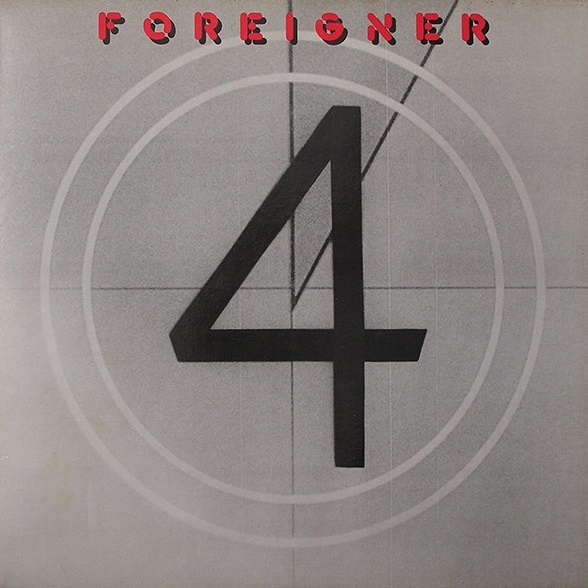
It is curious to note that Foreigner, one of the symbolic bands of American arena rock, is actually made up mostly of British musicians. Born in 1976 as a sextet, in 1980 they decided to thin out the lineup, without replacing two resigning members (keyboardist Al Greenwood and multi-instrumentalist Ian McDonald, former founder of King Crimson).
In this new phase, only singer Lou Gramm is an American citizen, while the other three are all names with long experiences in the British rock circuit: the founder, main songwriter and guitarist Mick Jones was a member of Spooky Tooth, drummer Dennis Elliott of If, and bassist Rick Willis of Cochise.
For the new project the band decides to rely on the production of the South African Mutt Lange, who has just edited “Back In Black” by Ac/Dc, the greatest commercial success in the history of hard rock, and has distinguished himself for his ability to launch bands with sounds that are very distant from each other, such as Bob Geldof's Boomtown Rats, standard bearers of the first new wave, and City Boy, with their prog-spiced arena rock.
The formation is now without a keyboard player, and although Jones knows how to recycle himself in this role, the figure of an expert who knows how to bring out the maximum potential from the rock instrumentation sector which at that moment is undergoing the most important technological revolution is missing. Lange then remembers Thomas Dolby, a boy who sent a demo to his London agency, Zomba, and who impressed him with the sounds he proved capable of extracting from the cheapest synthesizers (Dolby's own famous anecdote, according to which he learned to play with a Powertran Transcendent 2000 found in the waste bin of an electronics shop).
Lange thus has him summoned to New York, where the new album is being recorded: Dolby, when he hears the name Mick Jones, is convinced it is the Clash, of whom he is a fan. However, he doesn't know Foreigner, who had already had three multimillion-selling albums in the United States, but had never taken root in a United Kingdom that was still partially allergic to the sounds of arena rock.
In any case, there is no time to be disappointed, since from one day to the next the young musician finds himself with the largest catalog of synthesizers he could wish for. For the album in question he uses Minimoog, Roland Jupiter-4, Prophet-5 and an Oberheim, but he doesn't remember the exact model.
The album has already been recorded almost entirely, including keyboards, but Jones and Lange are not satisfied with the result and ask him to add them as desired for the entire album, in particular to reinvigorate the rhythmic pulsation of “Urgent” and to create an introduction to the ballad “Waiting For A Girl Like You”.
Dolby recorded almost all of his parts at night, in the absence of the band, who however constantly promoted the results, Jones in particular. Once his work was finished he returned to England and his work as a session musician was paid so handsomely that it constituted the main source of financing for his debut album, “The Golden Age Of Wireless”, which was released the following year.
Returning to Foreigner, the album was released on 2 July 1981 and achieved immediate success: it became their first album to reach number 1 in the Billboard charts, which it maintained for ten weeks, remaining in the top 10 for eight months. Among the singles, “Urgent” (number 4), “Waiting For A Girl Like You” (number 2) and “Juke Box Hero” (which initially stopped at number 26, but remained among their best-known songs over time) stand out. It also becomes the album that finally launches them onto the European market, reaching number 5 in the UK and number 4 in Germany.
The initial hard rock of “Night Life” immediately shows Lange's hand, just think of how similar it sounds to Def Leppard's “Let It Go”, from the “High 'N' Dry” album, which he would begin directing at the end of the Foreigner sessions.
“Juke Box Hero” was born from the union of two drafts of songs that Jones had developed and which were joined at the suggestion of Lange, perhaps also for this reason it has a much more complex structure than its catchiness makes it appear: just think of the verse, which begins mysterious and dark, guided by the bass and an electronic pulsation, and then takes off into a hard rock ride, returns to the initial atmosphere, and takes off again by modifying the melody and vocal harmonies, until it creates a sort of pre-chorus, and finally returning in the form of short fragments intersected right at the chorus itself.
“Break It Up” is a midtempo hard rock which in the attack of the rhythm section seems to refer to the classic “Cold As Ice”, from their debut album, but shows its character thanks to a chorus propelled by a synthesizer ostinato and a melancholic bridge marked by digital piano and a small sequenced embroidery mixed in the background.
“Waiting For A Girl Like You” is another song whose originality risks being overshadowed by media overexposure. The introduction of ambient keyboards that flows into an FM radio ballad was already quite ambitious in itself, but even more notable is the fact that the song never reaches a climax, remaining calm from start to finish following the chords of the electric piano, the reflections of the synthesizers, the ethereal vocal harmonies and the linear drums, which seems to avoid surges for fear of breaking the enchantment. The elephantiasis of many power ballads that in the years to come will infest arena rock, decreeing its artistic decline, is thus masterfully avoided.
“Luanne” also shows itself to be unexpectedly delicate and with its adolescent atmosphere it comes close to the Cars of “My Best Friend's Girl”, showing a band capable of covering a decidedly wider emotional and stylistic spectrum than is usually described.
“Urgent” is the perfect marriage between arena rock ride and electronic new wave, with the arrangement propelled by a twang of guitar effected with delayBass slappedand a synthesizer part built from a sort of syncopated echo (which also undergoes notable variations over the course of the piece). From 2'38″ to 3'28″ there is also space for a sax solo played by Junior Walker, the legendary Motown musician, who pairs perfectly with the gritty voice of Gramm, one of the singers most influenced by rhythm and blues in his field.
If “I'm Gonna Win” is a massive midtempo that seems to hypothesize a soul response to the contemporary Ac/Dc, “Woman In Black” is still a hard rock with a multifaceted structure, with an atmospheric introduction for guitar and sequenceras well as some of the most complex vocal harmonies in the setlist.
“Girl On The Moon” moves between electronic carpets and guitar refractions that get lost in the meanders of the mixing, resulting in the darkest song on the album, a sort of noir reversal of “Waiting For A Girl Like You”.
The closing is entrusted to “Don't Let Go”, in which the vocal harmonies even refer to sunshine pop of the Sixties (Beach Boys, Association and surrounding areas), thus fading into the sign of melancholy and nostalgia.
“4” is the album that seals Jones among the best songwriters in his field and a triumph of attention to detail. Foreigner would only return in 1984, with “Agent Provocateur”, which, although graced by the enormous success of the melancholy single “I Want To Know What Love Is”, would sell significantly less, and above all would damage the relationships within the band (not surprisingly, the releases would become rarer from then on).
Curiosity: the cover should have been designed by the Hipgnosis studio, which proposed the image of a sleeping boy spied on by floating binoculars. It would have been one of their best, if Atlantic and Bud Prager, the band's manager, hadn't gotten in the way, considering it “too gay”. In the end the album will be released with a cover signed by Bob Defrin, which reproduced a still image of a countdown on cinematographic film: decidedly less ambitious, however elegant in its cleanliness.
06/22/2026
Daniel D`Amico for SANREMO.FM