
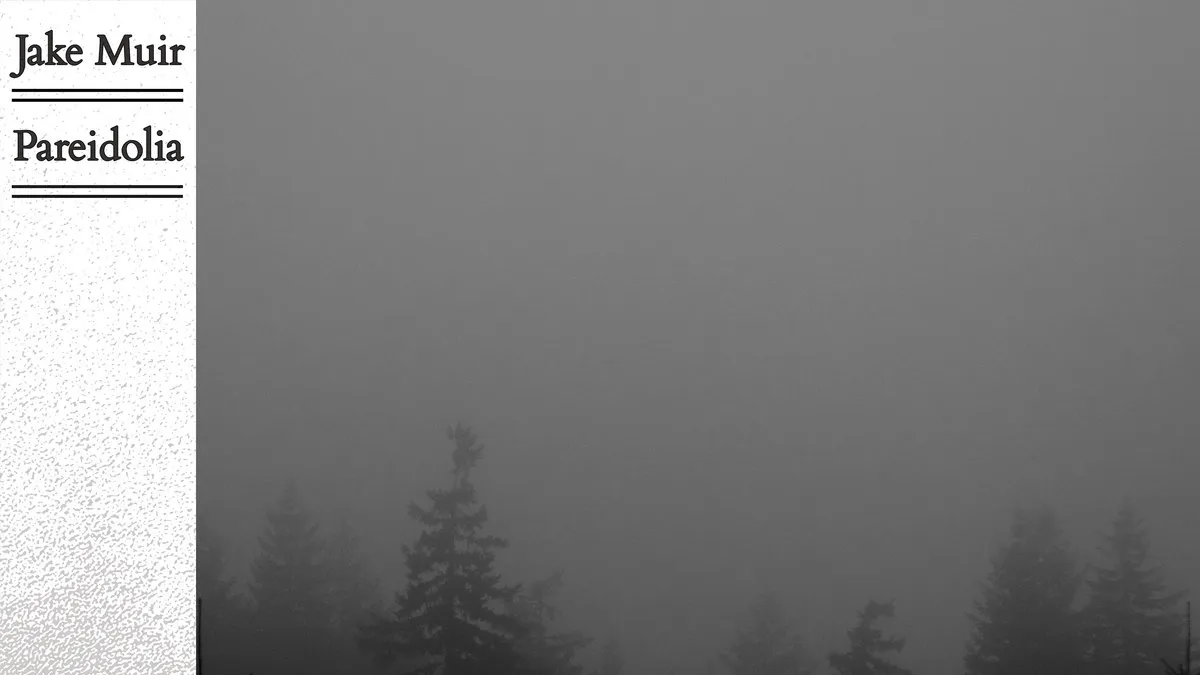
The ambient producer Jake Muir has a gift for hearing depth in sounds that might otherwise be deemed forgettable. The omnipresent church bells that fade into the background of European city life became the focal point of Campana Sonans, his brilliant album of manipulated field recordings from Berlin. On Bathhouse Blues, he sampled incidental music from vintage gay porn films, finding a dark pulse wriggling beneath their surface eroticism. Muir’s latest album, Pareidolia, mines the oft-overlooked intros, outros, and interludes of hundreds of extreme metal albums for raw material, reshaping them into a menacing, inscrutable, richly textured collage. There’s no actual metal on Pareidolia, just fragments that Muir has excavated from metal’s marginalia and spun into what resembles a kaleidoscope filled with black beads.
The atmospheric interstitials that Muir deconstructs on Pareidolia are a time-honored (if often unloved) metal tradition. When done carelessly, a minute-long intro of canned thunderstorm noises becomes an instant skip. When done well, those moments can be as important to the world of an album as the riffs and blast beats. It’s impossible to imagine Celtic Frost’s To Mega Therion shorn of the Wagnerian brass of “Innocence and Wrath”; Bathory famously tacked slight variations of “The Winds of Mayhem (Outro)” onto the reissues of each of their albums, to illuminating effect. Other bands have used interstitials to show off their taste in non-metal music, as Mayhem did when they opened Deathcrush with “Silvester Anfang,” the Conrad Schnitzler instrumental that has been piped into nearly every concert they’ve ever played. Still, those are the exceptions. The rule is a chintzy keyboard line and some haunted-house sounds. As he did on his past projects, Muir insists that even those uncelebrated moments are worth a closer listen.
No score yet, be the first to add.
Pareidolia opens in medias res, with the first strains of “Beithir” emerging out of a mist of whirring, anxious noise with no clear source. Muir sampled guitars, synths, vocals, percussion, and sound effects for the record, but they’re manipulated beyond recognition, transformed into skeins of distortion that he shapes to each piece’s needs. (He revealed some of the source artists in an interview, but I certainly couldn’t connect any dots.) On “Beithir,” the main bed of drones might be built out of slowed-down voice; the gonging, atonal notes might be resampled guitar; and the distant percussion might be hyper-processed rain sounds; but that could all be totally wrong, and anyway, it doesn’t really matter. What matters is the atmosphere Muir creates, which is as dark and ominous as that of any black-metal record, and even more unsettling for its alienness. On a metal album, even the ugliest sounds tend to have some earthly referent. Muir’s transformations celebrate artifice.
Despite the album’s explicitly metallic architecture, the artist that Pareidolia most closely recalls is dark-ambient pioneer Lustmord. Like Muir, Lustmord’s Brian Williams creates harrowing, light-devouring music by digitally manipulating a vast library of sounds he’s collected via sampling and field recording. Both artists push back on the stereotype of ambient music as something that’s necessarily meditative or pleasant. (Williams bristles at the idea that his music is ambient at all.) Traces of the metalhead-friendly cosmic soundscapes of Lustmord’s Heresy and The Place Where the Black Stars Hang echo through Pareidolia, especially on the slow-throbbing electro-doom tracks “Oblivion” and “Anima,” which seem to unfold against a backdrop of deep time.
