
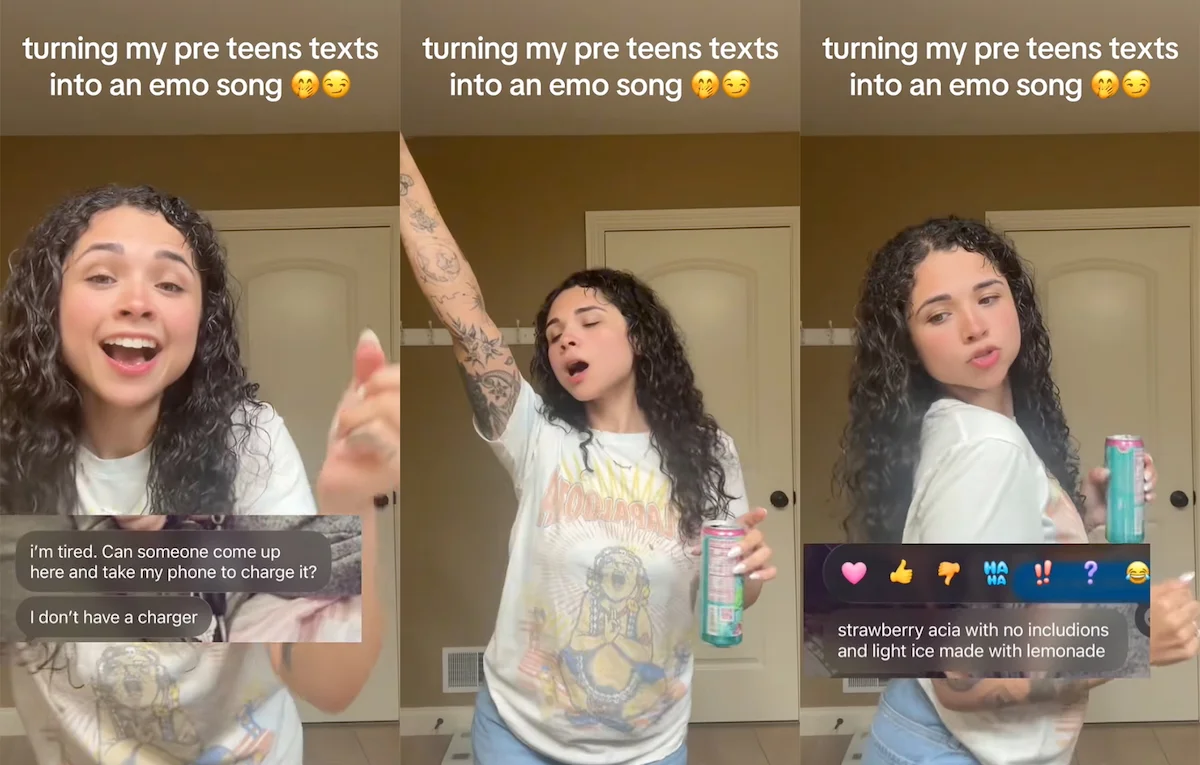
Justice Washam is 30 years old, a travel agent, lives in Illinois, has three children and creates travel and parenting-themed content on TikTok. Despite having 250 thousand followers, until the beginning of April he had not earned much from the platform. Her goal of reaching one million followers by the end of 2026 seemed decidedly unrealistic until a friend sent her a TikTok in which screenshots of some messages received on her phone had been transformed into the lyrics of an AI-generated song.
“Your daughter's messages are perfect for this trend,” the friend told him. Washam did, collecting messages in which her 11-year-old daughter asked for Starbucks drinks (“strawberry acai with no inclusions and light ice made with lemonade”), permission to open a social media account (“all I want for Christmas is Snapchat”) and other preteen things (“Mom, I don't know what to do with my hair, Mom, why don't you reply?”). She downloaded Suno, pasted her daughter's words and asked to generate a song in the style of Avril Lavigne from the early 2000s because “when I was her age that type of pop-punk was very strong”.
He chose the first version generated by the app and shot the video while dancing and singing the lyrics. After making sure her daughter agreed, she posted and went to sleep. When she woke up the next morning the video had reached one million views. Five weeks later it reached nearly 10 million and Washam gained 200,000 new followers.
@justicetheexplorer My 11 year old daughter is literally an ICON #preteen #kids #mom #music #parenting ♬ original sound – Justice Washam
It's one of TikTok's musical trends: friends, relatives, acquaintances and (sometimes) enemies transform chat texts into songs generated by artificial intelligence. It's a perfect trend for Suno, which in this period has to deal with the legal battle initiated by two major record companies for the way in which its model was trained and is looked at with suspicion by large sections of the music industry. What if instead of replacing musicians and producers, music-generating AI tools became a kind of Snapchat filter?
Some of the songs created this way even have a therapeutic effect, like the one about a woman who turned the guy's texts asking her to reimburse him for dinner and the Uber because she didn't go home to his house into a Broadway-style song (a cappella interlude: “142 dollars and 18 cents, to be exact”). There has even been a subgenre of songs built around Slack messages from annoying bosses (pop-rock singer AI: “I need it by the end of the day / I know it's 4.47pm”) and there are plenty of emo songs built around messages from kids to their parents. After a piece similar to hers went viral, Washam commented: “Wow, our daughters look so much alike… except she doesn't have a daughter.”
One of the many viral pieces is based on the exchange of messages between two friends: one of the two is stuck in a man's bedroom while his partner is returning home. His all-caps “HELP HELP HELP” transforms into an almost operatic gospel crescendo. The video has totaled 23 million views and the song has become the soundtrack to over 28 thousand other videos.
Thanks to this trend sometimes accompanied by the hashtags #texttosong and #textmessage, in April alone Suno downloads in the United States quadrupled week on week, making it temporarily the most downloaded music app on the Apple store in the United States and the United Kingdom. To further fuel the phenomenon, the Suno team developed a new feature that partially automates the transformation of screenshots into songs. “We built it within a week,” explains Jack Brody, Suno's Chief Product Officer. According to him, the trend shows that AI can pave the way for new forms of creativity. «We've seen it happen in other areas. Since everyone has a camera on their phone, new applications have been created for photography and videos, short content, tutorials, livestreams.”
@space_frogz DEEEEJAAAAHHHHHHH!!!! 🤣🤣 #VIRAL #TRENDING @a3r1n #helphelphelp ♬ original sound – LollyPoppin
Olivia Jones, analyst at MiDia, a music and entertainment research company, calls consumer creator the emerging category of users who use music generation tools like Suno, a category obviously distinct from the traditional ones of musicians and producers. According to Jones, consumer creators “may not have any intention of entering the world of music, they use these tools as a way to express their creativity, as a hobby.”
According to Brody, hobbyists and musicians are destined to coexist. With the advent of cell phone videos, he says, «Hollywood blockbusters still exist, just as movie photographers continue to exist. National Geographic». According to Jones, even if consumer creators are not and do not consider themselves professional musicians, they will inevitably end up competing with them. It cites research showing that people who use AI tools for voice and music “often tend to engage more with fan-made versions of a certain content than with the original content.” For example, he explains, people can “create songs about a TV series they love, then listen to the songs created by others and remix them, entering a circle that continues even when they perhaps no longer watch the series”.
Translated into music industry terms: TikTok has become one of the most important ways to discover artists' music, but if the music that people discover and share on TikTok is increasingly user-generated thanks to AI – like the song about the girl hiding from her jealous girlfriend – what will happen to real artists? “There will be more and more competition for users' time,” Jones says. «It won't be something like: everyone creates and no one watches anything anymore. There will be a gradual change.”
Some creators leading the text-to-song trend have already published their songs on Spotify, despite there being open questions about the copyright of music generated with Suno. Washam didn't. “I don't know if I want people listening to my 11-year-old daughter ask about Starbucks and Snapchat in the car,” she says, laughing. “I didn't think it could become anything more than just a TikTok game.”
For her, however, TikTok has become much more profitable. Because AI songs are longer than his usual posts, Washam now earns more than ever from the platform's advertising revenue (in general, content must exceed one minute to be monetized). In the last month he has earned about $4,000. He calls them “my five minutes of fame” and says that “in a few years we'll all be saying: do you remember when people made songs with messages?”.
The trend will pass, but it's likely that non-musicians will eventually find other ways to create and use music with AI. A recent example: On May 20, the day Meta laid off 8,000 employees, a worker used AI tools to launch a 24-hour Internet radio with songs like Meta Layoff Frank Ocean style and folkish Missing the People. As Washam says, “I don't think music made with AI will disappear.”
From Rolling Stone US.