
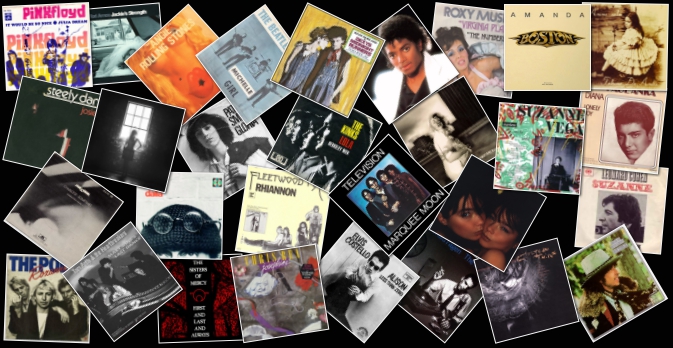
One hundred songs for one hundred women's names. Behind each of them a story, a mystery, a love (often only dreamed or finished). To celebrate March 8th, we thought we'd collect them all in an “open” mega-playlist (in the sense that it can continue to be integrated thanks to your suggestions). These hundred woman's recipesto put it with the late Ornella Vanoni, are just a mirror – sometimes even a little distorted from the male perspective – of a female universe which has been told in music in the most varied and disparate ways.
Many of these hundred women are unknown or mysterious figures: from the dark “Amelia” by the Cocteau Twins to the gothic “Dulcinea” by Black Tape, from the futurist “Venusia” by the Klaxons to the lugubrious “Marian” by the Sisters Of Mercy, from the enigmatic “Suzanne” by Leonard Cohen, which combines dreamlike and biblical elements with sensual impulses, up to the fascinating Rio of Duran Duran who dances on the sand evoking vibrations brazilian. Other times they are mythological or legendary figures (Dead Can Dance's Persephone, Natalie Merchant's Ophelia, the Welsh legend of Rhiannon revived by Fleetwood Mac, Television's Venus, cited through the famous Greek sculpture of the Venus de Milo, the cheerful Cecilia, personification of music, addressed by Simon & Garfunkel), if not history – the Jackie evoked by Tori Amos, for example, is none other than Jacqueline Kennedy (“Jackie's Strength”) – or of the show, as in the case of a young Carole King to whom Neil Sedaka dedicated his “Oh! Carol”, of the model Edie Sedgwick to whom the “Edie” of the Cult is addressed or of the diva Bette Davis celebrated by Kim Carnes in “Bette Davis Eyes” (but not of Rosanna Arquette, to whom, contrary to common opinion, “Rosanna” by Toto is not dedicated, although at the time she was the partner of keyboardist Steve Porcaro).
But most of the protagonists of these songs are ordinary people – wives, ex-girlfriends, occasional and fleeting lovers – or purely imaginary figures, born from the fervent minds of the authors.
To the “wives” category we can certainly ascribe what remains perhaps the most beautiful song written by one of them: the intimate and poignant “Sara” by Bob Dylan, with its load of memories and regrets. In that of lovers, one of the most famous is undoubtedly Eric Clapton's “Layla”, heroine of the Middle Eastern epic behind whom Pattie Boyd, at the time wife of her friend George Harrison, hid. However, as is commonly believed, it is not Angela “Bowie” Barnett who hides behind the “Angie” of the Rolling Stones (nor even the actress Angie Dickinson). And speaking of David Bowie: we enjoyed retrieving his naive “Letter To Hermione” (1969), addressed to his partner at the time with whom he also spent three months of monastic isolation with four Tibetan lamas in Scotland (!). “Maggie May” instead tells us about the daring sexual initiation of a young Rod Stewart.
In many cases they are dreamed and mythologized creatures: the dreamlike Julia of a young Roger Waters (“Julia Dream” by Pink Floyd), the “Amanda” longed for by the impatient Bostonians (“tomorrow may be too late”), the “Candy-O” with the ruby ring of the Cars, the English provincial heroine Eileen of Dexy's Midnight Runners, the sensual “Valentine” of Bryan Ferry, the “Michelle” of the Beatles, condensed of charm French from Nouvelle Vague, Donald Fagen's “Maxine” with which to travel between Mexico City and Manhattan, the melancholic “Renee” of Talk Talk, the romantic “Josephine” to whom the late Chris Rea directed all his love, the sweet “Alison” who made Elvis Costello swear “my aim is true”. Or even literary figures, as in the case of the Cure's “Charlotte Sometimes”, inspired by the novel of the same name by Penelope Farmer.
In other cases they are slightly more prosaic characters, such as the Parisian prostitute “Roxanne” iconized by the Police, the punk-rocker Sheena of the Ramones, the groupie Sharona, made immortal by riff of The Knack, the stalker Billie Jean, portrayed by an exasperated Michael Jackson, and the nonchalant Josie of Steely Dan, who has become “the pride of the neighborhood”.
It's not just men who turn to women (see Patti Smith with “Gloria”, Suzanne Vega with “Marlene On The Wall”, Bjork with “Isobel”, Marissa Nadler with “Dead City Emily” etc.) and there's also a transgender ode (the famous “Lola” by the Kinks). The only rule we have set ourselves – mostly to limit the selection – is to choose only one song for each female name. And there is also a small Italian chapter, which ranges from some classics of the “genre” (the epic “Margherita” by Riccardo Cocciante, the very sweet “Agnese” by Ivan Graziani, the lacerating “Lilly” by Antonello Venditti) to lesser-known gems, such as “Anna di Francia” by Claudio Lolli and “I saw Nina fly” by Fabrizio De André, as well as that affectionate ode by Francesco De Gregori dedicated to his muse Caterina Bueno (“Caterina”) and to the poignant letter that Lucio Dalla addressed to a woman who had yet to be born, named “Futura”.
But now all that remains is to take some time and listen to them all, these one hundred “In The Name Of The Women” songs. To make International Women's Day a little less empty and rhetorical than many make it appear.
Antonio Santini for SANREMO.FM