Once upon a time it was the city: Detroit, London, Bristol, Berlin. The right club, the record store, the pirate radio, a group of people from the same neighborhood. Then a story was born to tell. Today we are hyperconnected, but not necessarily closer. A scene can be born even without ever actually meeting: it can be on SoundCloud, starting from a radio show, a Telegram channel, from a sample sent via DM on Instagram at 4 in the morning.
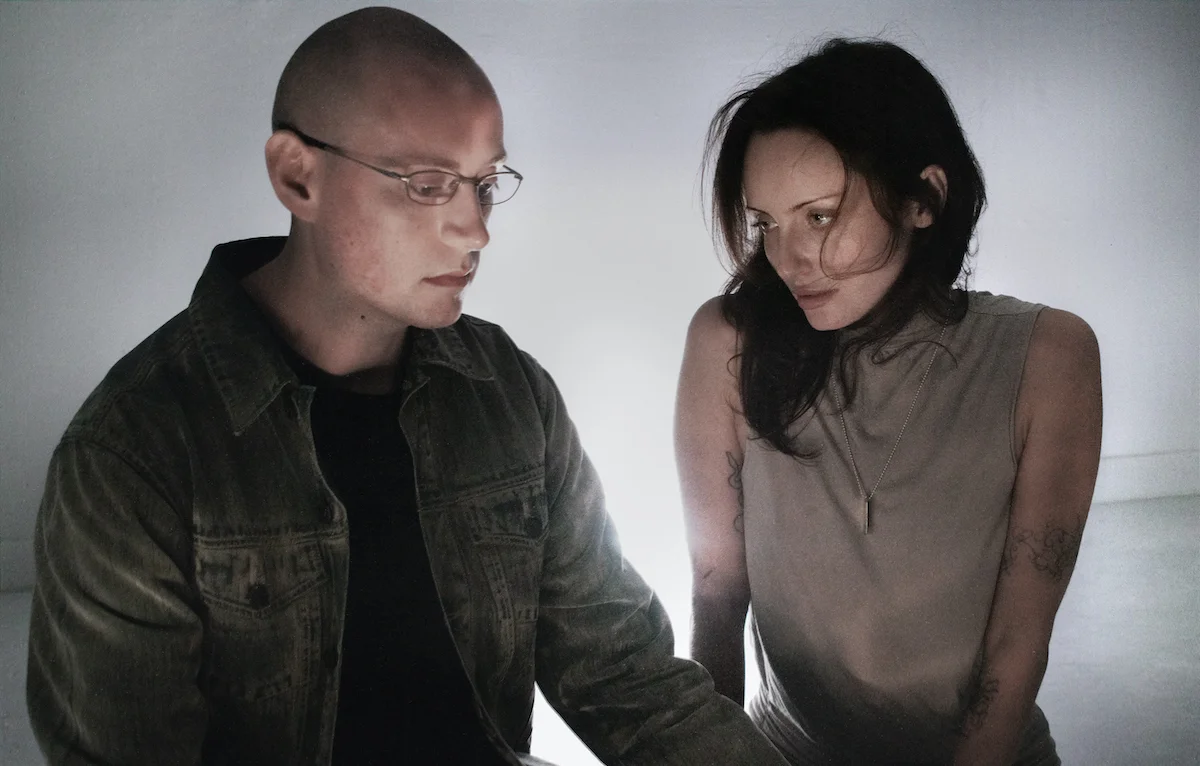
Yawning Portal, a London duo formed by Jess Mai Walker and Joseph Ware, are a good starting point to understand this type of post-real scenario. They make pop that doesn't really want to be pop, ambient that seems to remember having a body, club music that doesn't necessarily have to end in a drop, voices that come in and out like ghostly apparitions. In short, that area there. Calling it experimental electronic would be convenient, but the truth is that the duo's music tries to voluntarily escape from a rigid or sanctimonious definition.
On July 3rd they will bring Anywhere – Extendedthe live dimension of their debut album, at the LOST Music Festival, which returns from 3 to 5 July and as usual at the Labirinto della Masone, just outside Parma (also in the line-up are Debit, KeiyaA, Ulla, Saint Abdullah & Eomac, Jabu, Foodman). The labyrinth, it must be said, seems like the perfect metaphorical context for them: a live show made up of deviations, open versions and pieces that change shape in a place built specifically to get lost.
We interviewed them before their arrival in Italy, starting right from the initial image: what remains of a music scene when it no longer has a precise address? “I think our music doesn't physically exist in one place,” Ware says. «It's more something that is born and exists on the Internet». The scene in the classic sense, however, has not disappeared: it has just stopped inhabiting a real place. As Ware adds: “On a physical level it can all feel very isolated. Then you go on tour, play with someone who does something similar, suddenly you realize that that thing was already there somewhere. Except he didn't live in a concrete room yet.”
Walker talks about «inter-referencing continuous: artists who share references, quote each other, sample each other, pass on materials without needing to write a manifesto.” And he calls it “unintentional world building”, an involuntary construction of worlds. At a certain point the comparison they make is with J Dilla: not so much, obviously, for a direct sonic similarity, but for that way of citing collaborators, friends, close references, to the point of transforming a network of exchanges into a recognizable sound.
It comes from there Anywheretheir debut for YEAR0001, a Swedish label and creative studio closer to an incubator of independent projects than to an old-fashioned record company. It's not an album that suddenly arrived to bring order to a series of scattered releases: they had been working on it for about three years, after a first EP released five years ago now. A long, fluid album, conceived more as a continuous mix than as a collection of songs (their program on NTS Radio, Under Sleepy Moonit works with the same creative approach).
«We have always worked with this idea of long continuous mix. It made perfect sense to think of our first album the same way.” The result is a record that is not very friendly to the single form, and even less so to the spotification of listening: each song should stand on its own, work immediately and possibly not ask for too much attention. Walker doesn't beat around the bush too much: «Yes, most of the album is decidedly and deliberately anti-single in format, but that's the nature of the project». Then the singles came out anyway, because even the music that tries to deviate has to sit down, smile and take the usual photo. But then it certainly goes elsewhere.
And unlike the compulsive scrolling we are used to even during music enjoyment, Anywhere It really works when you listen to it in full. The songs don't stay still in their place: a voice reappears, a texture survives as long as it decides, a trance impulse dissolves into ambient and then returns later, changed. The point is not just the peaks, but the transitions. That is, that part of the music that algorithmic listening tends to treat as the corridor between two more important rooms. Here, however, the corridor is often the room. Then the comparison with the IDM of the 90s or the braindance: recognizable materials, often from the track, moved to a more oblique area, for careful listening rather than immediate use. Not Warp nostalgia, but continuity of method: taking a common language and sabotaging it. As long as it becomes personal.
Part of the album also arises from a real distance: Walker lived for a period in the Midwest of the United States, while Ware remained in London. During the Covid-era, he often traveled by car to listen to music, he imagined a long journey and his soundtrack accompanying those paranormal moments. Anywhere however, it is not their “isolation album” but more the story of what happens when you are between different places and no one seems really definitive (anywhereprecisely). Once In Iowaonce In Orionreal coordinates move inside, invented, terrestrial or not, it doesn't matter, surprise incursions by other actors (Oli XL and Innerinnerlife, in Silver Plated and Eternity Sunrise). Sound seems to think in terms of movements rather than destinations, in that brain area where the journey matters more than the arrival.
The references are there and are not hidden: PC Music, Sophie, AG Cook, Elysia Crampton, even Massive Attack. Ware says it openly: «I think the album has a lot of references, all very obvious. And no, we don't try to hide them.” The point, however, is not to do name dropping an end in itself. It's understanding what happens when, as happens here, those references are not a mood board but become a new language.
At a certain point Walker comes up with a definition, then almost tries to take it back: post-pop. “Maybe don't put it in the title,” he says jokingly. In reality, however, it becomes a clue. It's not hyperpop, it's not PC Music ten years later, it's not the usual “deconstructed” stuff because calling it that would seem smarter. In a rather agreeable reading, Walker says that in their opinion «PC Music took pop and polished it to its brightest, most artificial, almost dazzling version. In our work the opposite happens: pop structures are made unstable, more intimate, less recognisable. But they remain emotional: it's electronic, but there's no fear of the melody.”
And then, he is keen to point out, the sonic flirtation with pop is not something ironic: «It can become a totally sincere gesture, it depends on which path you take on a sonic level», he says. In fact, the Yawning Portal do not treat it as a ruin to be looked at from the heights of a more digital research, nor as a kitsch object to be handled with pliers: they take it seriously (but then, of course, they deform it to their liking). The point is that today even saying pop means indicating something increasingly less stable: «The Internet has made it almost impossible to define. There is no longer a shared center à la Michael Jackson, but rather a constellation of niches, micro-languages.”
The same goes for the voice. In the first works, between EPs and experiments for the radio show, sampling was more evident: vocal fragments taken from elsewhere, moved, transformed. In Anywhere the human presence is closer, less phantom. It's a natural transition for a project that grew up in a culture where sampling, editing and sharing were the basic grammar. At a certain point, however, speaking through the voices of others is no longer enough.
And then the live: Anywhere – Extended it's not an elongated version of the album, nor the classic “faithful” performance: «We're using the whole album as a sample library of ourselves. Live we work on the stems, we move them, we reassemble them. An element of the second piece can end up in the eleventh, a part can change function, a passage can open up to improvisation. For us it's more fun if it's a little more free form». The short circuit is right there: if before the sample was the world around, now they themselves are.
The future, they say, could be more collaborative. Until now Yawning Portal has been a world of two, intimate and almost self-sufficient. Now there is a desire to open the room, let other people in, see what happens when that language meets different sensibilities: “Who knows, maybe we'll send something to Madonna”, they joke. It's a joke, but it explains things well: Anywhere it speaks of a generation that grew up without a stable coordinate, yet still hungry for contact, lateral exchanges, mp3s sent at unlikely times to discuss ideas, on the other side of the world. You no longer need a real point on the map.
Yawning Portal have made an album that doesn't want to work straight away, doesn't want to become moody and doesn't seem interested in being comfortable. At a time when everything must be cuttable, nameable and playlistabledoes a simple thing: it doesn't care about lasting, it changes shape, it never fully arrives. Can be Anywhere.