
I
n 1776, the notion of citizenship was a new idea. But there were now some people living on the East Coast of British North America who wanted to be citizens, not subjects, as most human beings had been throughout history. They knew that it would require self-improvement in order to earn and maintain that right. It’s the beginning of an American catechism that revolves around two ideas, utterly misunderstood for the past 250 years. One is that in order to be a citizen, to earn this extraordinary privilege, one has to be actively involved in community, in a civic dynamic. And two, that there’s also an inner dynamic that is essentially Socratic: Who am I? How do I get better? What’s my place here?
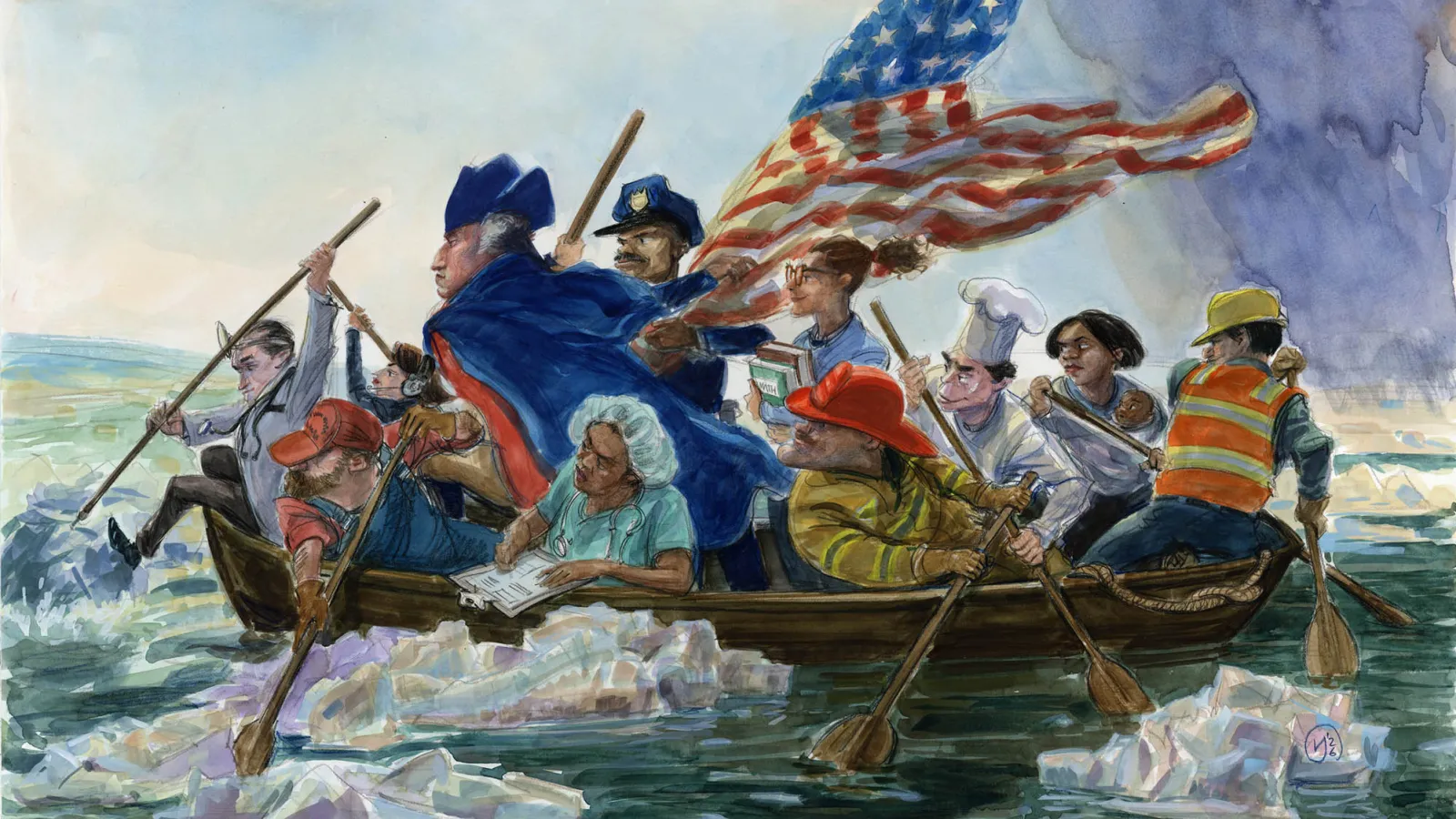
Everyone then knew, of course, that when the Founding Fathers wrote, “We hold these truths to be self-evident, that all men are created equal,” they meant all white men of property. But the aspirations of a broader notion of citizenship quickly asserted itself. The exigencies of the Revolution lead to promising more people representation. And by offering these kinds of natural rights, no matter how long it takes — four score and nine years for slavery to end, 144 years before women get the right to vote — the founders opened a door for all of the arguments, as well as aspirations, we are still having around the world today.
The American Revolution would go on to influence revolutions around the world for more than 200 years. We were the catalyst. The French, Haitian, and Russian revolutions. Revolutions in Central and South America, and then, later, Asia and Africa. They were all inspired by the idea we first articulated (however sparsely it was initially applied). When Ho Chi Minh declared Vietnamese independence on Sept. 2, 1945, the same day the Japanese surrendered on the USS Missouri in Tokyo Bay, he quoted Thomas Jefferson.
The Declaration also reads: “All experience has shown that mankind are more disposed to suffer while evils are sufferable.” At first it sounds hard to parse, but it’s easy. It means that heretofore most people have been under authoritarian rule. And to maintain and sustain a republic, it’s going to take extra energy, extra virtue, as the founders would say, at both a civic and individual level.
We should remind ourselves that those founders created a system that was malleable. The Declaration says “pursuit” of happiness. We are a nation in the process of becoming. It’s an active thing, participating in democracy, which was an unintended by-product of the Revolution.
Today, unfortunately, civics has become a dirty word. History is disappearing from school curricula. Our connection to our complicated past is being dumbed down. All of which comes with great peril for our future. If the founders returned, they would not be surprised that somebody was seeking authoritarian rule. That’s what they were reverse-engineering against. They’d be upset about Article One of the Constitution, the legislative branch abdicating its powers; that is, the people’s power to wage war and to levy tariffs. To cede all of that ground to the executive, and to do so in such an obsequious way, is shameful. The founders would be extremely disappointed.
But they’d also be pleased that we’ve gotten this far. And, after not a little bit of culture shock, they’d understand how important it was to expand the radical liberties they first proposed.
Our Latin motto is “E pluribus unum,” out of many one, which is another way to say the now-verboten phrase “DEI.” We celebrate the strength of our alloy. The journalist Pete Hamill, in our film Prohibition, reminded us that immigration creates an alloy. We’re always stronger than the base metals that are the constituent parts of it. That’s how we’ve always been. The beauty of the United States is it always gets stronger the more you let in a variety of people.
One of the great blessings of our Revolution was when citizens saw that the Articles of Confederation didn’t work, people began to participate in a conversation about a Constitution. It was the biggest civic engagement in history up to that point. And they were going to ratify that Constitution only if it came with a Bill of Rights to enshrine the things they’d fought for. At the heart of it is a lesson about civic engagement. It doesn’t mean you have to run for office. It means you just need to be involved. You can’t be a bystander.
Too many people have abdicated their collective responsibility. Authoritarians want us to be prisoners of our own ignorance. They want us distracted by conspiracies and doomscrolling. That’s not what the pursuit of happiness is. Civic engagement is the alpha and omega of citizenship. Once you’re involved in the democratic process, you can’t just say “my way or the highway.” It’s got to be a negotiation. The tension of freedom is that give and take between what “I want” and what “we all need.”
Our responsibility as citizens is simple. It’s to participate, period, to be engaged. Maybe it’s local — your school board, your selectmen, a zoning board. Vote and be educated about the issues; don’t just assume that the person on the other side is evil. That’s when you lose the ability to see who the other is. We’re always stronger as a nation when we’ve come together to do big things. I trust in the essential American idea. Do we get distracted? Yes. Do we take many steps backward? Yes. Is our next period about restoration and repair? Yes. We can and will right the ship.


KEN BURNS is a filmmaker and most recently director, with Sarah Botstein and David Schmidt, of The American Revolution.
Daniel D`Amico for SANREMO.FM