
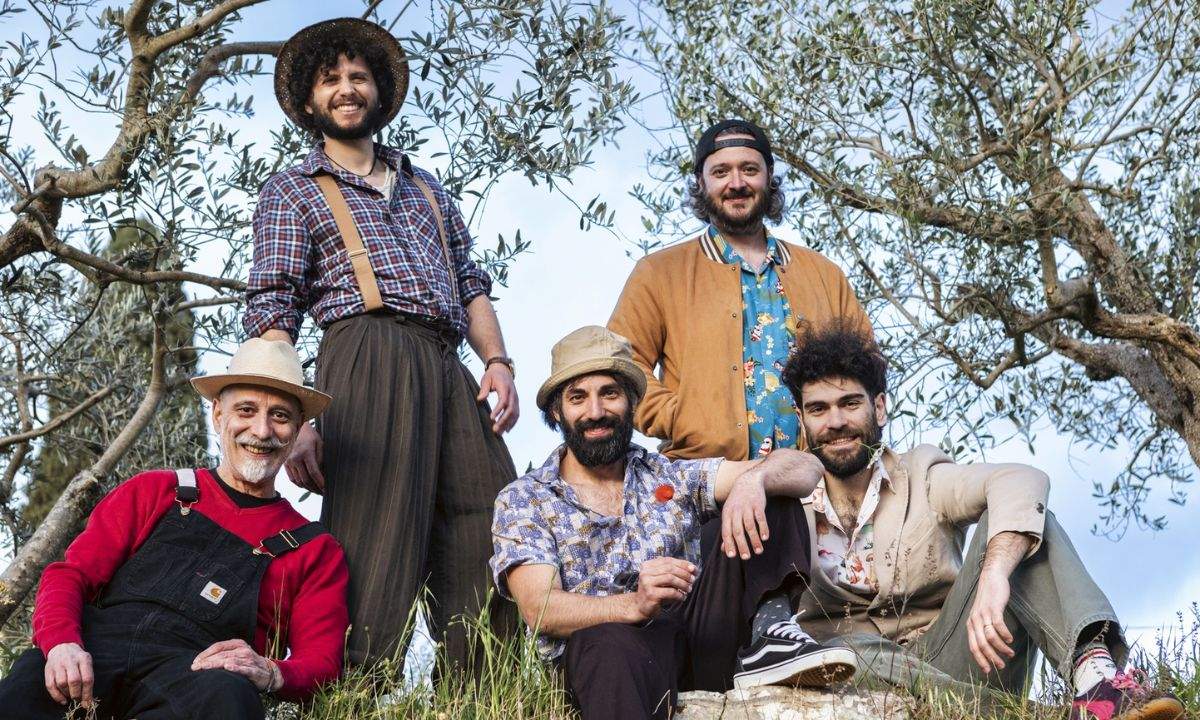
One year after the release of the EP I came from the Dungi Livestock Wagon they come back with Back when things were made to last (Maninalto): a record with which the Umbrian band perfects its sound recipe, freeing itself from those canons and preconceptions that too often relegate folk to a niche for a few enthusiasts.
“There was a time in which concreteness and care were valued, an era in which repairing an object – or a bond – was an act of respect. Today we are immersed in the disposable era, where obsolescence not only affects machines, but also desires and relationships.
This album was created to slow down. The songs are thoughts, which, shaking off the frenzy of a world that runs without looking where it is going, rise in flight above the rubble of the superfluous to take us back to the essence, to the values that we cannot afford to ignore”.
“In the time when things were made to last”: the interview with CarroBestiame
Hi guys, welcome to All Music Italia. How are you?
Hi everyone! Very good. Let's say that in this period we are really excited and eager to start the tour!
Can you tell us what lies behind your stage name: CarroBestiame?
Our name was suggested to us at the beginning – almost as a joke – and, as you can imagine, it aroused laughter and curiosity. After having it positioned correctly, we understood that it represented us a little, in the sense of “moving caravan”, and so we sewed it on ourselves.
You present yourselves as the link between the folk tradition and the more modern pop-rock. When did you first meet these two genres and what fascinated you so much that you wanted them to meet?
This conjunction is the consequence of the fusion of our personal baggage, which inevitably put itself at the service of the project, creating this style that we feel we must carry forward. We are convinced that folk, combined with the usability of pop refrains, can become a truly powerful instrument perceived on a large scale.
How much and how has your land, Umbria, influenced your project?
Umbria for us is a bit like the county for the Hobbits. It is a fantastic land where it is still possible to live in a genuine and above all slow way. Almost all of our songs are enriched by our strong tradition.
What was the creative driving force that then led to the birth of Back when things were made to last?
In a world marked by planned obsolescence, we feel we must issue a loud and clear invitation to repair. From objects to relationships, everything is now disposable, when in reality what makes everything special is precisely the time that one is able to dedicate to it.
When cornering, the bike goes where your gaze goes. In a world that runs, without looking where it is going, what direction does life take? And where is your gaze going?
Our gaze is directed towards what we like and, above all, makes us proud as artists. This for us is the real key or at least the bike. The road is the saving network that we are building, taking our music around Italy.
In Kites sing: “Peace is not possibleAnd again: “Love is now too bold a desireIn these words, at times resigned, there is still room for hope: “Tell them to tie them (the flags) and make kites with them” What was the drop that then made the ink overflow onto the white sheet?
We will certainly continue to see children and innocents continually involved in wars unleashed for dirty interests, without any loyalty. This situation has become a daily reality and, ironically, is becoming normality. We cannot afford to give in and remain helpless in the face of all this.
In The luxury of growing old “life is a privilege even in painWhat role did music play in your moments of pain?
We believe that every moment of life has a soundtrack. Music is an anchor, both alone and in company.
In this album there is a lot of introspection, hidden by a veil of irony. And here it is: “Everyone wants me in Sanremo, but I prefer to be an idiot”.
Absolutely yes. Music is becoming more and more dominated by large distributions and all this is leading to a real loss of artistic identity. The message we want to send is to return to filling the squares and festivals, where independent artists can still dream together with a real audience, the only one that is really needed!
The album ends with Son of Africa. How did the collaboration with Davide “Dudu” Morandi and Francesco “Fry” Moneti of the Modena City Ramblers come about?
The song was born from the pain of continuous abandonments at sea, from the need to denounce that, behind all the difficulties of the moment, there were still human lives fleeing from the impossibility of pursuing their dreams, as well as their own life.
In that same year we shared the stage with i Modena and from there the idea of involving them in something that they too have always strongly defended and we knew they would enrich properly was born!
From the recording studio to the stage. This album seems to have been created for live performances. What type of show will you offer to those who come to listen to you?
For us, live shows have always been the core of the project. With this work, as with the previous ones, we hope that the viewer feels involved by the contents and enraptured by the music and our energy. We really need to close the loop by merging with the audience throughout our tour!
In closing, I borrow your words and ask you to complete the sentence: In the time when things were made to last…
We were all more capable of appreciating, of being happy. Let us not lose hope in the authenticity of relationships and healthy sacrifices!
