
Back in early March at an Exxon in northern Virginia, a man at the pump beside me looks over as we wait for our tanks to fill. He gives me a cautious nod.
“Boy. High gas prices, huh?” he says, conversationally.
“Yup,” I offer in return.
“Well, it’ll go back down now that the war’s over, right?” he says. Earlier in the day, the president told CBS News that the Iran war “is very complete, pretty much,” and news organizations are running with the comment in their headlines.
“If you say so,” I reply, keeping my voice neutral.
“You don’t think so, huh?” This time he answers with a wry smile, as if encouraging me to take a stand: Plant your flag! Declare your tribe! Whose side are you on?
I give my best Gallic shrug, well past the requisite amount of life experience required to see the downsides of engaging in a politically charged debate with a stranger at a gas station.
The exit strategy for unwanted conversation is simple: Disengage and depart.
The exit strategy for unwanted conflicts is the same. Ask Ronald Reagan.
Anyways. The stranger and I both paid $3.59 a gallon for regular that day at the pump, according to my receipt. Gas at that same Exxon is now $4.09 a gallon.
I’m not, of course, psychic. I was speaking regularly to regional experts, commodities traders, and a variety of other sources. None of them thought this thing was anywhere close to being resolved. None of them think so today, either.
In the five months since that random encounter, we’ve been reliably informed dozens of times that the war has ended.
Every week or so, President Donald J. Trump pretends he’s once again found a way to end the Iran war with an American victory.
Every week or so when the war ends, Trump’s Cabinet members gather around him and smile at the cameras. The chief executive of the world’s most powerful country then closes his eyes to reveal the reverse-racoon of a spray-tanned face, which bobs gently heavenward as he slips into the fairyland of dreams.
Every week or so when the war ends, legions of pseudonymous social media accounts praise the president’s genius in starting the war, the raw courage it took to defeat this foe — who, if left unchecked, would most assuredly be dropping nukes on the Great Satan, obliterating its people and its freedom and its Chick-fil-As. Iran is very evil, they say, and if you don’t agree America has utterly defeated it, then you must like evil.
Every week or so when the war ends, Secretary of Defense Pete Hegseth yells at an assemblage of reporters, berating them for insufficiently loving the troops, because they ask questions about what’s happening.
Questions such as, “Why are there insufficient air- and missile-defenses at U.S. facilities in the region?” or, “How many troops have been killed or wounded so far?” or, “Why are American servicemembers dying in a war the president says we’ve already won?”
That last one causes the brains of administration-friendly talking heads to short-circuit, a logic error frying their motherboards.
“I don’t understand how it is possible that Iran still has the capabilities to fight this way… because the U.S. has obliterated Iran’s military, and the president continues to reiterate that,” says Maria Bartiromo of Fox Business News on a recent Sunday show, the confusion and pain evident on her face as she tries to square MAGA reality with actual reality.
Well, Ms. Bartiromo, there’s a pretty simple explanation here…
Speaking of lies, America’s latest plan to end the war is actually being worked out by Oman. The early drafts appear to say Iran will continue to control the Strait of Hormuz — but that Oman, too, will get a cut of transit tolls to guarantee the safety of shipping that flows through the waterway. Huh. Guess that’s a win — right?
Now, for many years — something like a couple of centuries — the idea that a regional hegemon could close down an international maritime thoroughfare and charge tolls for through-passage was anathema to… well, the foundational concepts of international trade and maritime law, as well as the global order that the United States helped build in the wake of the Second World War.
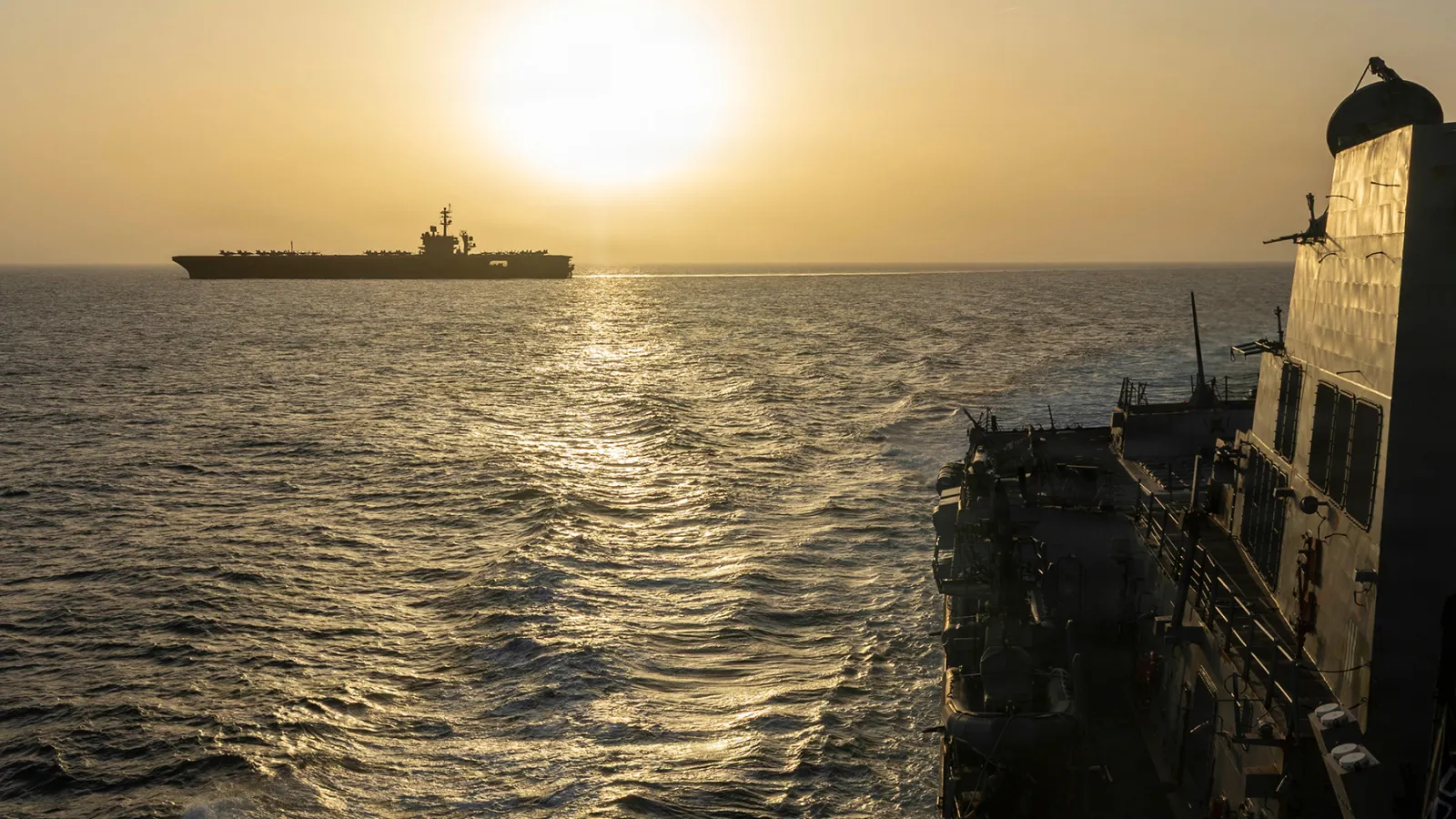
That’s because during that time, if you tried to control an international sea lane, The World’s Most Powerful Navy™ — a title the U.S. Navy inherited from Britain’s Royal Navy sometime around 1922 — would show up off your shore. And they wouldn’t be smiling.
Prior to the war with Iran, this principle held firm. No one had to pay to use the Strait of Hormuz, because neither Iran nor anyone else wanted to have a full-on war about the matter.
“Well,” the leaders in Tehran figured, “since we already have a full-on war, why not start charging tolls?”
That’s what they did. And the World’s Most Powerful Navy™ showed up as promised. I mean, they were already there — but now they are there even more so.
Now, it happens that most naval officers have long memories when it comes to events like “that time our ship nearly got sunk,” and as a result the U.S. Navy learned some important lessons the last time they had to do this exact same thing, in this exact same place, about 40 years ago, in what was then called The Tanker War.
What the Navy learned is that it’s dangerous to guarantee “freedom of navigation” in a narrow waterway when an active war bleeds over into international shipping lanes. Back in the 1980s when the U.S. ordered its captains to escort oil tankers because of this, a bunch of Navy ships hit mines, dozens of sailors died, and an American cruiser shot down an Iranian airliner and killed a lot of civilians. It was all a horrific mess, to be perfectly honest.
Also, it didn’t work. It’s hard to convince merchant ship captains and insurers that it’s safe to transit a choke point, when ships are being blown up there. The Tanker War only ended in 1988 because the Iran-Iraq War itself ended.
Ah, but that was 40 years ago, and back then, the problem was mostly sea mines. What relevance does this experience have now, amid a proliferation of long-range precision munitions, such as anti-ship-, cruise-, and ballistic-missiles, or cheap one-way attack drones?
Hegseth assures us that Iran doesn’t “control” anything, touting the success of a desultory on-again, off-again effort to convince commercial ships to run the strait under American protection, dubbed Project Freedom.
Lloyd’s List dismisses Project Freedom as a meaningless gesture that does nothing to convince shipping firms the strait is safe to navigate, probably because the world’s oldest shipping trade publication is a bastion of wokeism, or hates freedom… or something.
“Project Freedom never stopped, and we’ve run 125 million barrels of oil through the strait and Iran couldn’t do anything about it. How many ships from Iran have transited our blockade? Zero,” Hegseth told CBS News, on Face the Nation. “We have controlled the strait this entire time.”
OK, look. Anyone who’s studied the past 60-odd years of American foreign policy will take it for granted that the country’s national security establishment rarely produces strategic geniuses. It’s hard to even be mad that Hegseth obviously doesn’t understand what “control” means when it comes to sea lanes — that the entire dilemma is that commercial traffic through the strait is reduced to a fraction by the mere threat of attack.
Hegseth thinks that if a few destroyers can run the strait, or Marines can board random tankers, that it means America is winning. He’s a former National Guard infantry officer. Ignorance of naval strategy is to be expected.
If he were to seek to fill in some gaps in his understanding, he might read Sir Julian Corbett’s Some Principles of Maritime Strategy, to learn that the entire point of a navy is “control of maritime communications, whether for commercial or military purposes,” and that a strategy of “sea denial” by threatening sea lanes to choke off commerce is a predictable asymmetric response by a weaker maritime power.
Or — since MAGA bros seem to have a bit of a complex about Europeans (yes, even Brits) — he could pick up an American book, Alfred Thayer Mahan’s The Influence of Sea Power upon History. In it, he would hear the argument that technology is secondary to geography, that control of sea lanes — “the great common” upon which commerce moves — is vital, and that the core principles of maritime strategy never change.
Or if he wants something more recent, he might consult Bernard Brodie, who warns in his Guide to Naval Strategy that although the goal of one’s maritime strategy should be simple — “to secure the passage of the sea to friends, and deny it to enemies” — rapid advances in technology can upend naval tactics overnight.
The secretary likely has other things to concern himself with than books, however — such as worrying about whether the troops are manly men, or Low-T losers.
Hegseth used his top brass to convince the president that the Venezuela raid proved American military manhood could rise to any challenge. It’s hardly surprising that a clique of brainwashed Crossfit fools would mistake counting a leader’s deadlift reps for the importance of counting on him to evaluate the strategic consequences of military action.
All the raid in Venezuela proved was that if you have the world’s most highly trained, expensively maintained military, you can snatch the foreign leader of a relatively dysfunctional country from their bed in the middle of the night and put them on a one-way cruise to Brooklyn — while hardly changing a single political reality on the ground.
As ever with America’s military adventurism, tactical brilliance gives way to strategic idiocy.
Perhaps it’s too much to expect a defense secretary with Hegseth’s background to be immersed in naval strategy, but surely someone in Trump’s Pentagon has read Carl von Clausewitz. Wouldn’t a Prussian land-army officer be acceptable to even the most anti-woke of modern crusaders?
“The political object of war can be of two kinds: Either to totally destroy the adversary, to eliminate his existence as a state, or else to prescribe peace terms to him,” Clausewitz writes.
Certainly Israeli Prime Minister Benjamin Netanyahu did his best to convince Trump that the first of these — total destruction of Iran’s regime — should be the goal. He failed, and there’s no sign the regime is falling any time soon.
Trump and his officials now say that the point of all the bombing is to re-open the strait. This, too, is strategic folly. Re-opening the strait cannot be accomplished militarily. That battle will be won with conference calls, not with cruise missiles: it requires diplomacy.
“Command of the sea is only a means to an end,” Corbett writes. “It never has been, and never can be, the end itself.”
Which returns us to Clausewitz’s principle that war must have a political goal, and that there are only two end states that make sense: peace, or annihilation. When a country seeks neither of these, Clausewitz argues, then its policy has ceased to be rational and its war will become a monstrosity of ceaseless violence, a “senseless thing without an object.”
Well, OK, sure. That’s his opinion. But what does the author of On War know about war?
Did Clausewitz even lift, bro?
Daniel D`Amico for SANREMO.FM