
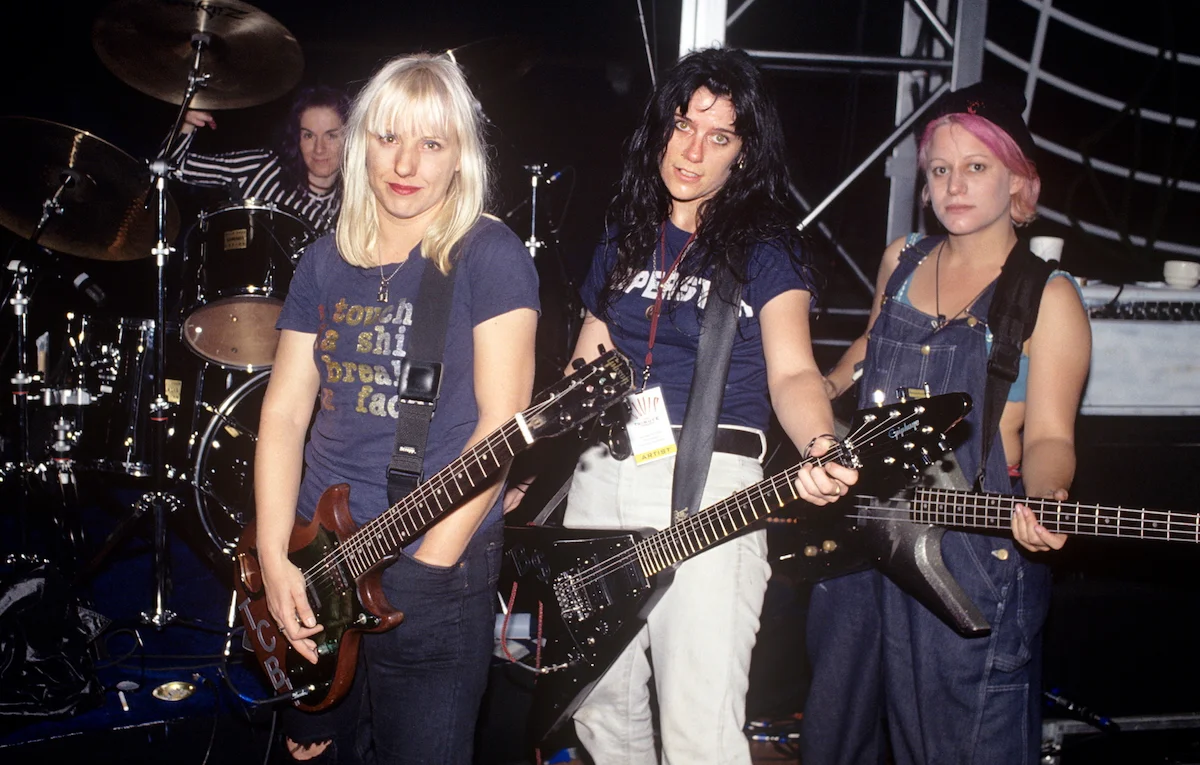
They serve generous portions at Gladstone's on Santa Monica Beach. Godzilla stuff. The dish of lobster, clams, mussels and prawns is enough to feed an entire developing nation and is served by a waitress in microshorts who is evidently obsessed with tanning beds. «Since we signed with a major label, every time there is a meeting we make sure they take us to eat lobster», explains Donita Sparks, the singer of L7, laughing. It's actually the most punk thing you can do.
«The waitress is practically naked», protests bassist Jennifer Finch, who is also wearing a short top which is not exactly an example of chastity. Add the pierced navel, the many tattoos and the stocky build and the result is not sexy, but provocative. The musicians of L7 are, and are proud of it, the strangest people found in Gladstone's today. Drummer Dee Plakas has bright green hair, guitarist Suzi Gardner wears one of those leather jackets with multicolored patches, hideous but cheerful, the kind that the '70s revival has made fashionable again.
They rose to fame in the era of grunge and riot grrrl, but their DIY spirit and fuck-everyone attitude comes from old-school punk-rock. Ramones, Sex Pistols, X. Crazy, rough energy. Screeching, subversive guitars that Sparks and Gardner wield like weapons. Tough and uncompromising texts, children of a ferocious feminism, to Thelma & Louise in the scene where they blow up the tanker.
“How many times do they have to tell you, there's no place we don't go” is the refrain of Shirleyfrom the new album Hungry for Stinka tribute to drag racer Shirley Muldowney. “What's a beautiful girl like you doing running around in a place like this?” a journalist asks Muldowney in a sampling from the film The heart like a wheel. Muldowney's response: “Winning.” The L7s repeat it on a loop: win, win, win.
“It was ironic, because at first they asked us questions like that all the time,” explains Finch. «The woman in the world of men, that bullshit». L7 are not, they point out, foxcore, riot grrrl or girl-something. “Creating a gender out of gender is horrible,” Finch says. «And journalism contributes to perpetuating this thing. I hope that sooner or later the stories about L7 will be the same as those written about Nirvana or Cracker. Being a woman entails a certain uniqueness, but let's not exaggerate.”
Yet the L7s enjoy throwing their being women in the face of others, even in a literal sense. At the 1992 Reading festival Sparks took off her tampon on stage and threw it into the audience. Tampax hasn't yet taken advantage of this unique promotional opportunity, but Midol – whose menstrual cramp products appear in L7's concert rider – once sent the band a big box of free products.
The L7 are united by an absolute solidarity that a professional sports team would envy. Cigarettes. Politics. Unit. In L7 there are no stars. They do not give individual interviews, nor do photo shoots separately. They communicate as a team, completing each other's sentences, while one joke triggers another of their countless internal gags. “Being misquoted happens a lot,” says Finch. «Did you propose this article or did they assign it to you?», he asks with a suspicious look. “Did you come from New York especially for us?” The L7s protect the territory.
When they started out, in the mid-'80s, they rehearsed at the home of Maxine Nazworthy, the benevolent and eccentric Max Factor heiress who served as a modern patron to a generation of Los Angeles punks, including Chemical People, Redd Kross and Down by Law. “It was very strange to go to Beverly Hills to rehearse,” Finch says. “Very ironic.”
The bassist is the only Los Angeles native in the group. Sparks and Plakas came from Chicago, while Gardner grew up in Sacramento, California. “All those losers playing rock 'n' roll in my town had no idea what they were doing,” Gardner says. “I knew I had to leave.”
«Suzi was involved in the scandal of River boys» Sparks intervenes. It refers to the film inspired by a true case, in which a teenager kills his girlfriend and brings his friends to see the body.
«The river boys it's the perfect representation of the environment and the kids I hung out with,” says Gardner.
“Suzi found the body,” Finch says.
“That body almost wasn't me,” Gardner says. “I swear to God, I came very close.”
Then luckily he met Sparks, putting up with loser, sociopathic bassists and drummers for a few years before finding Finch and Plakas. L7 was released on Epitaph in 1988, followed in 1990 by the EP on Sub Pop Smell the Magic. But they were Bricks Are Heavy from 1992 and its surprisingly commercial single Pretend We're Dead to start selling their CDs (we're talking about over 250 thousand copies). They also made it to the cinema, playing a band called Camel Lips in John Waters' film The lady who kills everyone. “The Babes in Toyland were busy,” Finch jokes. “We were honored to do it, because we've been fans of John Waters for a long time.”
Now L7 is preparing for the summer of Lollapalooza, with a predictable surge in sales of Hungry for Stink. They indulge in the occasional wacky song about love and heartache like Andresbut it's the rebellious songs that make the album a classic. “People like you just fuel my fire!” Sparks shouts in Fuel My Fire on a rollercoaster rhythmic base that manages to be both aggressive and joyful at the same time. “People like you” seems to refer to certain Republicans and assholes of various kinds, but L7's main political commitment remains Rock for Choice, the pro-choice organization they founded in 1991. This summer they hope to have a booth among those at Lollapalooza.
“When we started Rock for Choice,” Sparks says, “one of the things we were most concerned about was that Bush was in the White House and represented a huge segment of people who were intent on taking away women's rights. Since then we have focused on other, more grassroots issues: right now, Rock for Choice money is used to buy surveillance equipment and bulletproof vests for clinic staff, which cost around $2,500 each.”
Rock for Choice benefit events held across the country have raised a lot of money for the Fund for the Feminist Majority. “More than we bargained for,” Sparks says. «But in Pensacola, Florida, we had a huge concert with Pearl Jam and we raised very little money because it cost a lot to organize it, and the Pensacola police insisted on having a huge number of security personnel. It's a place to good old boys. After all, otherwise they would have canceled the concert.”
Sometimes those are the ones who show up at their concerts good old boysbut without obtaining results. «Every now and then someone comes along who shouts: “Show us your tits!”», says Finch, perfectly imitating the types Beavis and Butt-Head. «But we are on the side of the microphone. Going against us is ridiculous.”
In the challenge between the L7s and the lobsters at Gladstone's, the latter ultimately win. The leftovers return home lovingly wrapped in strange creatures made from foil. “I just insulted the tinfoil artist by calling his whale a turkey,” Plakas says.
“I wonder if he really is a tinfoil artist and if he responded to an ad for tinfoil artists,” Finch says, “and if he practices his tinfoil art less at home because he has to do it at work.”
L7s probably eat leftovers. They may be rock stars, their finances haven't improved much. Gardner talks longingly about his '73 Cadillac, which would need $2,500 in repairs. Plakas drives a truck full of bumper stickers. “My father still accompanies us at the airport,” says Finch. «In a certain sense he is the father of the whole band, because he is from here. But when we go to other girls' towns, Suzi's mom takes us to eat at a buffet and Dee's mom cooks for us. Donita's mother also cooks for us.”
L7 glimpsed the future when they toured Brazil and Japan to promote Bricks Are Heavy and they were welcomed by adoring crowds, as is typical of those places. “It's a novelty at first, then it becomes a pain in the ass,” Gardner says. «Brazilian fans are much more aggressive. In Japan they stand there in front of your hotel for hours and, when you leave, they smile at you to see if you want them to come closer.”
“In Brazil they tear your hair out,” says Plakas.
“You have to tell them to calm down and they usually listen to you,” Finch says.
“Not in Brazil,” Sparks says.
“Because they don't speak English,” Finch says.
“They were chasing our bus down the street,” Gardner says.
“They wanted our cigarette butts,” Finch says.
Now that they're more or less stars, L7s feel more confident approaching celebrities. Finch recently ran into Angelyne, the Jayne Mansfield wannabe with the explosive cleavage and platinum backcombing who has been seen on Los Angeles billboards for years. Finch asked her to give her an autograph and add “Good luck at Lollapalooza.”
“He said (Finch imitates Angelyne, ed): “I just did an interview for Lollapalooza.” And I'm like, “Seriously? Because, you know, it's a concert series.” “Are you in a band? If you need someone for a video, here's my business card.” It was a strange meeting.”
He thinks about it and laughs. «But I liked it. I saw a lot of us in her, twenty years from now, with her pink Corvette…”.
From the August 11, 1994 issue of Rolling Stone US.
