
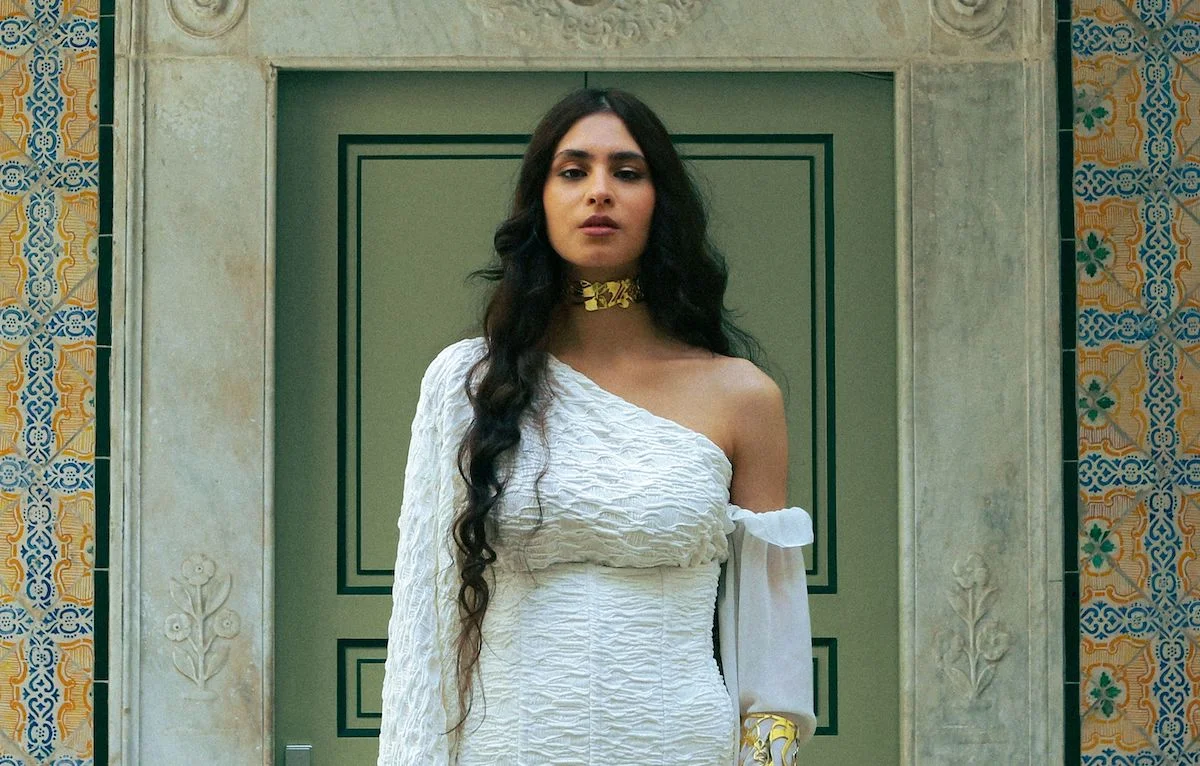
Not all artists make their debut with a musical project. Some make their debut before even publishing a song, building an imagination, a community, a way of being in the world. Tära belongs to this category. His music arrives as the culmination of a journey that began much earlier, between personal research, diasporic identity and the need for representation.
Tära, stage name of Tamara Al Zool, is an Italian-Palestinian singer and content creator who in recent years has built a loyal community on social media addressing issues such as diversity and belonging. After establishing herself online thanks to an authentic account of her roots and her second-generation experience, she transformed that path into a musical project that fuses contemporary R&B, pop and Levantine influences, culminating in the release of her debut EP Zephyr.
Born and raised in Italy, with Palestinian roots and a cultural education crossed by different languages, religions and references, Tära says she found the trigger for her creative process in the 2020 quarantine: «I found myself in a situation where I had many people around me, but many things didn't represent me», she explains. It is the beginning of a journey of reconciliation with herself, far from the idea of having to resemble those around her to be accepted.
Her story is that of a girl who grew up often perceiving herself as the only one. The only one with a certain origin, the only one with a certain family experience, the only one to carry on her shoulders a collective memory that the others seemed to know only superficially. A condition which, as she says, initially led her to seek adaptation and subsequently to understand that identity is not something to be smoothed out but to be inhabited.
This is where his art comes from. Not as an aesthetic exercise but as a direct consequence of internal work. «Everything that I transmit today musically, in terms of writing and image, is the result of this personal research», he says.
For this reason, defining Tära as just a singer would be an understatement. Her path also passes through social media, a terrain that she refuses to consider separate from artistic expression. In a historical moment in which the distinction between content creator and artist is continually discussed, his position is clear: content construction is also a creative practice. «There's art there too. There are days of work to think about how to achieve something.”
There is no attempt to distance oneself from the digital dimension. On the contrary, Tära claims it as a space of cultural construction. Not a shortcut to music but one of the tools through which to develop a vision. «I use social media to leave something, to leave a mark». But it is when the discussion shifts to Palestine that the deepest core of his project emerges. For Tära the relationship between art and politics is not a theoretical question. It is an unavoidable reality. “I've always thought that art should communicate,” she says, almost surprised that anyone would imagine it differently.
The concept of wound often returns in his words. A Palestinian wound that he describes as something difficult to explain to those who have not experienced it, a feeling of incomprehension that runs through personal and collective experience. The last few years, marked by the escalation of the conflict in the Middle East, do not represent a discovery for her but rather the painful confirmation of a story she has always known. What struck her most was not just witnessing the events, but observing the emotional distance with which much of the West perceived them. For this reason his activism was born even before music and translates into a constant work of testimony and memory. “If I don't do it for my blood, no one else will.”
The political dimension, however, does not overwhelm the artistic one. On the contrary, it becomes its creative engine. Autobiography, belonging and cultural experimentation coexist in his songs. The declared influences range from Michael Jackson to Shakira, from Adele to the Arabic, Lebanese and Syrian music listened to during childhood. Writing also arises from this border condition. Raised bilingual, Tära experiences the transition between languages and worlds as a natural, almost automatic gesture. The same happens on the sound level, where instruments and suggestions from the Levantine tradition dialogue with a contemporary Western sensitivity.
“The cure is found in the community,” he says, speaking of the experiences of discrimination he experienced while growing up. All these tensions – identity, belonging, memory, representation – find a first synthesis accomplished in Zephyrthe debut EP which marks Tära's entry into the Italian music scene. Six songs that function as chapters of the same story and that convey the complexity of a young artist suspended between different worlds without ever feeling obliged to choose just one of them.
The title borrows the name of the west wind and transforms it into an existential metaphor. In Zephyr movement becomes a permanent condition: geographical, cultural, linguistic and emotional. It is the invisible thread that connects Italy to the Levant, the present to family memory, the private dimension to the collective one. It is no coincidence that the project opens with Crescent And Diasporatwo songs that address the theme of distance from different perspectives: the first as shared nostalgia, the second as an identity experience lived first-hand.
For Tära, moreover, music comes directly from a path of personal research. «Everything that I transmit today musically, in terms of writing, in terms of image, is the result of this research». Along the way, the reclamation of a non-conforming beauty emerges Halathe cultural tensions told in Petra and above all Yafaprobably the emotional heart of the work. More than just a collection of songs, Zephyr appears like a declaration of intent: the first map of an artistic universe that Tära is building piece by piece, avoiding both folklore and exoticism.
In a scene that continues to question the ability to narrate complex identities and expose oneself politically, Tära appears as a figure destined to occupy a specific space: that of those who use pop as an emotional archive, music as a political language and their own biography as a bridge between different worlds.