
You don’t need to have logged in countless hours playing Resident Evil — or its legion of sequels, spin-offs, first-person or third-person iterations — to immediately sense that Zach Cregger‘s addition to the video-game-turned-multimedia-franchise’s legacy is different. Yes, the Weapons director’s movie jettisons a metastasizing mythology that’s infected both the popular PlayStation title and those woeful big-screen adaptations, and which mutated what was once a industry-changing survivalist horror shooter into just another intellectual property plagued by diminishing returns. Reboots gonna reboot, although simply restarting things from scratch and/or throwing canon out the window is no guarantee of an upgrade. The good folks behind the series tried this once already, and, well… we apologize for bringing it up. Please go back to forgetting it existed.
What makes this a fresh take on an old warhorse isn’t just a back-to-basics approach, although it does have that: One central character, trudging from location to location, solving puzzles and slaying monstrosities. You expect the film to stop and ask if you want to save your progress at certain junctures. Rather, it’s that Cregger isn’t simply taking the raw materials of a beloved I.P., the fan-favorite protagonists and the wink-nudge references, and then throwing them into a blockbuster blender and hitting purée. He’s asking: Why do those games work so well? What is it about the gameplay that’s made it a classic? How do you channel the frights, the fun, the feel of spending hours shooting the virtual damned and undead, and translate that in a way that works as a horror movie?
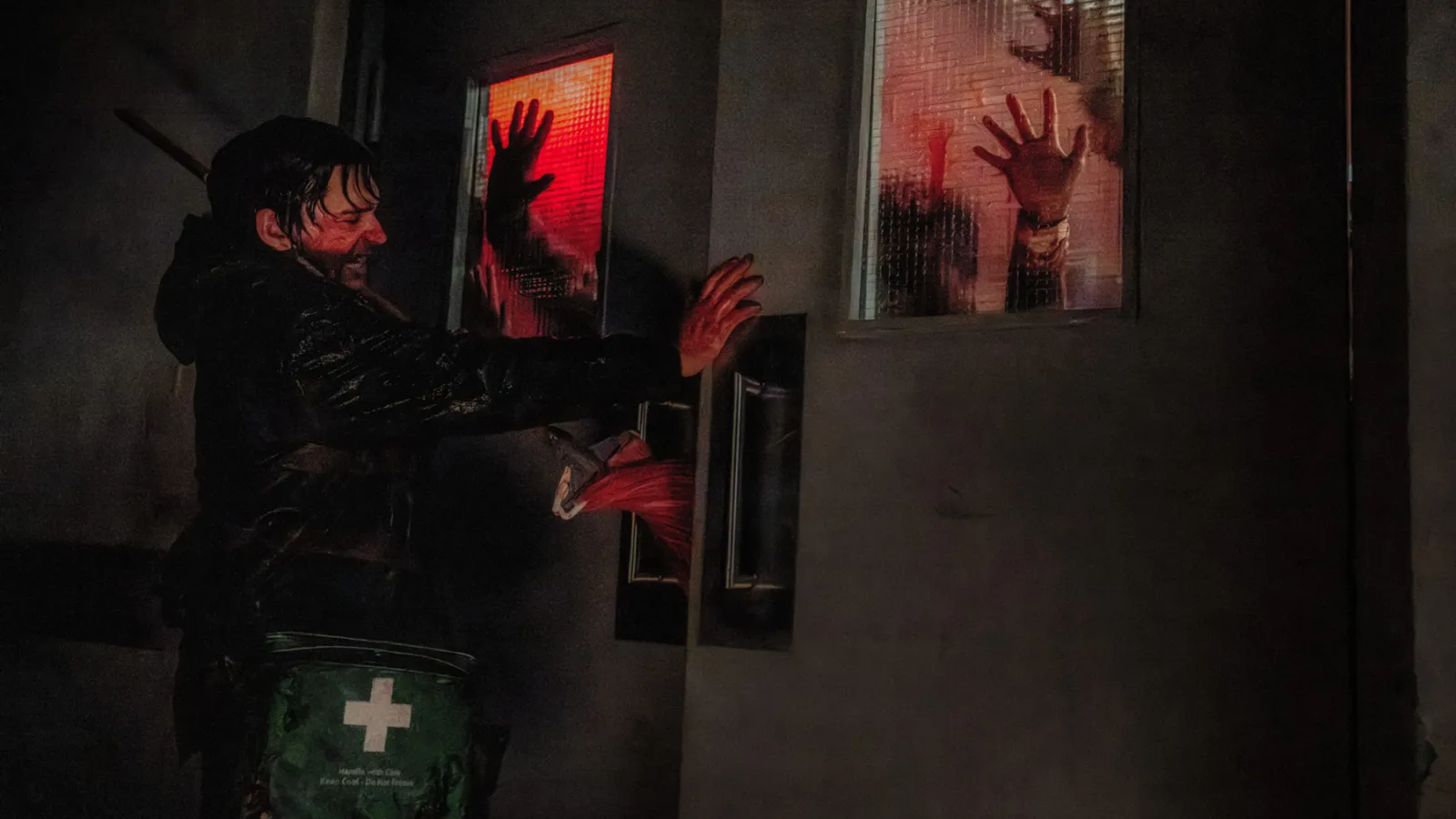
To say Cregger’s cracked that cheat code would be an understatement. His Resident Evil is, hands down, one of the single best video-game screen adaptations to date, yet works in a way that doesn’t feel like an adaptation, doesn’t rely on fan service and Easter-egg hunts to pay homage, and doesn’t skimp on the dynamics that made the game so endlessly playable. The destination of our hapless hero, a courier (Austin Abrams, absolutely awesome) who must transport an important package between medical facilities, is indeed the game’s residentially evil homebase of Racoon City. The “Umbrella Corporation” get namechecked. Things will definitely go down inside a biohazard lab. But past that, the movie focuses its eyes on a bigger prize: melding the dual sensations of playing a survivalist shooter and being immersed in an unpredictable genre flick. This is how you do it.
If anything, the filmmaker’s wild, gory redo owes as much to John Carpenter’s remake of The Thing as it does to the namesake series. Everything seems like business as usual at first, with Abrams’ “glorified Postmates” delivery guy running across a woman in a snowy, desolate forest who seems a little “sick.” His Good Samaritan instincts do not pay off. Soon, people are jumping out of the shadows and getting a little too bitey for comfort. Cregger takes his time between action beats and jump scares; as with 2022’s surprise hit Barbarian and last year’s Weapons, this Resident Evil benefits from an expert use of the frame, a sleight-of-hand approach to making the rug underneath you suddenly disappear, and the ability to use humor to escalate tension as much as relieve it. His now-established “brand” of horror storytelling is as much a selling point as the title, and he deploys it here with gusto — and literal guts.
Then an encounter with a dog who, shall we say, is more than he appears to be starts to introduce elements of truly unsettling and straight-up Lovecraftian transformations. Let’s put it this way: Just because you shoot, stab, or bludgeon something doesn’t mean whatever is squirming around inside of it can’t reassemble in a new hybrid form. If the urban-legend concept of the “king rat” makes you queasy, you may want to avoid this movie at all costs.

Paul Walter Houser exits, stage left, in ‘Resident Evil.’
Sony Pictures
Potential allies and people to be saved come and go, some of whom will seem familiar — here comes True Detective: Night Country‘s Kali Reis as a traditional Resident Evil commando type, there goes I, Tonya‘s Paul Walter Hauser as a whiny, weaselly corporate executive — and others who simply start sprouting tentacles out of their faces. Essentially, however, you’re just following Abrams as he goes from one mission-like set piece to the next, occasionally hovering behind him like he’s an RPG avatar. Get to that creepy house in the middle of nowhere. Get out of that creepy RV, the one with the conspicuous sounds of a crying child. Get through the creepy sewer tunnel filled with zombie rats. Get to the creepy hospital’s 48th floor, where a laboratory may be able to fashion a cure for this viral outbreak turning people into the walking, running, jumping, chomping dead.
Most videogames work their way up to a boss battle. This cinéma du gaming landmark has its own brilliant variation on that trope, and like the underage rampage that characterized the climax of Cregger’s previous movie, it uses a cartoonish momentum to keep gaining velocity. Everything ends on such a high that you start to get the equivalent of the Sunday scaries over a possible sequel — the fear that, like so many franchises before it, this new and vastly improved version will simply run itself into the ground and piss away any good will. Hopefully, the lessons learned here will be used to level up other projects and possible continuations. For now, everyone behind this superior subgenre entry should take a victory lap. They’ve just made the best horror-reboot of the year.
