
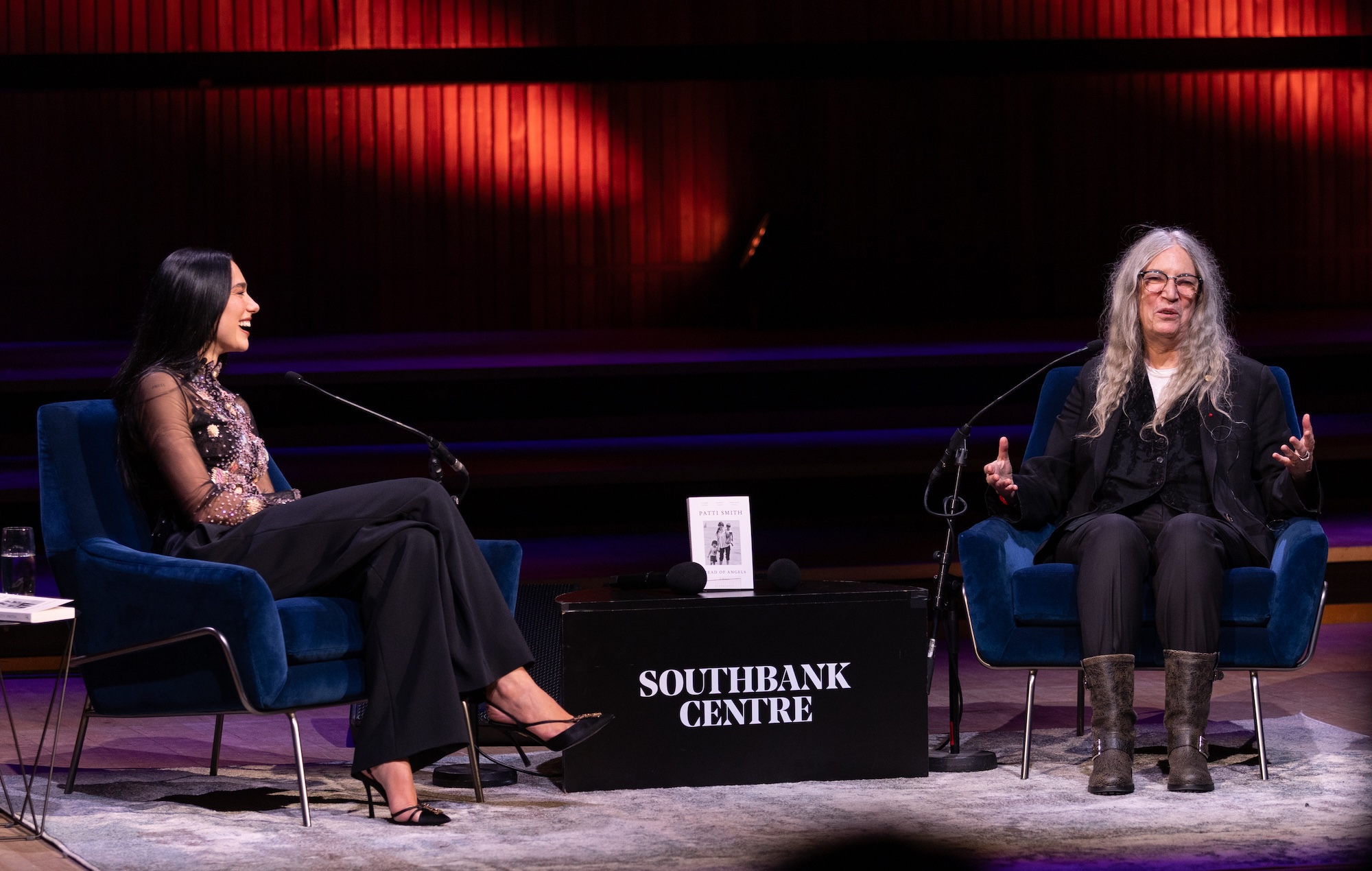
Patti Smith joined Dua Lipa at the London Literature Festival at Royal Festival Hall last night (Sunday October 25) for a moving conversation about the punk poet’s latest book, the memoir Bread Of Angels.
The book was published last year and follows Smith’s previous non-fiction tomes, Just Kids, M Train, Devotion, and The Year Of The Monkey, as well as several poetry collections. Bread Of Angels focuses initially on Smith’s upbringing in Philadelphia, before taking in the rest of her life so far, signposted by four different dresses given to her over the years by meaningful people, including her late husband Fred Sonic Smith, brother Todd and friend and photographer Robert Mapplethorpe.
Lipa, who curated this year’s London Literature Festival with her Service95 Book Club, interviewed Smith about her latest book, exploring some of the stories inside.
Explaining the intention behind the memoir, Smith said: “It gave me a chance to show some gratitude to all the people that helped form me, and who I rebelled against too. My parents, my siblings, my teachers, people I met along the way, mentors and loves – all kinds of people. Even though it’s my own story, it shows that we are also a product of all the wisdom and all the experience that we have with others.”
Reflecting on the differences between this book and the acclaimed Just Kids, she added: “I wanted to give the people Robert [Mapplethorpe] in Just Kids, but in this book, I wanted to give them all of the people that helped me along the way.”

Discussing what Lipa described as a “more conventional narrative” in this book, Smith added: “I wrote Just Kids because Robert asked me to write it hours before he died. I didn’t know anything about writing a memoir or nonfiction. I like to write poems and fairy tales, and it was so much responsibility and took me so long.
“I swore I’d never write another memoir, but truthfully, I had a dream where a messenger came to my house with a white book, and I opened it up, and it was a book that I had written, and it had all the stages of my life, and they were broken down through dresses. I felt that if I dreamed that, there was a reason – and I felt like all those people were calling, ‘Don’t forget us; write our little story too’.”
Asked about the meaning behind Bread Of Angels’ title, the author and musician explained that she had initially wanted to call it Dancing Barefoot – after the song on her 1979 album ‘Wave’ – “but then some guy took my title”. “So I went through the book, and there was a phrase that I had written, and it was talking about small things that people do for you that stay in your mind because they’re such an unpremeditated act of kindness,” she continued. “I thought a lot of this book is about gratitude, so I chose that. I stole it from myself.”
When asked by Lipa what her “bread of angels” would be today, Smith pointed to an experience she’d had in Spain days prior, where 3,000 people gathered in choirs to sing her 1988 song ‘People Have The Power’ for her. “I just felt Fred [Sonic Smith, the song’s co-writer] would have loved it so much because when he wrote that song, he was hoping someday it would be useful to people who needed to articulate if they needed an anthem, if they needed words of power, if they needed a song to sing to give them strength,” she said of her late husband. “He didn’t live long enough to see the song get to that point. All I can think is how much he would have loved to see that.”
Smith also cited Lipa’s care with the interview and a recent conversation with Pope Leo XIV as her current “bread of angels”, as well as her bass player fixing something for her before going on stage, the people who say hi to her on the street and a hotel housekeeper.
In the book, Smith writes about her motto to “question everything” – a mantra that was influenced by her father, who she said “loved playing the devil’s advocate”. “He would get into some hefty argument about the Old Testament, whether UFOs are real, who was better – Plato or Aristotle,” Smith shared. “He taught me to question things and, sometimes, questioning, when you’re young, can be a form of simple curiosity, sometimes arrogance, sometimes rebellion – but in the end, what you’re looking for is answers. You’re looking for a bit of wisdom or some kernel of truth that can help you evolve to be a better person.”
Prompted by Lipa, the musician shared the first time she questioned her father, while on a trip to the Philadelphia Museum of Art at 12-years-old. While her dad was taken by the works of Salvador Dali, Smith was more excited by Picasso. “He was appalled by it,” she recalled. “I thought he had such an open, beautiful mind, but he was closed off to Cubism. That was our first fight; the second was over The Rolling Stones.”
Naturally, many musicians populate the pages of Bread Of Angels, from Richard Hell and Tom Verlaine to Bob Dylan, who was an early supporter of Smith. Lipa highlighted a section of the book where Smith wrote about a meeting with the folk star and other people in his circle, after which Smith “took off and went cross down to CBGBs, the stronghold of the unknown, to be with my own people”.
“I’ve always been grateful for all of those people,” Smith said. “I learned so much from Bob Dylan. When I say, ‘I left this whole scene to be with my own people’, I was still grateful to them.”

Elsewhere in the book, the author notes an out-of-the-blue Valentine’s Day call from R.E.M.’s Michael Stipe shortly after Fred died – whom she had yet to meet at that point – offering to be her Valentine.
“I got a phone call from a very drunken Michael Stipe – he was in San Sebastian, Spain, and I could tell it was his voice,” she remembered now. “He told me that he was intoxicated and that, in his drunken state, he was thinking about me, and he knew that my husband had died. It wasn’t that I needed to have a Valentine, but I was so touched by that, and now he’s one of my best friends.”
At points, Smith became emotional – particularly when Lipa referenced her late husband and how the book feels like it’s split into “before Fred and after Fred”. Moved to tears, she recollected her first meeting with her partner, describing it as being “just like in the movies when time stops”. “I knew that was the guy I was going to marry, and I didn’t even want to get married,” she smiled.
As the main conversation drew to a close, Lipa and Smith were joined by broadcaster and writer Zakia Sewell, who asked questions submitted by the audience. One attendee asked the pair to reflect on the differences between their rises in the industry and whether they felt artists “still have the freedom to be as creative in their journeys” as when Smith was a rising star.
“Freedom didn’t go anywhere,” Smith replied. “I don’t think of it in terms of some of us are more organic than others. I think we have different ways that we approach communicating with people. I went to see Rosalía’s show; I haven’t seen Dua live yet, but I’ve watched videos. The discipline and all the different training require so much discipline, and I admire that.” She continued to compare that to her own experience, saying that she didn’t “have any vision of anything” when she was starting out, other than to “make poetry more exciting”.
Lipa added her own perspective, noting that while “creativity doesn’t change”, the environment she had come up in was “so much more fast-paced and [because of] people’s attention spans, you feel like you need to constantly churn out so much more information and put things out”. “I believe that maybe now there’s a little bit less grace when you are young to not know everything, instead of allowing somebody to just grow and develop and become the person that they’re supposed to be with time,” she said. “That’s exactly right,” Smith agreed. “I didn’t have to be scrutinised. You have to make all your mistakes in front of everyone now, and then it’s posted everywhere.”
Another audience question asked the artists to choose a song of the other’s that they’d tackle, with Smith enthusiastically responding: “I’ll choose ‘Houdini!” Lipa, meanwhile, selected ‘Dancing Barefoot’, “because it’s such a sensual song and there’s just something about the love of something bigger than us that feels so visceral and fun”.
The evening concluded with Smith sharing the writing advice she would give her 30-year-old self. “I had to work really hard – I always had a good imagination, but I had a lot of trouble with grammar, with writing, with sentence structure, and I had to keep reading and studying others and then developing a discipline, a daily practice,” she explained.
“I would just tell anybody, if you want to be a writer, then write every day. It’s like a muscle. If you’re a runner, you need to run – you don’t say, ‘I’m a runner’, but only run a few times a month. You have to use that muscle, and even if you don’t like what you’re writing, just that act [is helpful]. So if you want to be a writer, then write.”

London Literature Festival continues at the Southbank Centre until November 1. The likes of Kae Tempest, Malorie Blackman, Ta-Nehisi Coates and more will take part in events across the programme.
“Curating the lineup for the London Literature Festival with my Service95 Book Club has been a true joy, and I’m so proud of the programme we have created,” Lipa said when the lineup was originally announced this summer. “We’ll be joined by icons as well as emerging voices from across the arts the world needs to know.
“You will recognise some as friends of the book club, and others may be your first introduction, but ultimately, I wanted to create a space that brings together some of the most exciting writers, poets, and thinkers from around the globe,” she added. I’m looking forward to being both in conversation and taking my seat in the audience at this iconic venue.”
Meanwhile, Patti Smith has been confirmed for two European festivals next summer, with the artist and her quartet set to perform at both Denmark’s Roskilde and Poland’s Open’er.