
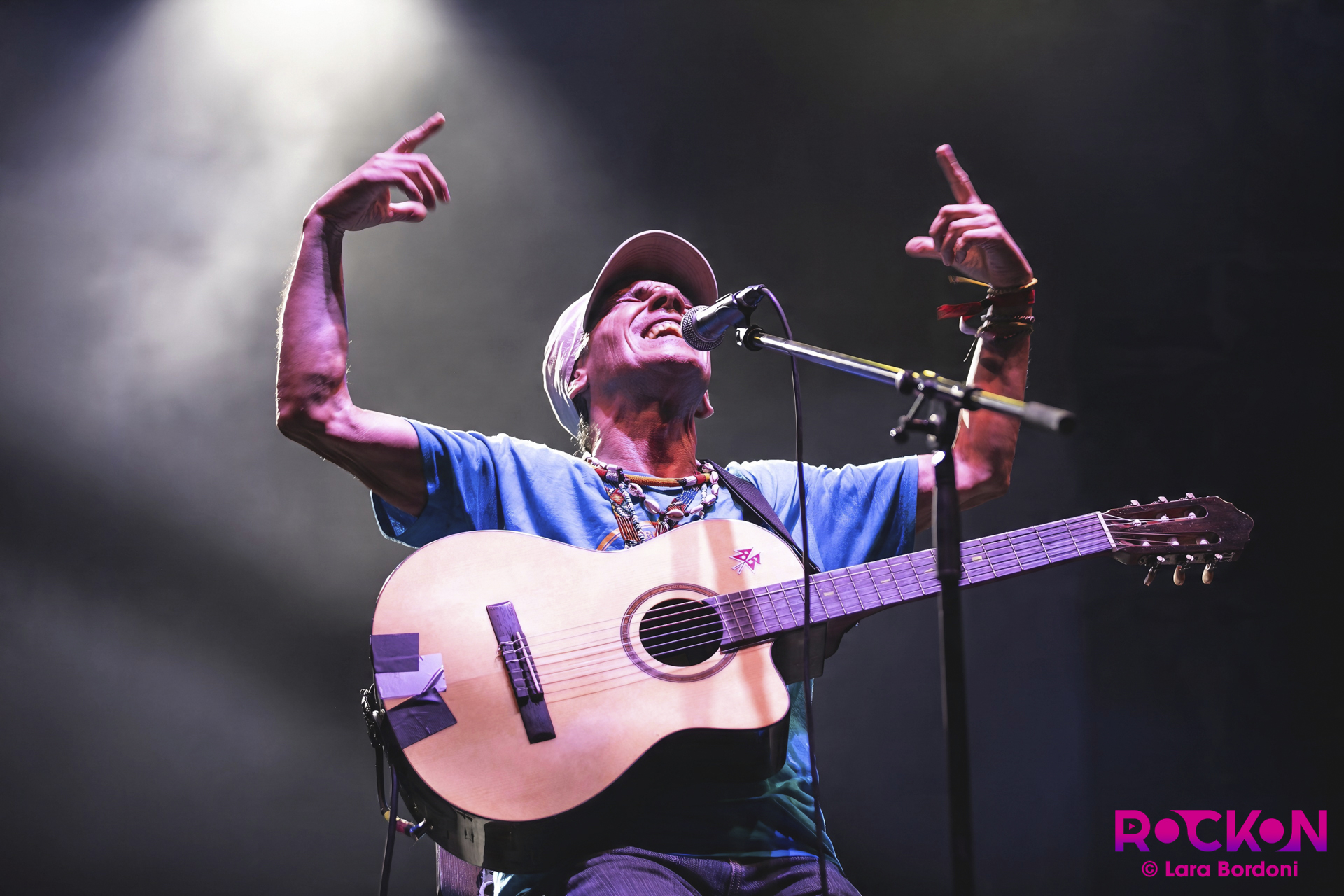
Article by Alessandro Amendolara | Photo by Lara Bordoni
July 19, 2001 Manu Chao he played in Genoa. There was the G8, there were thousands of people who had come from all over the world and there was even an eighteen year old who, for a moment, had thought about it. Then the servant's bills arrive: “If I spend twenty sacks on the ticket, how much will I have left to eat? Where do I sleep? Trains from Biella? Of course, there are also those Rifo types who come down by car…“In the end I didn't leave. That Saturday night I played records at Privilege, which, I still remember, was emptier than usual.
In a differently hot summer of 2026 I discover that Manu Chao is on tour with “Ultra Acoustic” and will stop on the last evening of Rugby Sound of Legnano. It is the perfect opportunity to make up for another small personal gap: an event that, for one reason or another, I had never managed to go to. This year, however, I really had no more excuses.
The logistics of the festival prove to be impeccable: large free car parks manage to absorb the approximately eight thousand people who came for the concert, a live area perfectly set in the splendid setting of the Castle Island and, to accompany the wait, the DJ set by Vito War with its unmistakable black and reggae style. A warm-up that is anything but formal: we will find him in the console even after the live show, making us dance until one in the morning as if Manu Chao's concert wasn't really over yet. The climate is perfect for dancing without melting and, to the tune of a surprising dub version of Hello beautifulthe console leaves room for acoustic instruments.

When Manu Chao goes on stage, the first surprise is almost banal: live it is much smaller than I had imagined. It's a feeling that doesn't last long. The first songs are enough and that tiny figure seems to occupy the entire stage, without ever needing to impose itself.
Many lands, Vecinos at the sea, Y Ahora Qué, Everything will be delivered, Me llaman Calle And Me Quedo Contigo they build the first act of the concert. The first four songs immediately open up the horizon: even before Manu Chao actually enters the scene, the world, its borders, the sea, doubts and hope enter the scene. But all this comes through, even before the words, through the way the trio occupies the stage. The percussions of Miguel Rumbao Serrano they chase the guitar of Lucky Salvadoriwhile Manu Chao's voice jumps from one language to another with disarming ease. In the space of a few minutes the eight thousand people of Rugby Sound seem to forget that they are in the Lombardy plain. More than a concert, it seems like a street party that could belong to any latitude.
Then that map fills with people. With “Me llaman Calle” the story stops talking about lands and borders and begins to look into the eyes of those who cross those borders every day. The road becomes the privileged observation point of those who live on the margins, of those who live in the cities without ever really being protagonists. “Me Quedo Contigo”, finally, adds a final piece: that of a popular, simple, shared love. From this moment on the concert no longer just crosses the world. It crosses the lives of those who inhabit it.
During La Vida Tombola the concert suddenly changes dimension. As happens in street parties, at a certain point someone always joins in: the trumpeters also make their entrance and the stage expands. The sound acquires even more body, while the memory of Maradona evoked by the song seems to merge perfectly with that idea of irregular freedom that has always run through Manu Chao's imagination (accompanied by an eloquent middle finger aimed at FIFA). From then on the crescendo is continuous. Rumba de Barcelona, Freedom, Spring And Por el suelo they do nothing but fuel it, progressively transforming Rugby Sound into a gigantic popular square where reggae, rumba, folk and Latin music coexist with absolute naturalness. It is Manu Chao's patchanka: a mixture of languages, cultures and rhythms that, for almost forty years, continues to reject any boundaries.
And it is precisely this wave that finds its peak with Pinocchioa surprising reinterpretation of the historic theme song composed for Comencini's film. The playful spirit of the nursery rhyme remains, but everything else changes skin. Eight thousand people sing it in unison, jump in the same tempo and, for a few minutes, Rugby Sound even stops feeling like a concert. The feeling is surprisingly familiar: that of a summer of 2006 spent singing, with pride and without needing to agree, the “Po po po po po po po po” Of Seven Nation Army. There are songs that, twenty years later, still manage to remind us how simple it can be to feel part of the same voice.

If the previous block represented the moment of maximum expansion of the party, Malegria, Mi vida, Forcing Maquina, He'll lie, Mr. Bobby, Je ne t'aime plus And Bongo Bong they demonstrate how Manu Chao is capable of keeping the intensity alive without turning it into a routine. The concert continues to change language, rhythm and atmosphere with surprising naturalness. Spanish gives way to French, reggae meets rumba, cumbia borders on folk, while the audience follows every deviation as if it were part of the same journey from the beginning. It is only an apparent lightness: beneath the surface there always remains the idea that music can be a meeting place even before a show.
With Clandestine, Welcome to Tijuana, The wind, Romerito Verde, Disappeared, Tears of gold, Long live you And Me Gustas Tu the concert brings together all the threads scattered throughout the evening. Borders, travel, the last and suspended identities return, but after more than two hours of music those borders now seem to have lost their main function: to divide. What remains are the people who pass through them, their stories and the dignity with which they are told.
When the first notes of Me Gustas TuRugby Sound once again explodes into a collective chorus. It is the ending that everyone was waiting for, but also the one most consistent with the journey built up to that point. Eight thousand people singing, dancing and smiling with the same naturalness with which, three hours earlier, they had started that journey through different languages, borders and stories.
Before leaving the stage, however, Manu Chao allows himself a single break away from music. Few words, no proclamations, no slogans. The dedication is for Carlo Giuliani. He arrives almost on tiptoe, without interrupting the atmosphere of the evening and without seeking applause. Yet it is enough to reread everything that has happened up to that moment. Borders, the last, freedom, the dignity of common people: these were themes scattered throughout the setlist. The dedication does not add them. It simply makes them impossible to ignore.
Then the instruments start playing again. The band greets the audience to the tune of a rousing Salento taranta, while Rugby Sound continues to clap and dance. It is the last image of the evening, and is perhaps also the most faithful to the spirit of Manu Chao: letting the music, once again, have the last word.

While I indulge in another hour of dancehall between a vintage Sean Paul and a Sister Nancy coming out of Vito War's speakers, the Rugby Sound slowly empties. Then it's my turn too.
Before taking the motorway I think back to that eighteen year old in July 2001, who had done the math and decided to stay at home, convinced that he had only missed one concert. Twenty-five years later I know that that choice, unintentionally, also kept him away from days destined to change the history of our country forever. If I could say one thing to him today, it would simply be: “Ale, not all concerts are missed. Some simply wait for the right moment… because life is a tombola!”
Click here to see photos of Manu Chao in concert at Rugby Sound in Legnano (or browse the gallery below).

MANU CHAO – The setlist of “Ultra Acoustic” at Rugby Sound in Legnano
Many lands
Vecinos at the sea
Y Ahora Qué
Everything will be delivered
Me llaman Calle
Me Quedo Contigo (Si Me Das A Elegir)
La Vida Tombola
Rumba de Barcelona
Freedom
Spring
Por el suelo
Pinocchio (Travel on the back of the tuna) (cover by Fiorenzo Carpi)
Malegria
Mi vida
Forcing Maquina
He'll lie
Mr. Bobby
Je ne t'aime plus
Bongo Bong
Clandestine
Welcome to Tijuana
The wind
Romerito Verde
Disappeared
Tears of gold
Long live you
Me Gustas Tu
Daniel D`Amico for SANREMO.FM