
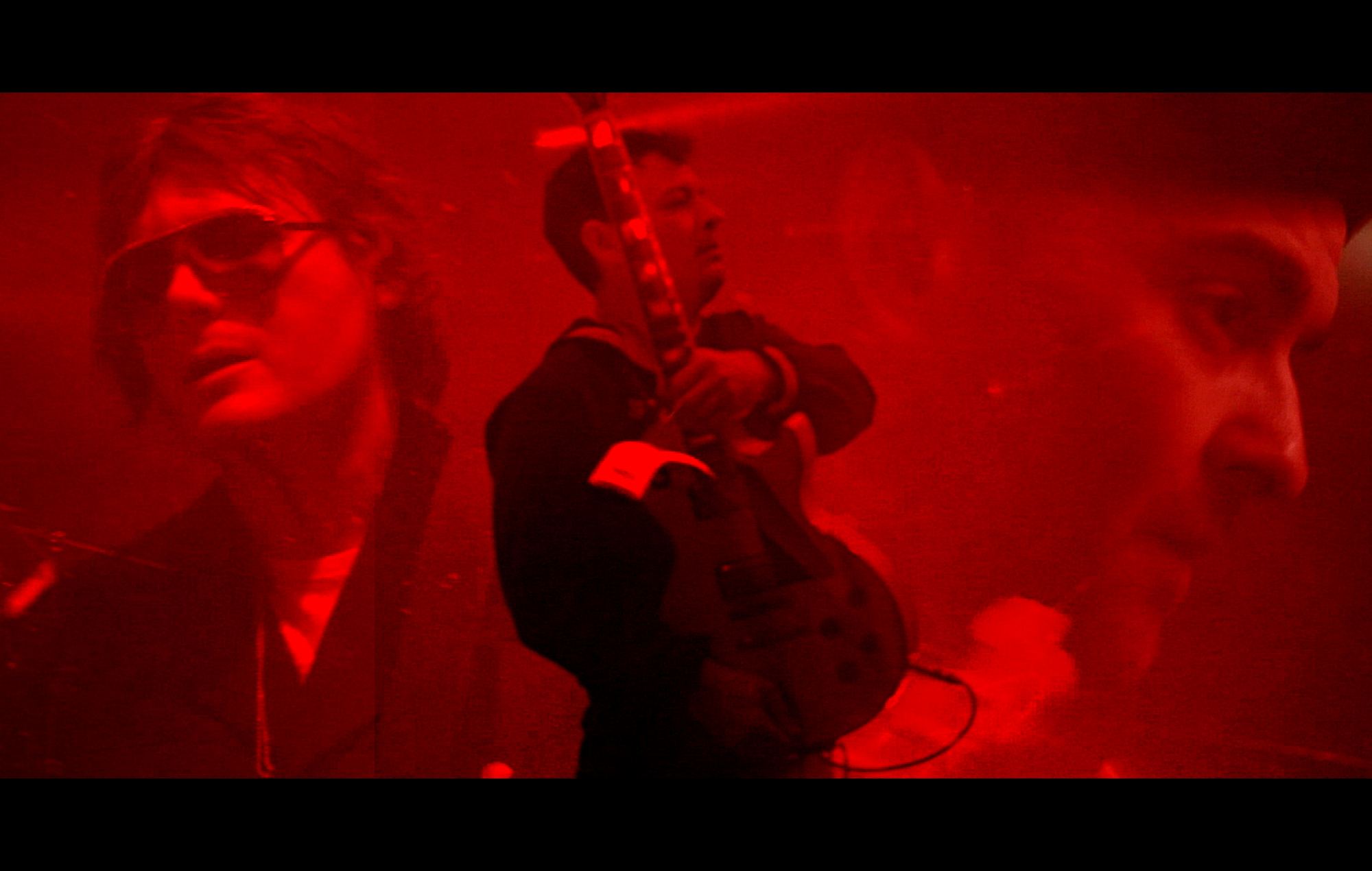
Manic Street Preachers have announced details of a new live album celebrating their seminal ‘The Holy Bible’, along with the long-awaited release of Kieran Evans’ concert film Be Pure, Be Vigilant, Behave and a Steven Wilson spatial audio remix of the original record. Check out all the details below along with our interview with Nicky Wire.
In 2014, off the back of the huge success and acclaim of their 12th album ‘Futurology’, the Welsh rock icons finally felt they had licence to revisit their cult classic third LP ‘The Holy Bible’ by playing it in full for the first (and probably last) time. In full military garb as they were in ’94, the Manics were on fine and furious form. The UK shows were captured by their now longtime visual collaborator and BAFTA-winning director Kieran Evans for the film Be Pure, Be Vigilant, Behave – its title taken from a lyric to closing track ‘P.C.P.’.
Now, the Manics have announced that they’ll be releasing ‘The Holy Bible Live’ on October 23 across various formats, with the live album accompanied by Evans’ concert film and a new Steven Wilson spatial audio mix of the original 1994 album. The release will be available as a 2 x 12” and 3 CD deluxe edition, 2 x blue marble 12” vinyl, CD+video BluRay and on digital platforms, and is available to pre-order here.
‘The Holy Bible Live’ was mixed by producer Dave Eringa recorded across the three nights played at the Roundhouse in London – a venue chosen for its similarity to now-lost Astoria, where the band played their final shows with guitarist and lyricist Richey Edwards. Edwards disappeared a few weeks later in 1995 ahead of a US promotional tour and has not been seen since. He was officially declared dead in 2008 in order to settle his affairs with his family.
“’The Holy Bible’ is a record that still sort of scares me at times as an investigation of the soul,” bassist and lyricist Nicky Wire told NME. “I never wanted to go that far, but it’s a good thing to feel and to revisit that at times. A lot of the live album is a tribute to Richey. When you think back to that point, we’d done three albums in three years, and then his lyrics also hang over ‘Everything Must Go’, and we were working with such speed of intensity. It gives me such a special feeling that people are hearing these words 30 years later.”
To match the album’s darkly poetic lyrics and shocking subject matter about the Holocaust, eating disorders, prostitution of the self, the evils of man and the spiralling mental health of guitarist and lyricist Richey Edwards, the gigs were shot and edited with a brutal intensity. The film originally premiered back in 2016 but has not received a full release until now.
“To start with, there was never a ‘plan’ to make a concert film,” Evans previously told NME. “I just wanted to document each show as I felt they were just too important for the band not to have a record of.
“Every night, there was was a palpable nervous tension in the air as the audience waited. The lights dimmed, stage lights strobed and then those familiar sampled words ‘You can buy her, you can buy her, this ones here, this ones here, everything is for sale…‘ began to fill the air and the chopped guitar lines of ‘Yes’ sprang out. The audience roared, the lights exploded and suddenly we were off…and in that moment I knew I was witnessing something incredibly special and life-changing.
“I’m glad I had my camera with me.”

Speaking about the challenge of the shows, frontman James Dean Bradfield said he “wanted to prove that we were still a band tough enough to play ‘The Holy Bible’”.
“I wanted to prove to people that being on stage and hammering it through together like a military unit was still part of us,” he admitted. “We still have that muscle memory, that badge of honour. We knew there would be a reflex reaction to doing something like this – people looking at the record and your performance through a prism of the past. ’It’s not quite got the spark I was hoping for.’ Proving those people wrong – disproving cynics- massively powered me on.”
Bradfield added: “When we played the album, I felt like I was wearing a different mask. I didn’t feel as if I had to completely connect with all the lyrics, I just needed to mainline into the energy of it all. And that felt good – it felt good for us to be a piece of rock ’n’ roll theatre. It felt good to be close to that power again.”
NME caught up with Nicky Wire earlier this week, in the midst of a “quiet year” off the back of their 2025 album ‘Critical Thinking’ and ahead of their winter co-headline UK tour with Suede.
“We’ve just been doing a few shows in Europe, some nice festivals, and trying to write some new songs,” said Wire. “We’re just rehearsing existing, really. We’re not interested in thriving – surviving will do.”
Check out the rest of our interview with Wire below, where he told NME about the new release, memories of 1994, and what to expect from new material in the works.
NME. Hello Nicky. Seeing as we’ve just had Reading Festival and you played a legendary show there for ‘The Holy Bible’ back in ’94, what do you remember about your time in that field?
Nicky Wire: “It was incredibly tense and slightly stressful that we had to do it as a three-piece because Richey was in The Priory at that point and we did need to pay bills, but we did have such a sense of wild abandon and ferocious discipline that it was an amazing show. The crowd was massive. It did feel something had happened; I don’t know what. ‘Faster’ had been out, ‘Revol’ had been out, the album was coming out, but people seemed to want to be there. We had the full ‘The Holy Bible’ regalia, and it was just fucking vicious. It was a peak of sorts.”

What was it like to be in that version of the Manics in ’94, going to war on stage and every night?
“It was a badge of honour, but it was starting to get quite… ‘grim’ isn’t the word. We’d done our own shows and played with Suede and Therapy in Europe. We’d offered to Richey that we could cancel or do them as a three-piece but he was determined to do them. We were all slightly unravelling at that point and the whole thing had become something of a self-fulfilling prophecy. The shows themselves were still brutal. We inhabited ourselves and were like no other band around at that point.
“It was still brilliant to get on stage, but culminating with those three shows at The Astoria there was a sense of auto-destruction as well.”
There was official footage from the Astoria shows in 1994 that was made into music videos Do you have the rest and do you think it’ll ever see the light of day?
“To be honest, I’ve seen what you’ve seen. I’ve got bootlegs from people with camcorders and there’s not much more apart from the memories of paying off the debts. You can piece together bits and pieces. Radio One recorded some of those shows, and that’s out there. There’s nothing left really, apart from the debris. We’ve got some of the smashed guitars and stuff!
“I did find a box of photos by [legendary photographer and fellow NME Godlike Genius winner] Pennie Smith. There are these remarkable pictures of us backstage, and there are a couple of them in the box-set that’s coming out. Whenever Pennie turned up, we respected her so much that we’d always be on best behaviour and do whatever she asked us to do. There’s so much humanity in these pictures before we go on stage. We were really close and comfortable with each other, even though it was particularly tense when we got on stage.”
To decide to play the album in full in 2014, what was it like as a band to embody that mindset and recreate these songs and be in ‘Bible’ mode?
“I was really reticent. I didn’t think I had the ferocious discipline that you need. People don’t quite understand the reason we don’t play the songs very often is because you just can’t fake them. You can’t glide. It’s not like ‘You Love Us’ where I can put my guitar down and skip for 20 seconds – with ‘The Holy Bible’, you’ve got to be absolutely on it. They are really difficult to play, and you’ve got to feel that sense of venom and slight nastiness.
“I wasn’t sure of myself, but James really loved the challenge of it and to prove that we could still be that band. We had to go for it really full-on with the camouflage, the outfits, and to really dig deep into our former selves. We hadn’t done that for a long time. By the end of the tour, it really paid off. It was pretty overwhelming with so many of those fans singing those words back to us. With the amount of words and the meaning of them, it was really gratifying. Part of doing the tour was just to make sure people remembered Richey’s lyrics.”
Are you still finding new generations of fans getting into the Manics via this album, just as they might with Joy Division‘s ‘Unknown Pleasures’, Nirvana‘s ‘In Utero’ and other dark albums like that?
“You can see it through streaming patterns and stuff like that; it’s just a cult album. It’s got so much depth and intellectual worth to it. It’s like reading a great novel or something. You’re always going to be able to go back to it and get something new out of it. I’m glad it’s in this genre because some of our records are liked just because they’re incredibly popular. It’s nice to have records that go down a deeper angle.”

You’ve worked solely with Kieran Evans for your music videos, documentaries and stage production for over a decade now. What is it about your shared aesthetic language, and how does that translate into this film?
“Me and him were just talking at some point and said that we really need to record this in some way, but we were both really reticent about making it big or widescreen. He just said, ‘Look, we’ll do it with two or three blocked-off cameras; we’ll film every night and just try to capture it’. The shared aesthetic is really important because Kieran occupies the same mindset, in terms of musical and visuals. The ferocity of those shows just comes across so well in the film. As someone who suffers from migraines, sometimes it feels like you’re watching a migraine.”
It certainly feels like an onslaught of images and noise, with a sort of Clockwork Orange effect…
“It does. I get slightly bored playing bass, and I’ve just got to concentrate so hard to play those songs and lock in with Sean’s amazing drum patterns again. You’ve really got to disassociate with the music, but when the fans actually started singing back tracks like ‘Mausoleum’, it kind of warms the heart. There is some humanity in the film when you see the fans singing along, which I didn’t expect.
“It’s not the sort of thing that happened the first time because it was such a different era. We probably only played about five or six of these songs at each gig in ‘94. It’s not like we were playing the whole album, and we’ve barely played that many ‘Holy Bible’ songs since really – and I doubt we’ll play them again because it is a state of mind and you can’t fake those songs. The crowd know straight away. You’ve got to have that overall intensity, and you can see it in the film.”
It’s method-acting, isn’t it?
“It is, and James loves all that shit. It did make me realise what an amazing musician James is – the vocal melody compared to the guitar melody and the amount of words he’s trying to cram in, it’s pretty awesome to watch.”
It’s rare for a band make a live album from an anniversary tour. What made you decide to do so?
“Every about ‘94 feels really claustrophobic and in your face with the album and the gigs, but when we played back the recording of this it just felt more like a Steve Albini recording. There’s more space in it and the songs are more muscular. It was really spine-tingling. I was pushing more for the visual but James was adamant that we record the audio even if we never fucking released it because we’re never going to do this again.”
And you’ve been sitting on it for all this time?
“Yes, and that’s my bad. We wanted to release two years ago for the 30th anniversary of ‘The Holy Bible’, but we were on such a flow with ‘Critical Thinking’ that we didn’t have time to get it together. Obviously now it’s 32 years since it was released, which is a bit of an odd one.
What can you tell us about the Steven Wilson spatial audio remix?
“I’ve listened to a lot of Steven’s stuff and I like him as an artist. I find him really interesting anyway, from Porcupine Tree to his solo stuff. It’s the Rush and the prog side of me, so we just thought it was worth giving him a shot. There’s quite a lot of subtleties that were buried that have come through. It might not be everybody’s cup of tea. He’s not softened it, but there are a lot of nuances from the recordings that I forgot about. He’s given it a nice slant, a sense of space and it breathes a bit more.
“The vocals really are amazing. Now they seem rich and textured whereas sometimes they feel squashed and shouty. It’s beautiful. It’s like having a brand new mix of the album after going through all the master tapes. Some people might think it’s unnecessary, but it’s our stuff and I enjoyed listening to it.”

Do you imagine we’ll be getting a bit more of the ‘Bible’ on the upcoming dates with Suede?
“I just don’t know. I’d like to think so. I’d like to think we could do ‘Faster’ as it’s such a landmark record and so underplayed.”
You’ve shared on social media that you’ve been writing new songs. How’s that going?
“It is a fine batch of songs: ‘Threshold’, Don’t Be Afraid To Be Afraid’, ‘Recrudescence’… I’m just trying to find a thread to them at the moment that makes sense. We don’t have any problem with inspiration for songs, it’s just that the wherewithal to put it all together and release it gets harder. This is our 16th album, and that’s a lot of records! I don’t know any one of our contemporaries that has got close to that.
Lyrically, what’s inspiring you?
“It’s hard to say. I just think trying to find ways to survive, and corridors and shelters of meaning. Trying to find a way to stay creative at our age is not the easiest thing to do while trying to mean it. If it doesn’t feel important to us, then it isn’t going to feel important to anyone else.”
The last time we spoke, James said he wanted to make a “cold and European” album and record it in Hamburg. Is that still the plan?
“The only combined thread is Echo & The Bunnymen at the moment. From ‘Heaven Up Here’ through to ‘Porcupine’ and ‘Ocean Rain’, those three albums are the biggest inspiration at the moment: the sonic coldness of something like ‘Heaven Up Here’ and the rich tapestry of ‘Ocean Rain’. There are a lot of Bunnymenisms.”

Do you fancy a winter in Hamburg then?
“Always, or there’s a winter in Berlin. There’s a choice of two studios. We’ve got 10-14 songs, but everything just takes longer than it used to. Getting everyone together and recording, it’s just harder now.”
Perhaps you should let Steven Wilson produce the album?
“That’s not a bad shout. I will keep that in mind.”
Do you think we’ll get some new songs on the Suede tour?
“We’re literally reconvening for festivals now, so I’m not entirely sure. Here’s a beautiful version of Blondie’s ‘Union City Blue’, which is sounding magnificent. We slip that in along with a new song. I wouldn’t be too surprised.”
Manic Street Preachers release ‘The Holy Bible Live’ on October 24 before their UK co-headline arena tour with Suede kicks off, calling at Glasgow, Leeds, Manchester, Cardiff, London, Birmingham, Nottingham and Bournemouth. Visit here for tickets and more information.
