
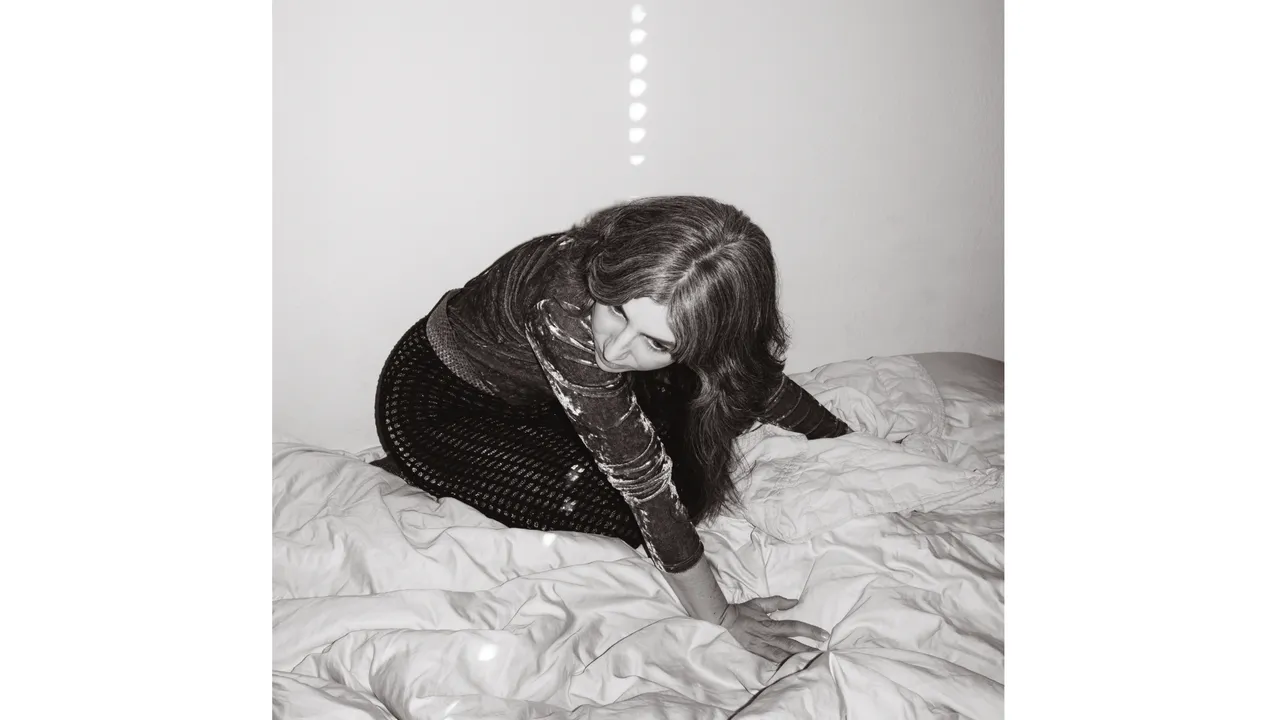
Julia Holter has a finger on a pulse and a hand in the ether. Over a decade and a half, the Los Angeles-based musician has written and produced an expansive catalog of celestial yet hummable ambient pop, marrying modern sounds with classical touchstones like Euripides and Hildegard von Bingen, great sprawling compositions that orient the ancient in a neon hall of mirrors. On Materia, the follow-up and companion piece to 2024’s Something in the Room She Moves, she reshapes and reenvisions previously recorded songs alongside new material, and the resulting seven-song odyssey is both slyly glinting and overembellished, dazzling and inscrutable.
The record opens with “The Laugh Is in the Eyes,” an asymmetrical, electrified tune that initially feels like a chimera, percussion and melody just barely stitched. Here as elsewhere on the album, instrumental flourishes flash like jewels set in molten metal, momentary glimmers in the strange flow. A flute trills midway through, like something breaking the surface, and a few moments later, the clarinet quavers tentatively before it’s reabsorbed. The layered sounds build like sediment, tall as a canyon, before the song ends abruptly, and the music box piano of album highlight “My Lost One” floats in like a new scene in an extended dream sequence. The lyrics broach surreality. “The news always hits the sea, too,” Holter avers on “The Laugh Is in the Eyes,” and then later: “I still love that day, we chased our tails around.” On “My Lost One,” she sings, “Blossoms in warm kitchens think it’s spring everyday.”
No score yet, be the first to add.
The title track, which previously appeared on Somewhere in the Room She Moves, is revivified, elasticized and warped nearly beyond recognition as two compositions, “Materia 2” and “Materia 3.” Where the original foregrounds Holter’s soprano like a liturgical relic, barely pinned in place by spare piano, its first doppelganger builds and swells, vocal layers competing like a ghostly peanut gallery. The last iteration, which closes the record, is short, simple, and reverberant, but less sure of itself, and particularly arresting in its use of pauses. It rubs its eyes; it looks down at an ashtray instead of up at a vaulted cathedral. Many artists, across many different mediums, will give a different answer to how and when they know a piece of art is “finished,” and Materia feels like an extended meditation on that question—Holter’s reply might be “never,” or at the very least “after several years of noodling to my heart’s content.”
There are moments when the noodling gets a bit overcooked. A couple of these songs were salvaged from the cutting room floor, and that’s sometimes fleetingly apparent. “My Twin” begins as a haunting, sonorous melody, echoing as if from the bottom of a well, and stretches over 10 minutes into something unwieldy and far-flung. The front-end charm of its spooky minimalism gets buried under a switchback melody and a wall of sound, claviers clanging, angel choirs singing, and the listener wondering what exactly we were building toward except noise.