
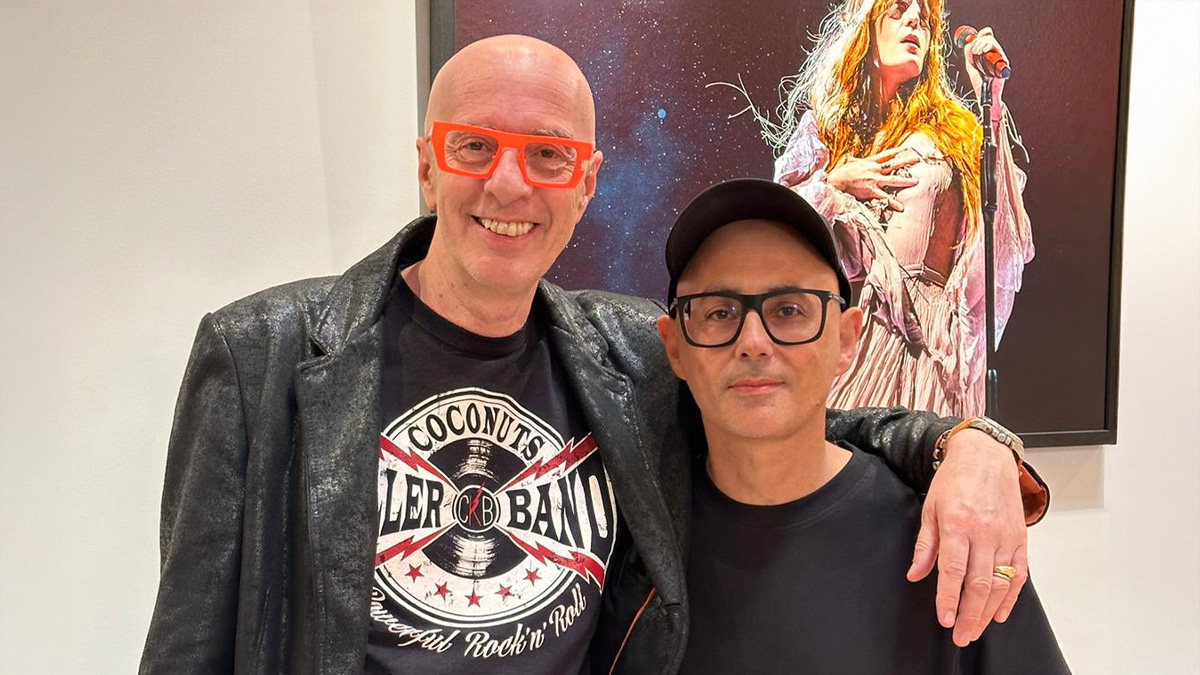
Until July 26th Pieve di Cento (Bologna) the interactive photographic exhibition is set up Pictures of Youa project by Henry Ruggeri and of Rebel House with the collaboration of Chiara Buratti.
The exhibition, organized at the “Le Scuole” Library/Picture Gallery (Via Marco Rizzoli, 4/6), collects over 40 photographs taken by Henry Ruggeri of some of the most important protagonists of the international music scene, including Pearl Jam, Foo Fighters, The Rolling Stones And Ramones. Through the app Notaway®each image comes to life: by framing the photographs with their smartphone, visitors can access exclusive video content created specifically for the experience by the journalist and writer Massimo Cottoamong the most authoritative voices of Italian music journalism.
Over a year after the Milan stop that we told you about here on Rockon, the exhibition continues to grow and enjoy great success with the public.
We reached Henry for an exchange, which has the exhibition as its starting point, but gradually transforms into a sharing of passions, emotions and life!
Hi Henry, first of all welcome and thank you for your time.
Many will have already asked you this, but for those who haven't listened or read anything yet
about the exhibition, how the idea that led to this project was born and when
did you realize that that idea was feasible? (I imagine a Gene Wilder-style “It can be done” moment in Junior Frankenstein – lol)
How were the artists to “tell” chosen?
Hello, first of all thank you for the questions and for the time you dedicated to visiting the exhibition, which is never a given.
The idea of involving Massimo Cotto was born in a very natural way. We spent a lot of time talking about music, concerts, photographs and anecdotes when we met at live shows and already in 2015 we promised ourselves to do something together.
At one point, with my partner Mattia Priori Of Rebel House with whom I have always organized exhibitions, we said to ourselves: But why do images have to remain still on a wall?
Massimo had this incredible gift of giving life to memories, I had an enormous archive of moments spent with artists… and that's where the spark came from.
The “it can be done” moment came when we really tried to make a photograph speak through augmented reality and we realized that it wasn't a technological effect as an end in itself: it worked emotionally.
That was the key. As you underlined, we almost “forced” visitors to stop in front of each work and take their time.

An exhibition different from those we are used to. I'll tell you how I experienced it.
First of all, the wow effect for the beauty of the image.
Then he frames himself with the app and… Massimo appears.
And here his heart sinks so much so that he arrives straight and clear with his reassuring smile and the bizarre glasses required.
And finally the story. An anecdote relating to an interview, a moment in the artist's life… in short, Massimo that connects you with the image.
And this is repeated picture after picture.
In a natural way you immerse yourself in a mix of emotions, memories and get involved. Can we say that it is a type of exhibition that “forces the visitor to stop”, to take their time to connect?
What are the fundamental ingredients to have this effect?
You have perfectly captured one of the fundamental aspects of the exhibition: today we are used to consuming images in half a second. Here, however, the opposite happens.
You stop, look at a photograph and then Massimo appears, who takes you by the hand and takes you into that moment. It's almost an intimate experience. I believe that the real ingredient is authenticity. There is no construction: there are real emotions, real memories, stories told by someone who really experienced music.
And it's wonderful that this thing happens right through a smartphone. We usually say that technology distances us, but here it connects — hence the
application name, “Not Away”.
But it only works because there is human content behind it. Technology alone is never enough. It takes a soul.
We can say that one of the aspects that united you and Massimo is not only the
passion for live music, but also the way of experiencing it and telling it, that is
wanting to convey not only the “powerfull” part of the concert, but also the person who is “behind the artist”? How do we get to this?
Yes, you understood the relationship between me and Massimo very well. We have always looked for the person behind the artist.
Live is adrenaline, power, spectacle… but the real magic often happens five minutes before or five minutes after. A look, a fragility, a laugh backstage. That's where you really understand who you are in front of and Massimo had an enormous talent in bringing out that human part in his stories without ever being intrusive.

Massimo was capable of entering the lives of all of us, even those who didn't know him
personally he has a memory linked to him. In addition to having absolute competence and total intellectual honesty, he was incredibly friendly. And we miss it. What path did he mark for all those journalists or enthusiasts who would like to take inspiration from him?
He left a very important path: that of credibility. Today everyone can talk about music, but Massimo taught that we need to study, listen and have respect. He never tried to seem more important than the artist or the story he was telling. And above all he had a rare quality: he managed to 'hypnotize' the listener with his unique way of telling stories.
You get angry if I define you stage ninjain the sense of fast person and
invisible (lol)? Artists say about you that they don't notice your presence, so much so that you are discreet in the shot. How do you become Henry Ruggeri, one of the most well-known live photographers in the world, loved and esteemed by artists internationally?
I really like “Stage Ninja”! (I'm laughing so hard because no one has ever told me this before!!!).
In reality the live photographer must be invisible. If the artist notices you too much, you've already done something wrong. You have to move quickly, predict the moments, breathe along with the concert.
How do you become Henry Ruggeri? Certainly doing thousands of concerts, making a lot of mistakes, sleeping little and having an almost obsessive love for live music. But above all, always respecting those in front of you. Artists immediately sense whether you are there to steal something or to tell something.
Ah, I forgot: to become Henry Ruggeri (Henry is my real name and not Enrico, as many believe – lol) you also have to shave your hair, dress in black and wear a New Era New York Yankees cap!
Live photography is very different from other types.
Capturing a gesture or a moment from below the stage or from the mixer is not like being posed. How “complicated” is live photography? I'm asking you because I don't think everyone realizes it…
Given that, when faced with a work of art, it is our emotions that guide us, can you give us some tools or lessons to be able to better grasp what an image has to tell us?
Live photography is very complicated. In fact, I believe it is one of the most complex forms of photography. You don't control anything: the light changes constantly, the stage is unpredictable, the moment lasts a fraction of a second and never returns.
You can't tell an artist, “Do it again.” You have to be mentally ready even before technically. And then you need sensitivity and instinct to be able to “bring home” the work, often in the very few minutes you have available.
As for reading an image, the simplest advice is this: stop. Today we look at everything too quickly. A photograph often tells details that only come if you give it time.
A look, a hand, a smile between two people… there is already a story in there.

Pictures Of You has been “on tour” throughout the country for over a year. How is your personal budget for this first period, are you satisfied? Did you want anything to go differently or are there things that exceeded expectations?
The balance of this first year of “Pictures Of You” tour honestly goes beyond all expectations. The strongest thing is seeing very different people get excited in the same way: young kids, people who have followed Massimo for decades, photography enthusiasts, people who entered almost by chance.
What I didn't expect was the emotional level that is created during the visits. At certain moments you really feel the silence of the people listening to Massimo speak. And it's very powerful.
For photography enthusiasts or more nerdy people, can I ask you what camera/lenses you usually use and how the images we see during the exhibition were printed?
On a technical level I mainly use Canon material. As camera bodies I work with two R6s and, as lenses, I mainly use fast zooms: 24-70 and 70-200 f/2.8.
The prints in the exhibition were created with great attention to detail in the study by Alessandro Scattoliniin the Marche, on museum-grade Canson baryta paper, because I wanted the photography to have a strong physical, almost material presence. And needless to say: live images must strike even before technology.
After Pieve di Cento, are there other installations planned?
We already have a next date in Milan and we are in negotiations with other locations for the autumn.
Is there any question I didn't ask you that you would have liked to have asked? If so which one?
Maybe I would have been happy to receive this: “What has this exhibition taught you as a person, not as a photographer?”.
And I would have replied that this project reminded me how important the
human connections.
The photographs remain, of course. But what really matters is what
we manage to leave people inside.
And in this Massimo was simply unreachable.
Thanks Henry!!!
Some details relating to the current exhibition:
The exhibition can be visited every Friday (from 5.00pm to 9.00pm), Saturday (from 10.00 to 13.00 and from 17.00 to 21.00) and Sunday (from 10.00 to 13.00 and from 16.00 to 20.00) on free entry.
In addition to the exhibition itinerary, the project develops into a real schedule of events that will animate Pieve di Cento for over two months. On the SILLA Stage, set up in the external courtyard, there will be alternating meetings, talks, showcases and concerts with artists and protagonists of the sector.
Friday 29 May from 6.00 pm it will be possible to visit the exhibition in the presence of Henry Ruggeri. Following, at 6.30 pm, showcase of guitarist Massimo Varini.
On the SILLA Stage there will be the June 12th at 6.30 pm Mauro Ermanno Giovanardi and Marco Carusino with “Pills from the Chelsea Hotel“, The June 19th at 6.30 pm a meeting with Marky Ramonehistoric American drummer, famous throughout the world for being part of the Ramones, the band that founded the punk rock genre. While the July 4th at 6.30 pm Chiara Buratti will interview BANDABARDÒ.
The event, which sees the patronage of Municipality of Pieve di Cento And Reno Galliera Unionis financed by Cassa di Risparmio di Cento Foundation.
Daniel D`Amico for SANREMO.FM