
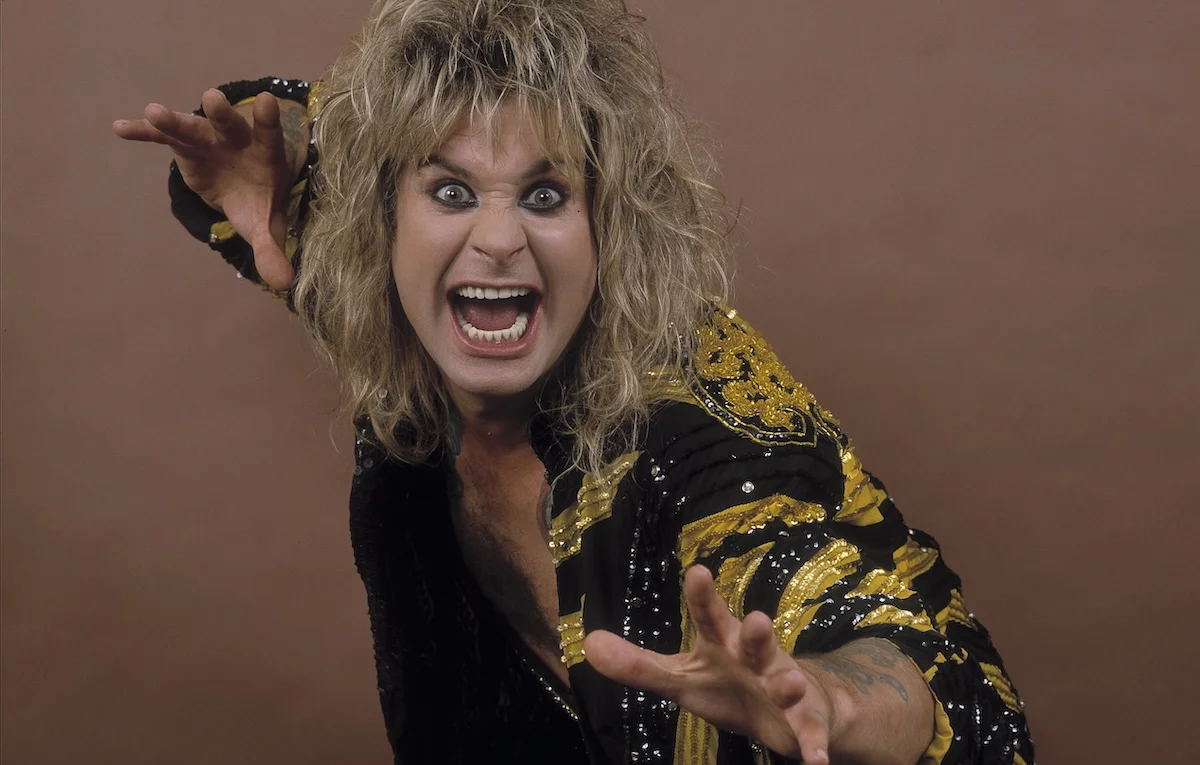
These days I've found myself thinking more and more often about the same thing: how much do we miss Ozzy Osbourne? How much more fun was everything with him? Fucking, to put it in his own words. Not only because there are no more concerts or records of his to look forward to, but because with him a certain way of being in the world, a human category, has disappeared.
Ozzy belonged to that era in which rock was still populated by unpredictable characters, capable of making people laugh, scandalise, move and even embarrass in the same day. It was enough to turn on the television, open a newspaper or go online every now and then to be sure that something concerning him had happened. It could have been one of his hallucinating outings, an absurd anecdote or yet another figure of global shit. Because with Ozzy normality didn't exist. And this is perhaps what is missing most today when everything seems controlled, artists speak through press offices, press releases, posts studied to the millimetre, interviews in which every word is weighed. Ozzy, on the other hand, seemed to live in a permanent state of improvisation. Of course, he played with it a little, but generally he did it precisely because he couldn't be anything other than himself.
He was a walking contradiction: he invented heavy metal and they called him the Prince of Darkness, but he could spend his days talking to his animals or most of his free time like the most tender of grandparents. And it is curious that such an apparently chaotic figure was, after all, one of the most coherent that rock has ever produced. Because Ozzy never pretended to be better than he was, he never hid his addictions, mistakes, fears, illnesses, fragility. Indeed, he transformed that fragility into the reason why millions of people loved him. In an environment where everyone often tries to appear invincible, he became an icon by also telling how imperfect he was.
After all, Ozzy was also the last of the romantics. It may seem like a strange definition for an artist who started playing with the intention of scaring people, but it's probably the one that does him the most justice. Because, after all, behind the mythology built over a 50-year career there was always the boy from Aston who managed to get excited and hope for a better future by listening to a song by the Beatles on the radio. Who burst into tears as soon as he saw a picture of Randy Rhoads or his wife Sharon and who for his latest recording project, Patient Number 9had tried to realize one of his great dreams: that of ideally bringing together the three historic guitarists of the Yardbirds, Jeff Beck, Eric Clapton and Jimmy Page. Not to mention the strength that pushed him to get to the final concert, because his fans had to say goodbye from a stage and Black Sabbath had to play one last time together with Bill Ward.
This is also why certain operations following his passing left a bitter aftertaste. I think of the controversy with Roger Waters and the t-shirt distributed by the family, with Ozzy depicted urinating rainbow on the wall of The Wall: Maybe they thought it was a way of saying that he remained irreverent even in the afterlife, but it was more vulgar than funny. Even in the worst situations, Ozzy almost never tried to be offensive, if anything it was alcohol or drugs that made him so. And when he realized the damage done he was the first to suffer. Like when he met his great hero Brian Wilson and told him that his recently deceased brother was a dick and that he should stick his head up his ass. The next day he publicly knelt in front of the Beach Boys genius to ask for forgiveness.
Ozzy was simply unpredictable and even his provocations were born from a childish instinct, never from a calculation. With Ozzy still around it was common to read that he had called the vet because he thought his dog was depressed, or to hear him candidly tell that he remembered almost nothing of the 70s and 80s due to drugs. He was capable of confessing that he had been looking for a room in his house for years without realizing that it didn't really exist, or of turning an interview into a succession of involuntary jokes. When he bit off the head of a bat on stage in Des Moines in 1982, convinced it was made of rubber, he unintentionally constructed one of the most absurd and famous episodes in the history of rock. When years later he revealed that his doctor told him it was a “scientific miracle” that he had survived decades of excess, he managed to get laughs by talking about his own self-destruction.
If there was one thing Osbourne loved, it was making us laugh by recounting his tragedies. Like when in his autobiography I'm Ozzyone of the most beautiful rock'n'roll memoirs of all time, recounted the wrong diagnosis of HIV positivity: «At the time it was a fucking death sentence. And if I was positive, then Sharon was also positive and that meant I had killed the mother of my children.” Then, the correction: «Mr Osbourne it seems that the error arose from the conditions of his immune system. In practice he is totally non-functional and this is due to factors in his lifestyle that can explain the anomaly. In practice she doesn't have HIV, but her body thinks she does.”
Then they arrived The Osbournes and the world discovered that the terrifying Black Sabbath singer was actually the most confused father in America, unable to find a remote control, constantly berated by Sharon and followed by a pack of dogs who seemed to have more sense than him. That program demolished decades of rock stereotypes in just a few episodes and transformed the Prince of Darkness into one of the most loved (and discussed) television characters on the planet.
His greatest talent, if you think about it, was precisely that of never taking himself seriously, of making the legend human. A year after his death, not only his music is missing, which will naturally continue to live on. The idea that something completely absurd and incredibly authentic can still happen in the space of a few minutes is missing. The feeling that rock can still produce characters is missing larger than life without anyone building them around the table. What is missing is someone capable of making tragedy and comedy, darkness and tenderness, madness and candor coexist in the same identical toothless smile.
Maybe the world wasn't better when Ozzy Osbourne was around, but it was certainly a lot less predictable and fun. And in times when everything seems planned, explained, filtered and correct before it even happens, there is a huge difference. Because Ozzy reminded us, every time he opened his mouth, that life can still allow itself to be beautifully out of control. And it is a lesson that, a year after his death, continues to be missed more than we imagined.