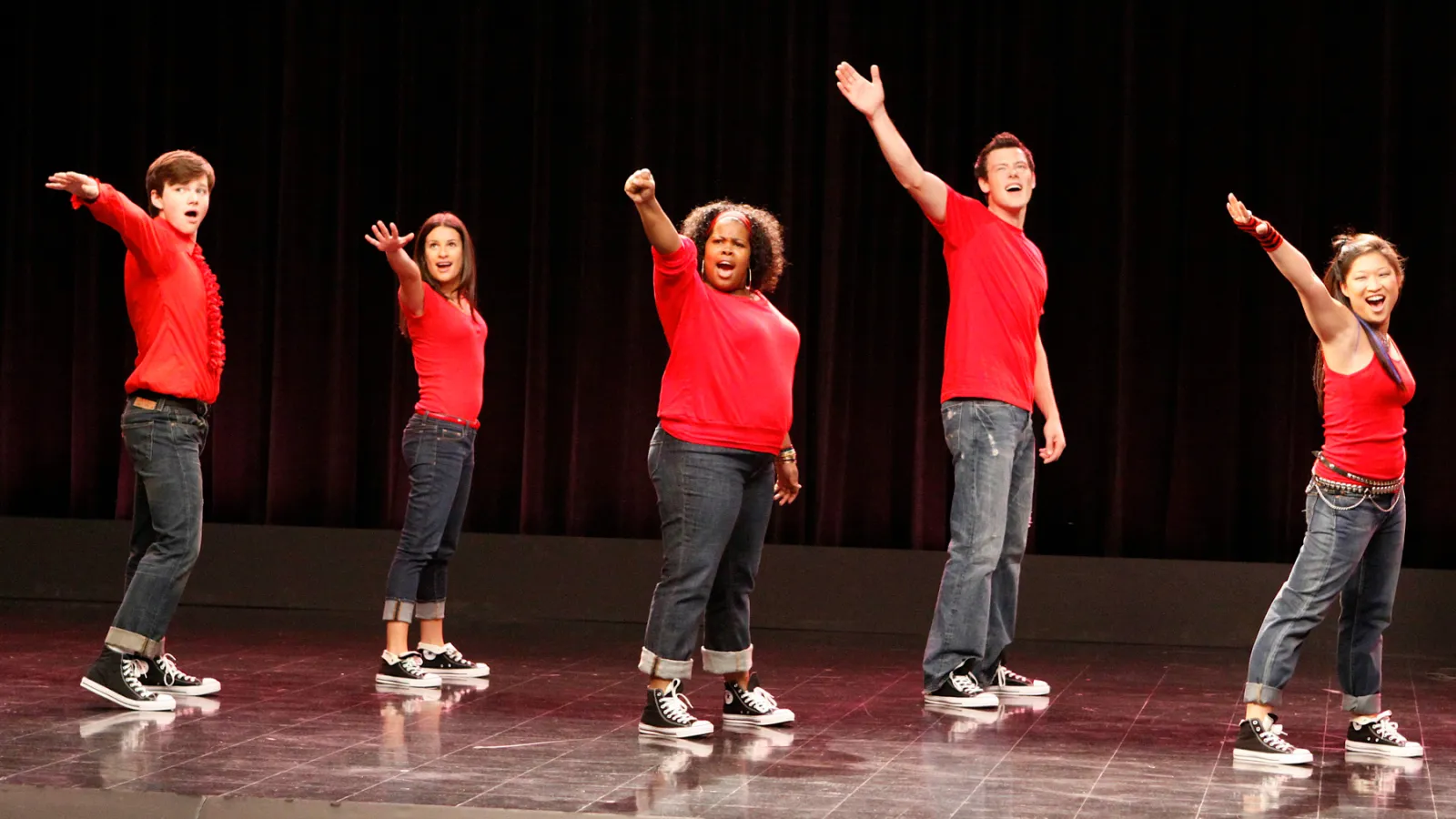
In the pulsing red world of the Upside Down in Stranger Things, rocks and debris fly as Max runs for her life to the soundtrack of Kate Bush’s “Running Up That Hill (A Deal With God).” Wednesday Addams, dead serious in a to-die-for dress, does a wacky dance to the Cramps’ “Goo Goo Muck.” Today, television is one of music’s most powerful discovery platforms, introducing new generations to older songs and giving familiar ones entirely new lives — but few series have wielded that influence as consistently or as commercially as Glee.
At its height in March 2011, music from Glee occupied six of the Top 10 spots on iTunes’ Top Songs chart. The previous month, songs from Glee amassed 880,000 downloads. The show had been driving its viewers’ music consumption since it debuted in 2009, beginning with Journey’s 1981 classic “Don’t Stop Believin’,” the first Glee cast recording to reach the Billboard Hot 100 Top 10. Over its six-season run, the Glee cast scored 207 entries on the Hot 100, setting a chart record that surpassed the Beatles and Elvis Presley.
Glee brought songs by Queen, Barbra Streisand, and Michael Jackson back into the zeitgeist while reimagining hits of the day by Katy Perry and Adele. These fresh takes, coupled with the series’ candy-colored visuals and relatable characters, made for destination viewing — and listening.
“One of the biggest reasons soundtracks are successful is because the consumer wants to relive the film or television experience,” says PJ Bloom, who was Glee’s music supervisor. “We were creating seven to 10 singles with full-blown music videos each episode. We wanted them to be available to the consumer pretty much as soon as the show ended.”
The timing for Glee’s singles-only weekly release schedule was ideal. Apple’s iTunes, launched in 2001, was already an established music-purchasing platform. YouTube was still in its infancy, and Spotify wouldn’t arrive in the U.S. until 2011, taking some time to gain traction. Bypassing the manufacturing and distribution costs of physical product helped boost the bottom line. But after the show’s astronomical success, physical albums followed, with 14 reaching the Top 10 of the Billboard 200, including three consecutive Number Ones, and cumulative U.S. sales of more than 8 million.
It wasn’t just the Glee cast versions that sold; the original recordings did, too. Had brick-and-mortar stores been the only option, it’s unlikely they would have stocked cassingles of long-out-of-print songs like Bon Jovi’s “It’s My Life” (2000) or Katrina and the Waves’ “Walking on Sunshine” (1983), both featured in the Oct. 7, 2009, Season One episode, “Vitamin D” — but they were just a click away on iTunes.
Geoff Bywater, Fox’s head of music during Glee’s run, spent time working in the U.K., where he saw firsthand the impact that the weekly chart show Top of the Pops had on viewers. “It was an institution,” he says. “Everybody in the family would gather around the TV to watch Top of the Pops. When I came back to this country and I was handed the script to Glee, I knew it was going to be massive because I had seen what culturally could happen around a family-oriented music show.”
Within months of Glee’s premiere, The Hollywood Reporter published a story about how the series was “reviving a beleaguered music industry.” Leonard Richardson, then vice president of music at the CW, was quoted as saying, “TV has basically become the new radio. It is about exposure and making an impression.” (That observation is especially striking given radio’s resistance to playing Glee cast versions, no matter how popular they were.)
The “Glee Effect” translated to an uptick in school choirs and vocal groups after the series’ first season. And even in an age when TikTok plays a large part in how young audiences discover current music and songs from decades past, Glee is still doing its thing. The series has been available on streaming services since 2011. With a reboot now confirmed through Disney+ and Hulu, a new generation of students is catching up on the original seasons and recognizing the Glee cast renditions of the songs.
“As much as Glee was about music, it really resonated with the American family and with families throughout the world,” says Bywater. “There were things in that show that culturally hit buttons, and those were buttons that were not easy to hit.”
“The world is littered with failed television musicals,” Bloom adds. “When we were doing the pilot, we all knew we were onto something special. But you can never predict the global-phenomenon effect Glee had.”
Daniel D`Amico for SANREMO.FM