
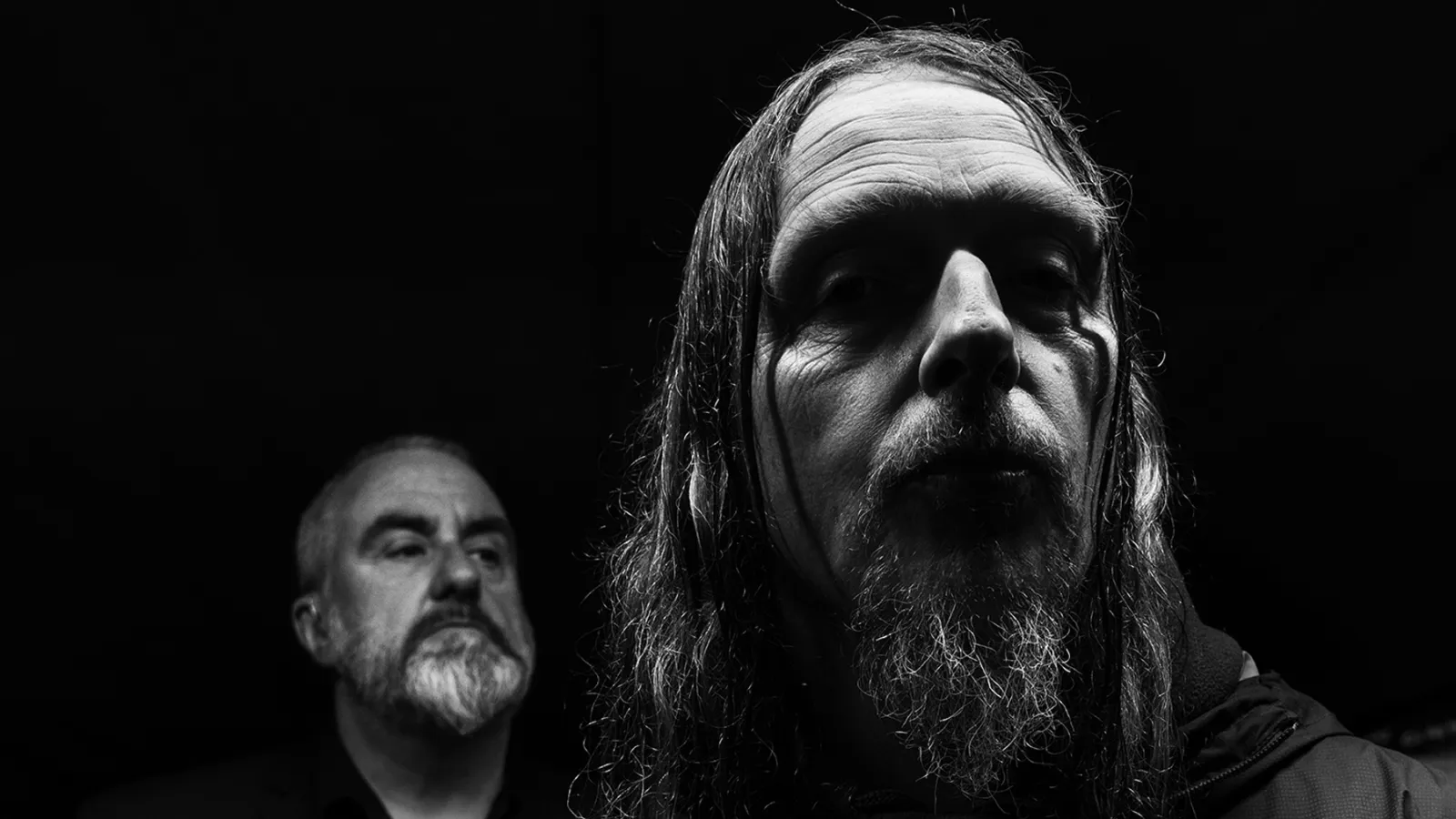
Over the course of Decay, Godflesh‘s 10th and supposedly penultimate album, frontman Justin Broadrick utters less than 150 words total in just 42 minutes. When you do hear his voice, he shouts, whispers, and growls. His words are at once part of the rhythm section and profoundly personal poetry. So when he sings, “Forlorn/evermore” on the song “Living/Ending” in a way that stretches two words into four — “for … lorn … ever … more” — you feel his pain. He sings in a way that makes you want to listen closely, and not just because Broadrick will never sing like this again.
This past spring, the singer-guitarist announced that hernia repair surgery left him with a six-and-a-half–inch scar and doctors’ orders never to growl again. If he did, he could rupture his abdomen, crippling him for life. Fortuitously, he had already recorded Decay’s vocals in the same sessions as Godflesh’s previous album, 2023’s Purge, so all he and bassist Ben Green had to do was polish off Decay’s music. Broadrick has said that Godflesh’s forthcoming final album, The End, will be more avant-garde — no yelling necessary.
Perhaps because they knew the end was near, the duo turned Decay into a perfect farewell to the unique fusion of industrial, techno, and rap’s mechanized rhythms and the downtuned guitar riffs of sludge metal that they have been chasing since the Eighties. Broadrick’s music has influenced Faith No More, Korn, Fear Factory, Living Colour, Metallica, and countless other headbangers, as well as Phoebe Bridgers, who liked Broadrick’s playing so much she enlisted him to play on her recent Lost Weekend album. But Godflesh never embraced pop song structures or melody in the same way as those that followed them, instead toying with musical form and resculpting the sound of heavy music into dystopic expressionism.
Unlike Purge, which hit hard right out of the gate with a barrage of forceful metal songs, Decay plays more to Godflesh’s experimental side, and its half a dozen tracks are some of the band’s most sophisticated and emotional songs. Opener “Master and Slave” inserts and removes musical motifs like a Jenga tower, sliding one sound out and adding others at a slowly uncoiling pace. There’s eerie synthesizer, trembling bass, and gut-checking guitar, all as Broadrick whispers, “There is no we/There is no me.” Then “Leaving/Ending” comes in with a Schoolly D–style drum machine rhythm and Broadrick shouts, “Bring about hard change/Soft wired, being boiled.” In contrast, “Feral Colony” is the sound of motion sickness with its pumping one-two-one-two drum-machine rhythms and undulating guitar.
The second half of the album is even denser. “Fear of Man” starts with techno-inspired bass-heavy drums, played at half speed, until piercing synthesizers hover atop them and Broadrick’s guitar squeals. It’s tough to listen to. There’s no midrange in the tone, only the most aggressive sounds your subwoofers and tweeters can muster. Then “Fodder” pushes even more bass frequencies until Broadrick starts sliding his hand up and down his guitar neck for disorienting sound; the drum machine serves as a nail gun here, holding listeners in place. There are house-music keyboard motifs in the background, but they’re easy to miss in the maelstrom. “What you say doesn’t matter,” Broadrick sings. “What you know doesn’t help.”
The album closes with “Consume Me,” a 12-minute descent into hell, Broadrick’s final recorded fury. It begins slow and atmospheric and altogether unsettling. Broadrick sounds like a monster when he sings: “Surrounded by razor tongues/Circling like sharks/Bleeding for your vampires/Sweating you shit out.” The intensity increases as the song progresses, leading to a final growl: “Bait, I am your bait, consume me.” It’s gutting and it’s emotional in its pureness. But from the sound in his voice, it’s clear that his own personal pain is what has been consuming him. You can almost sense the relief when he’s done, and it’s easy to share a sense of near satisfaction with him. The only thing that might have improved the album would’ve been if they’d dug into more rigid metal riffs, as they did on Purge, but that would’ve taken away from Decay’s general unease, the uneasy mood they can conjure up through experimentation.
Broadrick has always been one of metal’s most prolific compartmentalists, and his legacy is diverse. In the same decade Godflesh formed, he also helped pioneer grindcore as Napalm Death’s guitarist on their debut LP, and he dabbled in other kinds of industrial music and gloomy rock with Final, Fall of Because, and Head of David. He incorporated dub into Godflesh, explored EDM with Techno Animal and the Curse of the Golden Vampire, and shoegaze with Jesu, and he’s released music under the names of at least a dozen other projects. And he’s said he’s already been playing guitar on new recordings with Bridgers. He’s an artist who never shows all of his capabilities at once. So Decay isn’t the last the world will hear from Broadrick. It’s just the last time the world can treasure hearing him like this.