
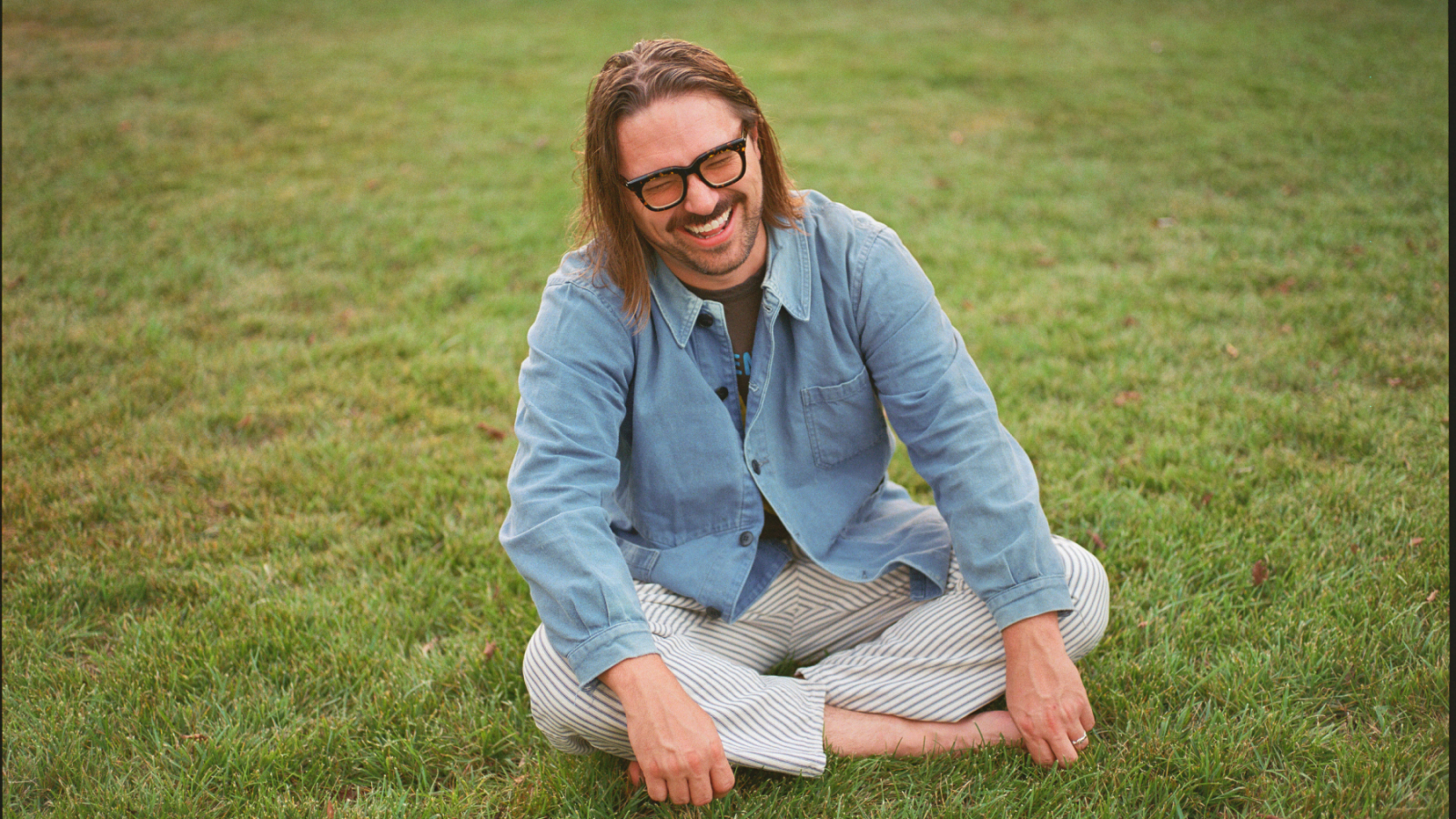
On a recent London afternoon, Gabe Simon is feeling rather uneasy. Though, as one of the most in-demand producers currently working in popular music admits, that’s exactly how he planned it. “We’re on an adventure right now,” says Simon, who recently uprooted his family from the comfortable life he’d built in Nashville for more than two decades to relocate across the pond and set up shop as producer-in-residence at London’s famed RAK Studios. “I wanted to be uncomfortable.”
It’s hardly a shock to hear him admit this: in many ways, stepping outside of his comfort zone, and specifically challenging himself to think beyond the confines of musical genre, has been the springboard to Simon’s recent success and critical acclaim. “I love doing things I feel like I’ve got no business doing,” Simon tells Rolling Stone. He’s best known as Noah Kahan’s production guru — one of the chief sonic architects of the folk-pop mega-star’s breakout 2022 LP, Stick Season, as well as this year’s acclaimed follow-up, The Great Divide. But what’s perhaps most impressive about Simon is his musical adaptability. In recent times, the producer, songwriter, and multi-instrumentalist — who cut his teeth writing songs for Dua Lipa and Lana Del Rey — has helmed production duties on albums for artists as varied as Kahan, rough-hewn country star Koe Wetzel, pop-rocker James Bay, musician-actress Suki Waterhouse, Myles Smith, and Dermot Kennedy.
“I’m trying to [work on musical] genres I don’t know much about,” Simon admits. “When I did Stick Season, I had never made a folk record before. And I felt like I had no business making a folk record. And now, every time I do something I have no business doing, it gets my juices going and I get really inspired. To do the uncomfortable things and show up and be ready and make great music with energy and a sense of wonder.”
A lifelong musician and 2011 graduate of Nashville’s revered music program at Belmont University, Simon tried his hand first at being an artist. He co-founded and fronted the indie-rock band Kopecky, who were signed to ATO Records. But when Simon and his wife had their first child, he realized it was time for a change. “Being in a band has its ups and downs,” he says. “But when we had the baby, I realized I couldn’t be gone anymore. Or if I was gone, it had to be something I was getting a lot of fulfillment in.” After a stint as a songwriter — “I was quickly dissatisfied” — he eventually pivoted to production work, if largely to feel he had more stake in the game. “I needed to do more,” he says. “I need to be touching every part of the music.”
Today, at RAK Studios, Simon says he broke out in laughter while looking at pictures that adorn the hallways, of famous producers who’d logged time there over the years. “Mainly dudes in suits sitting in front of Porsches,” he says of the photos.
He hardly sees himself in that stiff, cigar-smoking-producer-behind-the-boards lineage. Perhaps it’s because Simon’s style and approach is objectively more new age. “For me,” he says of his production style, “it’s a lot of sitting on the floor, crisscross apple sauce, asking artists questions so I can learn their vocabulary and what makes them tick and really go all in.”
A combination musical confidant, therapist, motivational speaker, and self-admitted hard-ass when the situation calls for it, Simon says his approach to working with artists – no matter their level of fame – is a delicate dance between encouraging them to indulge their wildest impulses while simultaneously holding their feet to the fire.
“I said this to Noah one time,” Simon recalls. “The only difference between being an artist and a kid is if a kid runs towards traffic you hold them back. But if an artist does, you let them get smashed and come out on the other side.
“I’m not a fan. I’m not going to bow down to them,” he continues, taking a hard look at his relationships with artists. “We are a team. That means I can tell them the truth. And it also means I give them my undivided attention and I’m listening to them. I’m asking the questions and learning about them. It’s not like an interview; it’s like therapy. They have all these feelings and all these emotions and all these sonic directions and years and years of trauma and joy. It’s turning all that into something useful.”
Wetzel, who first worked with Simon on the Texas country singer’s 2025 mainstream crossover LP, 9 Lives, and then again on this year’s The Night Champion, says collaborating with the producer resembled his first true therapy session.
“When Gabe and I first started working together, he sat me down and really pushed me to open up about parts of my life I’d never written about before,” Wetzel says. “He’s not afraid to keep asking questions until we get to the thing underneath the thing. He’ll dig and dig until you’re like, ‘Okay, damn, I guess we’re going there.’”
Simon understands the massive success he’s had working with Kahan has led people to perhaps pigeonhole him as the mastermind behind a specific musical style some have taken to calling “stomp clap.” He pays little mind to that. Simon believes his ever-expanding and undeniably diverse discography will paint the full picture.
“I have no desire to do one thing,” Simon says without hesitation. “I have no desire to eat fucking turkey sandwiches for the rest of my life. Nobody wants the same thing over and over again. I feel confident enough to move into different spaces without losing my own identity.”
To that end, Simon is taking meetings with label reps, managers, “and just exploring my options.”
“It would be kinda sick to make a post-hardcore, alternative British rock record,” he says. As for the idea that some fans familiar with his previous work could be caught off guard, he quickly replies, “Well, nobody thought Jack [Antonoff] would make the big Kendrick record.”
Simon admits he’s equal-parts proud and taken aback when he thinks about how big some of the records he’s produced have become. Notably, the ones he’s written with Kahan.
This past summer, Simon and his family attended one of Kahan’s sold-out shows at New York’s Citi Field; the producer couldn’t help but marvel at fans he saw crying and hugging as Kahan played songs he and Simon cooked up in a studio by their lonesome.
“It’s a terrifying thing, because then you recognize the impact of what you do by making these records,” he says of the experience. He pauses. “But at the same time, it’s fucking amazing.”