

vote
7.5
- Bands:
CRIMSON WAYS - Duration: 00:40:00
- Available from: 07/23/2026
- Label:
-
Fucking Kill Records
Streaming not yet available.
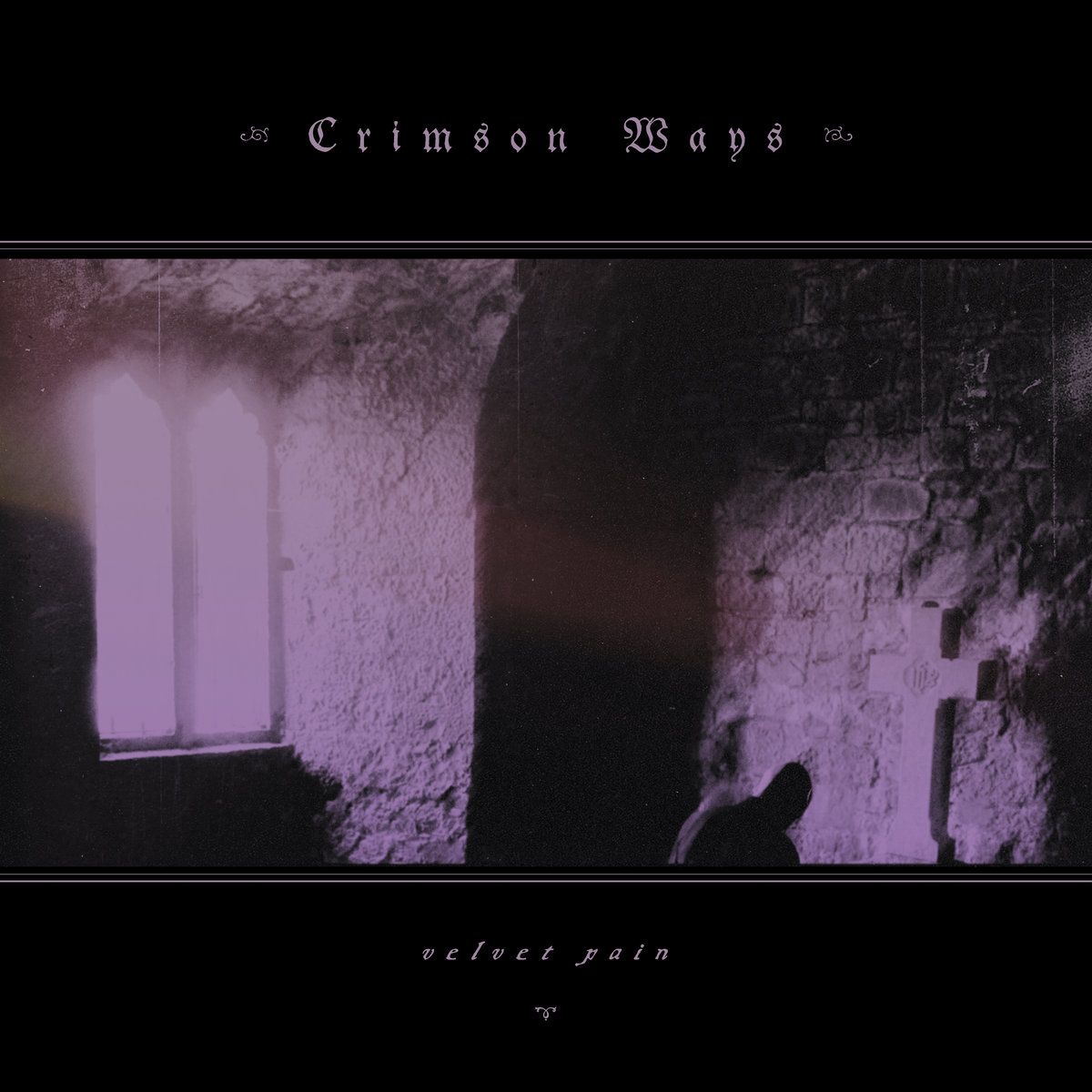
There are records that immediately declare their ancestry and others that prefer to hide them behind a more or less convincing veneer of modernity. “Velvet Pain”, Crimson Ways' debut, belongs without hesitation to the first category. From the first minutes, the German solo project reveals a deep connection with a specific season of European metal: the one in which death-doom was progressively abandoning its more monolithic nature to open up to a drier, more melodic and melancholic dimension. However, what makes this work interesting is not so much the fidelity to that stylistic heritage but the way in which it is reworked. More than simply evoking a consolidated aesthetic, Crimson Ways in fact seeks to insert itself into a still fertile tradition, treating it, at least in some cases, as a language to be developed rather than as a repertoire of formulas to be replicated.
The shadow of mid-career Katatonia inevitably hovers over the entire album: the cascading guitars, that peculiar mix of melancholy and tension that characterized works such as “Brave Murder Day”, “Sounds of Decay” and “Discouraged Ones”, represent one of the main reference points of the writing. Yet, where the Swedish band had often found its strength in essentiality, in controlled repetition and in a sort of austere expressive economy, Crimson Ways choose a slightly more lively path. In some episodes, the ideas are continuously expanded, folded and reassembled through developments that try to avoid staticity, introducing deviations and openings that significantly modify the profile of the compositions. It is precisely in a discreet management of the structures that “Velvet Pain” finds one of its most evident qualities. In fact, some songs go beyond the dimension of a simple song to take on almost narrative contours. However, this is not the hypnotic reiteration that had made the aforementioned “Brave Murder Day” memorable, where a few cells were explored to the point of emotional exhaustion. As mentioned, some compositions tend to progressively broaden their horizon, adding new sound environments along the way. Clean vocals that suddenly emerge from the growl texture, wider suspension openings, more enterprising lead guitar interventions and well-calibrated changes in dynamics contribute to giving certain songs a sensation of constant movement.
This vague propensity for expansion prevents the album from exhausting itself in the revivalist dimension alone. Alongside certain obvious coordinates before everyone's eyes, influences emerge that broaden the picture. In some passages a melodic delicacy emerges that seems to look to the more ethereal side of shoegaze and British alternative rock, indirectly recalling Catherine Wheel; elsewhere we perceive a decadent and vicious sensitivity that may recall certain intuitions of the Lifelovers. They are discreet presences, but sufficient to give greater depth to a writing that in some cases seems to carefully avoid the risk of homogeneity. At the same time, the album never completely renounces its heavier component: songs like “Aqueduct of Tears” bring the more severe side of the proposal to the foreground, through an incipit that clearly has its roots in classic death-doom before developing according to more agile coordinates. In these moments, the project's ability to balance gravity and melody emerges without sacrificing either. A piece like “Scum Prevails” is also particular, much more impetuous and mocking than the rest of the material.
Overall, listeners more accustomed to these sounds will probably end up finding a constellation of references that goes well beyond the name of Katatonia. In fact, within the folds of the album, suggestions resurface that refer to realities such as Yearning, Paragon Of Beauty or Daylight Dies, groups that have contributed to cultivating the lexicon of this particular cross between melancholy, reflection and metallic heaviness. These are not direct quotes at all, but rather a common sensitivity that runs through the entire work. Even the choice to entrust the mastering to Dan Swanö inevitably ends up strengthening the symbolic link with a certain tradition. On a compositional level, however, Crimson Ways show enough ambition not to turn this legacy into a limitation. “Velvet Pain” is an album that takes some time to fully assimilate, because its value lies not so much in its immediate impact but in its ability to progressively reveal new details and new connections. A debut therefore all in all mature and above all less predictable than its starting coordinates might suggest.
Daniel D`Amico for SANREMO.FM