
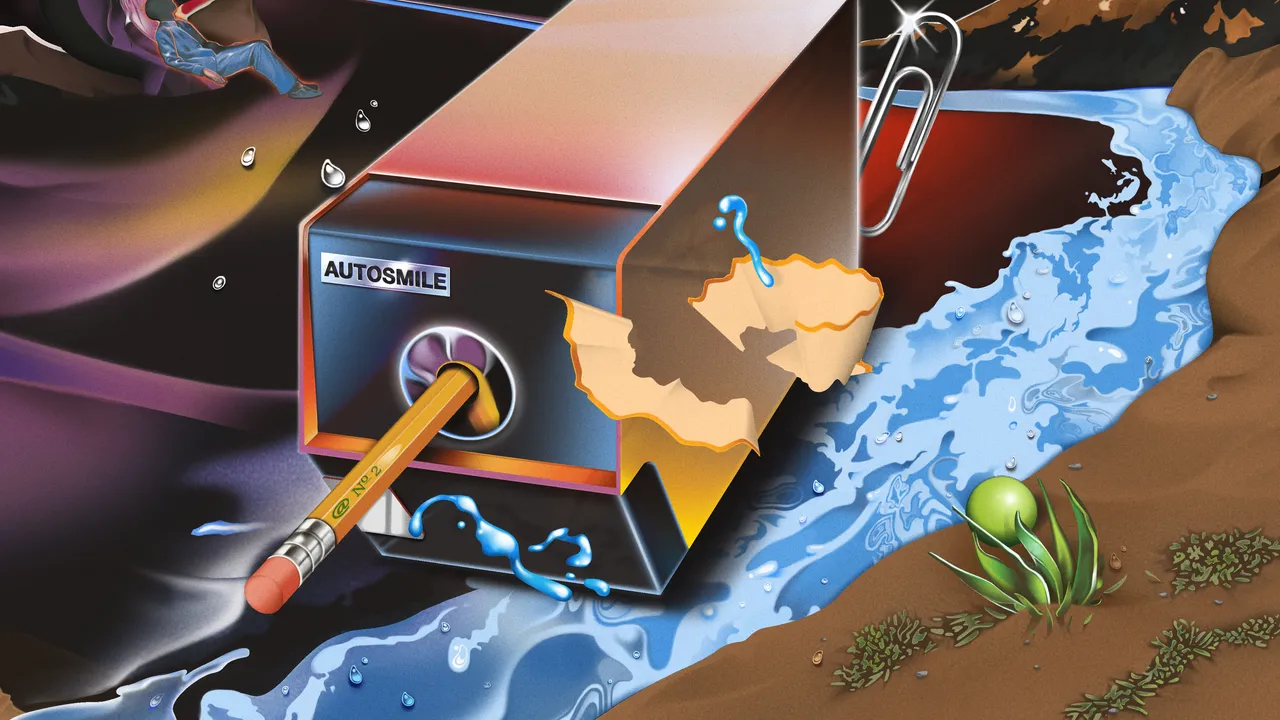
As songwriters, Filipczak and Rose favor expansive terrains. “Love in the Dark” sounds winsome and roomy with its synth arpeggios and dueling guitars. The percussion is sparse; it’s really not much more than the occasional kick drum. Autosmile, in general, uses percussion sparingly. Without the bowling alley bumpers of percussive rhythm, we’re left with a lot of negative space. And in that space we have songs like “Earthly Love.” Secret garden music. How lovely it is with all of its strings: the cello, the fingerpicked guitar. Among other things, Autosmile is interesting guitar music. When paired with Rose’s vocals, these songs have the ability to rise and fall with the speed and precision of a bird dive-bombing for fish. It all makes you feel achy.
Autosmile’s emotional centerpiece is its title track, a six-minute song that could be seven minutes longer. We can make out the broad contours of what Rose is singing about here: “Autosmile” is a song about a breakup. But it is also a song that evokes what it feels like to fall in love. It is about love as a feedback loop, a Möbius strip where those two things—falling out of love and falling into it—end up being the same thing. “You are not an accident,” sings Rose, “You’re perfect for this world.” She tells us that she is in a “lovely place.” She tells us that she feels blessed, that she wakes up every day and feels grateful to be alive. What a way to write about love.
Autosmile is a special record. It is earnest and weird and it is capable of doing that thing that I think very little music can, which is that it makes you want to examine your life. I did not know “Autosmile,” the song, was about a breakup, until I read about it. And when I learned this I thought to myself: The best love songs are told from outside of the room. They are told from the future about the past. The same can be said about Autosmile as a whole. Rose and Filipczak are writing from outside of the room. They are writing opaquely but with wisdom. With, as Rose sings it, beauty and grace.