
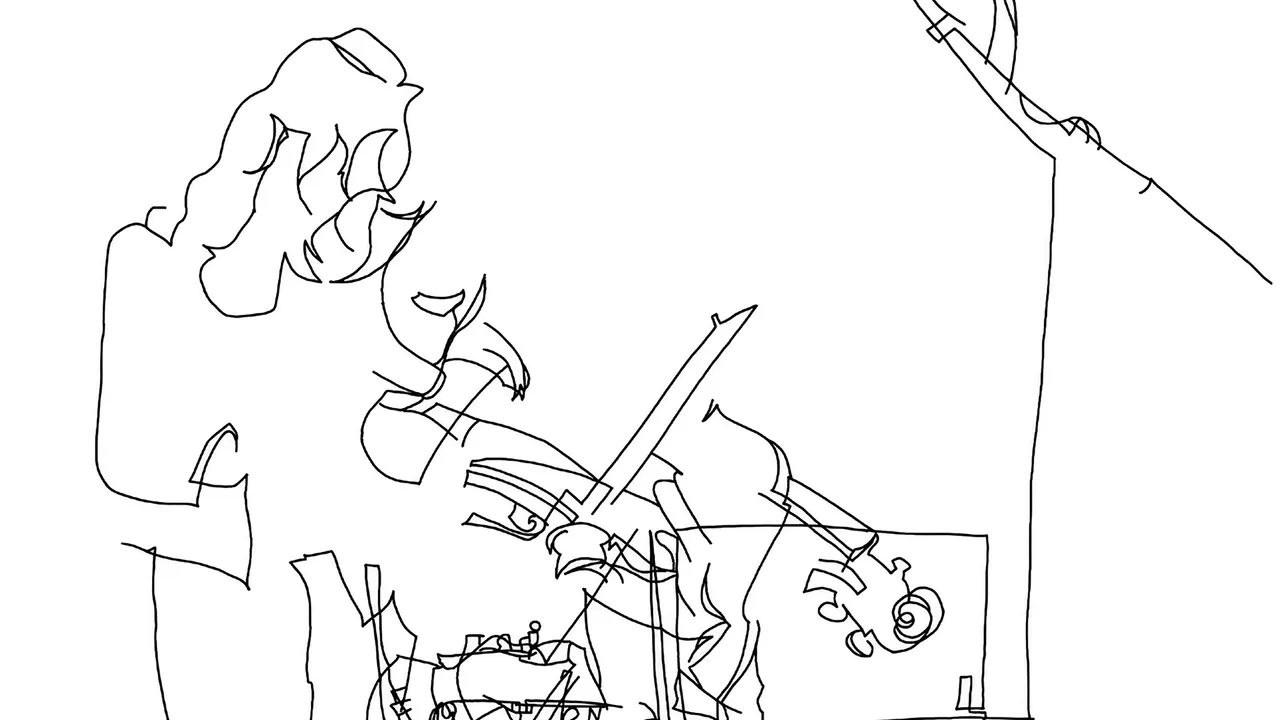
In Meeting the Universe Halfway, a philosophy of science book that launched a thousand PhD dissertations, theorist Karen Barad outlines two different approaches to understanding how we experience the world: reflection, where our experience is one of “mirroring and sameness,” or diffraction, which attends to “patterns of difference.” For Barad, diffraction is more apt for describing our real lives: seeing, listening, and touching, they argue, are always acts of translation. Diffraction is also a useful way to think about the music of Mari Rubio, who performs as more eaze. Rubio’s music taps into some essential component of an instrument, a genre, or an idea, and diffracts it back to us in a way that is both familiar and strange.
sentence structure in the country, her March 2026 debut for Thrill Jockey, stripped down Americana to the studs and fed the components through a process of electroacoustic experimentation. The result was a tapestry of bizarro folk elegies whose combination of violin, slide guitar, and the occasional lovestruck lyric sounded like tuning into AM radio in the midst of the apocalypse. On her follow-up, valley and structure, she continues to reference folk and country music, including some twangy violin and guitar. But she passes these sounds through the looking glass, filtering them through minimalist and ambient approaches.
No score yet, be the first to add.
Each song title on valley and structure includes the word “structure,” and each is built around loop-based patterning. The beauty of the record lies in how these loops slowly diffract over their runtime, becoming subtly reformed over each repetition. In the first half of the album’s centerpiece, the 20-minute “once you say yes to the structure, you never get out,” a simple violin loop and breathy vocals blossom against repeated twirls of woodwinds, guitar strums, and a walking bassline. Eight minutes in, the loops dissolve into slowed chords and the occasional pluck of piano. Slowly, she builds the track back up, and the force of her bow on the strings intensifies into a rush of ecstasy. This pattern is repeated across the record as each song becomes a study in complex simplicity: We get lost in the repetition of loops, trying to map the little details that slowly transform across the songs’ extended runtimes.