
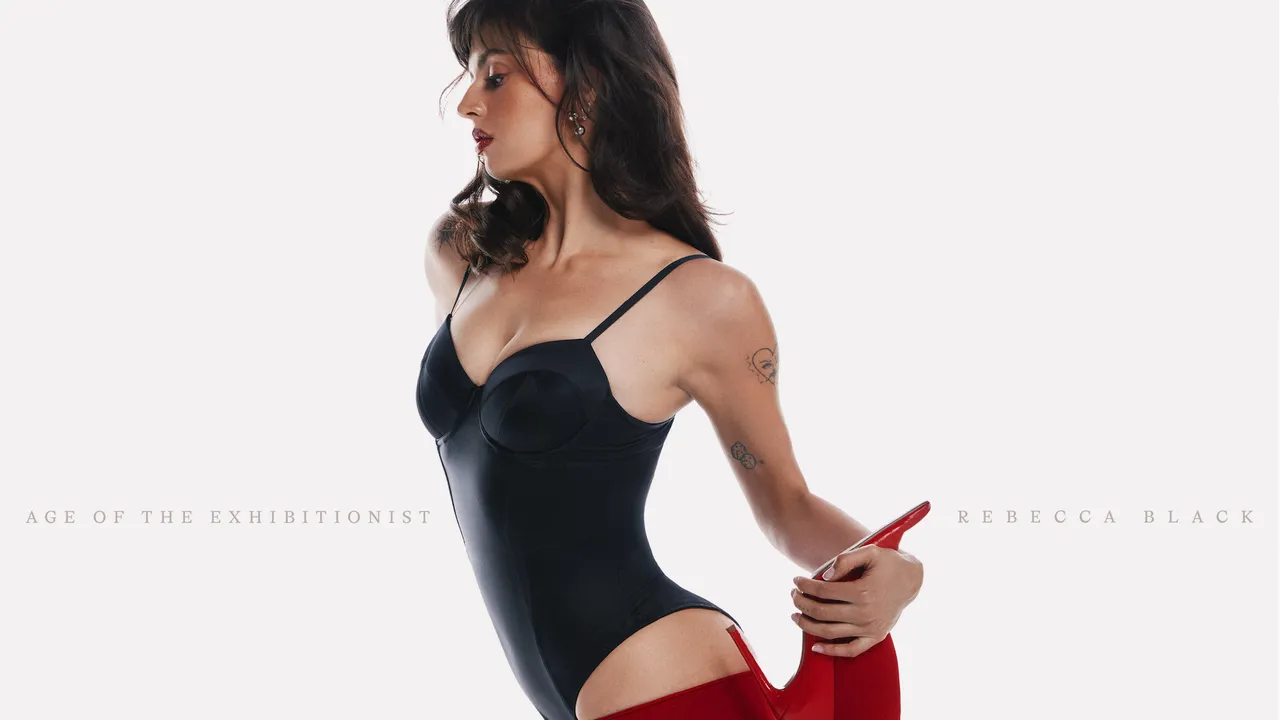
You could draw a map of the pseudo-Los Angeles pulsing through Age of the Exhibitionist. Begin in Anaheim, the sunburnt suburb and birthplace of pop artist Rebecca Black. Take the freeway to the laundromat that’s actually an underground queer club; hit the dancefloor where you can watch “your best friend go French with Miss Black.” Hell, there’s even a mansion, maybe tucked away somewhere in the Hills. Black’s second album, created with producers including Nightfeelings (Kim Petras’ Detour), Oscar Scheller (Kelela, PinkPantheress), and atlgrandma (ADÉLA, The Hellp), is full of these secret pleasure dens. It’s a giddy electro-pop concoction with frisky, hedonistic dreams, though even the most freaked-up tracks—“Exhibitionism,” “Miss Delicious,” “Waschesalon”—feel less like full-throated anthems to sexual liberation than digicam snapshots of that night you hit the sex clubs with your friends.
Age of the Exhibitionist is not the radical sexual fantasia of Erotica, nor the sensuous, tortured introspection of LP1-era FKA twigs, though Black does evoke something similar in the skeletal seductions of “Corsetry”: “Pain will make the idol.” Despite the album’s title and many gestures to kink—exhibitionism! femdom! gunplay! bondage!—it seems unlikely to kickstart anyone’s sexual awakening. But that’s no reason you can’t bump it in the Uber on the way to the dungeon. Much like a good dancefloor makeout session, where you can get away with not knowing someone’s name as long as the mood is right, Age of the Exhibitionist skimps on the story to focus on durably constructed pop and voyeuristic fun. Small surprises reveal the music’s playful curiosity: the juicy bass that becomes a squelchy puddle and a squirming maw of ecstasy in “Hot Wet Delirious,” the soaring helium-pumped “I wouldn’t mind”’s in “Michael.” that suggest a body lost in pleasure, the woozy trip-hop comedown of “Backstage Baby Interlude.”
No score yet, be the first to add.
You’ll recognize some stars at this club: There’s dashes of Britney and older Gaga in “Metamorphia,” a “Fergalicious” interpolation in “Miss Delicious,” and “Hot Wet Delirious” sounds like Kylie Minogue emerging from a K-hole in a West Hollywood warehouse. The album’s reverence of its idols may invite criticism, but it also showcases Black’s dexterity as a DJ, with each song twisting through multiple transformations. “Anaheim Star” is a new-age Gwen Stefani cheerleader chant for 30 seconds before it mutates into something else, all chiptune vocals and loopy verses that sound like they’re being squeezed out of a whipped-cream can. Thumping highlight “Waschesalon” is a journey in itself, beginning with the slow, trepidatious walk down a long entryway tunnel to the club and finally bursting its own “I Feel Love” high, where chants of Waschesalon! are drowned out by starbursts of ecstasy. Though Black has sanded down Salvation’s idiosyncrasies and Let Her Burn’s hyperpop hamminess in favor of smoother, more digestible dance-pop, she keeps some flourishes that let her get weird.
It’s tiring to still have to bring up “Friday” in discussion of Black’s work over 15 years later—She has a legitimate music career now! She literally made “Sugar Water Cyanide”!—but Black does allude to the song that, for better or worse, kick-started her arc. “I left my high school behind just to get what I want/I looked myself in the eye, cut the line to the front,” she sings on “Anaheim Star.” Her complicated past takes stage most poignantly on “Visions Again,” an ode to Orange County angst. Over a four-on-the-floor beat that sounds like a nervous heart thumping, Black sings of dreaming of the city that’s so close yet so far away, of waiting to become a star. She’s still on that road, but she’s nearer than ever now to where she needs to go.