
If you purchase an independently reviewed product or service through a link on our website, Rolling Stone may receive an affiliate commission.
Even as monitors boast ever-faster refresh rates and laptops come loaded with all sorts of AI-powered features, one crucial factor has stayed stagnant (or even regressed) in personal computing: sound quality. Not all monitors come with built-in speakers, and the ones that do are often underwhelming. Laptop makers have likewise increasingly prioritized lightweight portability over powerful sound.
Best Computer Speakers
That’s why the right pair of computer speakers can go a long way in making the most of an eight-hour workday. The basic criteria for a pair of desktop speakers are simple — they have to sit on a desk, easily connect to a computer, and should ideally sound good. But the use cases are broad, from gaming and video editing to conferencing and listening to music, which is why the best desktop speakers will have versatile connectivity options and powerful sound in a tabletop-friendly package.
How We Picked the Best Desktop Speakers
To find the best computer speakers, we started by testing options from well-regarded brands like Edifier and Cambridge Audio, evaluating them on sound quality, design, and features. Because computer speakers are expected to suit a wide variety of use cases, we also looked for options with plenty of connectivity options that could benefit gamers and content creators alike.
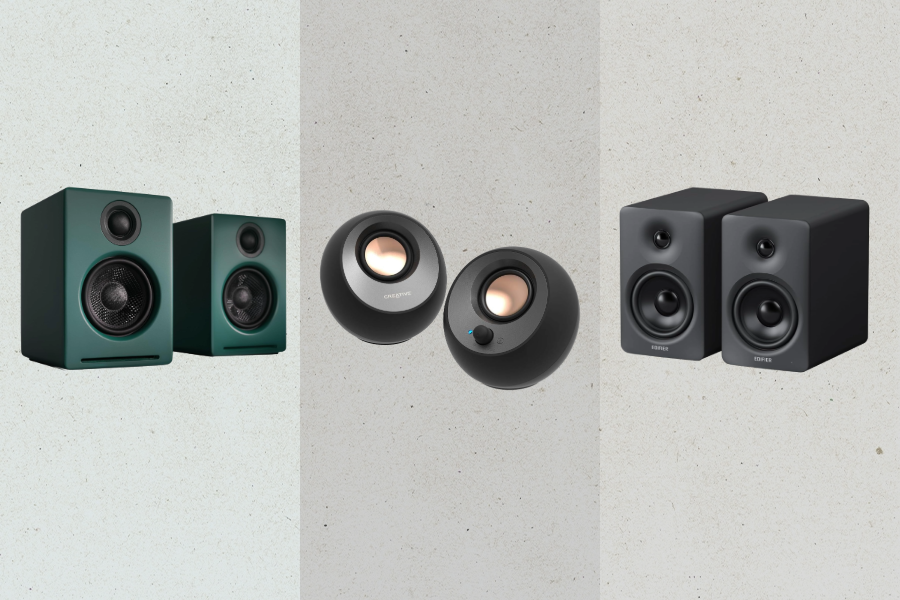
From audiophile-grade speakers to compact options for small desks, these are some of our favorite desktop and computer speakers to buy in 2026.

Jonathan Zavaleta/Rolling Stone
best overall
Edifier M90
Quick Summary: With great sound quality and plenty of connectivity options, Edifier’s M90 speakers are among the most versatile you can buy.
Pros: Plenty of ports, including HDMI eARC; big sound in a fairly compact package; easy to set up and use
Cons: Limited color options; pricey
Edifier makes a wide range of desktop speakers and has quickly become one of the go-to brands for affordable hi-fi audio. The M90 speakers get almost everything right in a pair of desktop speakers; they have plenty of connectivity options, and, size-wise, they’re just big enough to fill a small room but small enough to not overwhelm a desk. As for the design, they’re stylish and sleek, but only available in black or white.
In terms of connections, the speakers feature inputs for optical, USB-C, HDMI, and Aux cables, and they also feature Bluetooth. There’s a remote, although everything from powering them on to switching inputs to changing the volume can be done with the multifunction knob on the back. The HDMI eARC port means they can be used as TV speakers, in place of a soundbar.
The M90 speakers are no slouches when it comes to sound quality. They have rich, detailed sound with clean highs and sufficiently deep bass for music, and they should also be well suited to gaming, movies, and more.
Jonathan Zavaleta/Rolling Stone
Best sound quality
Cambridge L/R S Speakers
Quick Summary: Cambridge’s L/R speakers are among the most stylish and premium-feeling I have tested. They have excellent sound quality, too, but the price tag may put some off.
Pros: Stylish design; plenty of connectivity options; L-R orientation can be switched
Cons: Pricey; no on-board volume controls; somewhat large
Cambridge Audio’s powered speakers are among the most stylish on the market, with a modern look and availability in a wide range of colors to suit any desktop. The L/R S speakers are slightly on the large side, compared with other desktop speakers; they’re the ideal size for my 53-inch-wide office desk, but would overwhelm my 42-inch-wide home desk.
They offer a wide range of connectivity options; there are inputs for RCA, optical, and USB-C audio, and you can connect to them using Bluetooth. The back panel also adjusts the sound profile, depending on how the speakers are situated; there’s a switch for if the speakers are near or away from a wall, as well as for if it’s on top of a desk. There’s even a switch to flip the orientation and make the left speaker the right one and vice versa, which comes in handy if the power supply is on the other side of the desk.
Sound quality is where they shine the most — Cambridge is known for its audiophile bona fides, and these speakers are well suited for use as bookshelf speakers as well as computer speakers. The sound profile is balanced, with low end that’s energetic enough but won’t rattle your desk. If you need more bass, there’s also a sub out port.
Jonathan Zavaleta/Rolling Stone
best value
Creative Engine Pebble V3
Quick Summary: If you’re looking for an option for casual listening or work use, the affordable Pebble V3 speakers are a breeze to set up, look good on a desk, and are refreshingly affordable.
Pros: Affordable; easy set-up; can be powered directly from a laptop or monitor
Cons: Sound isn’t showstopping; speakers are permanently tethered
Not everyone is after audiophile quality for their desktop speakers — if you just need an affordable set of compact speakers to pair with a monitor that doesn’t have any, the mini Pebble V3 speakers are a great option. They’re very small and lightweight, meaning they should fit comfortably on even the smallest desks.
The tiny speakers are also easy to drive; you can use one USB-C cable for both audio and power, without needing to plug into a wall outlet, which cuts down on desktop cable clutter. There’s also a 3.5mm audio jack (the cable is not included), or you can connect to them using Bluetooth. The power and volume controls are on the front panel, so it’s easy to make adjustments.
Sound quality-wise, they’re not showstoppers — they don’t get particularly loud, and there’s a brightness to the highs and a lack of bass. But they’re definitely an upgrade over most laptop speakers, and they’re a great option for just $40.
Jonathan Zavaleta/Rolling Stone
best compact speaker
Audioengine A2+
Quick Summary: AudioEngine’s A2+ speakers have plenty of connectivity options, including RCA inputs, making them a great option for desktop or turntable use, and they come in a wide range of colors.
Pros: Stylish design; plenty of ports; small enough for most desks
Cons: Somewhat pricey for the size; use of speaker wire makes them less convenient
For such tiny speakers, the Audioengine A2+ pack a serious punch. They have a versatile range of connection options for everything from computers to turntables, but the small size means they can sit comfortably on even the smallest desks. They’re also available in a wide range of colors, from understated black and white to bright red and yellow.
They have an RCA input, making them a solid option for turntables, as well as a 3.5mm AUX input to connect to a wide variety of sources. As for desktop use, there’s a USB-C input and Bluetooth. The speakers connect with traditional speaker wire, rather than a single cable, and the power supply is bulky, making cable management somewhat trickier.
The speakers themselves are tiny — at 6” tall, you can’t expect room-filling sound, but the speakers have more than enough power for desktop use. There’s a 2.75-inch woofer and a front-ported bass port, so they deliver sufficient bass, and they shine with balanced mids and highs. You’d be hard-pressed to find better-sounding speakers that are this compact.
Jonathan Zavaleta/Rolling Stone
best for gaming
Creative Pebble Nova
Quick Summary: The design is undoubtedly eye-catching, and these speakers have great sound quality and features like multicolor lights that sync with your audio.
Pros: LED lights; speakers come with elevated or low-profile stands; solid sound quality
Cons: Pricey; other options have more connectivity options; design won’t suit all tastes
Creative’s Pebble Nova speakers trade classic hi-fi looks for a futuristic aesthetic, and the orbs won’t be for everyone. But the design is surprisingly practical for a desktop, thanks to the included stands — despite their large dimensions, they don’t take up too much space on a desk, and the drivers are angled at listening level.
The speakers also feature customizable lights that can sync with music or games, and they can be connected via USB-C, Bluetooth, or a 3.5 mm AUX-in cable. That’s versatile enough for most desktop setups, although other options on this list include more ports for a similar price point. But unlike most other speakers, these come with their own stand with two mounting positions.
As for the sound quality, it’s impressively rich despite the odd shape of the speakers, and they can confidently fill a bedroom or a small-to-medium-sized living room. The speakers also have passive bass radiators, adding extra oomph to the low end. If you don’t mind their somewhat unusual aesthetic, they’re a great option to consider.