
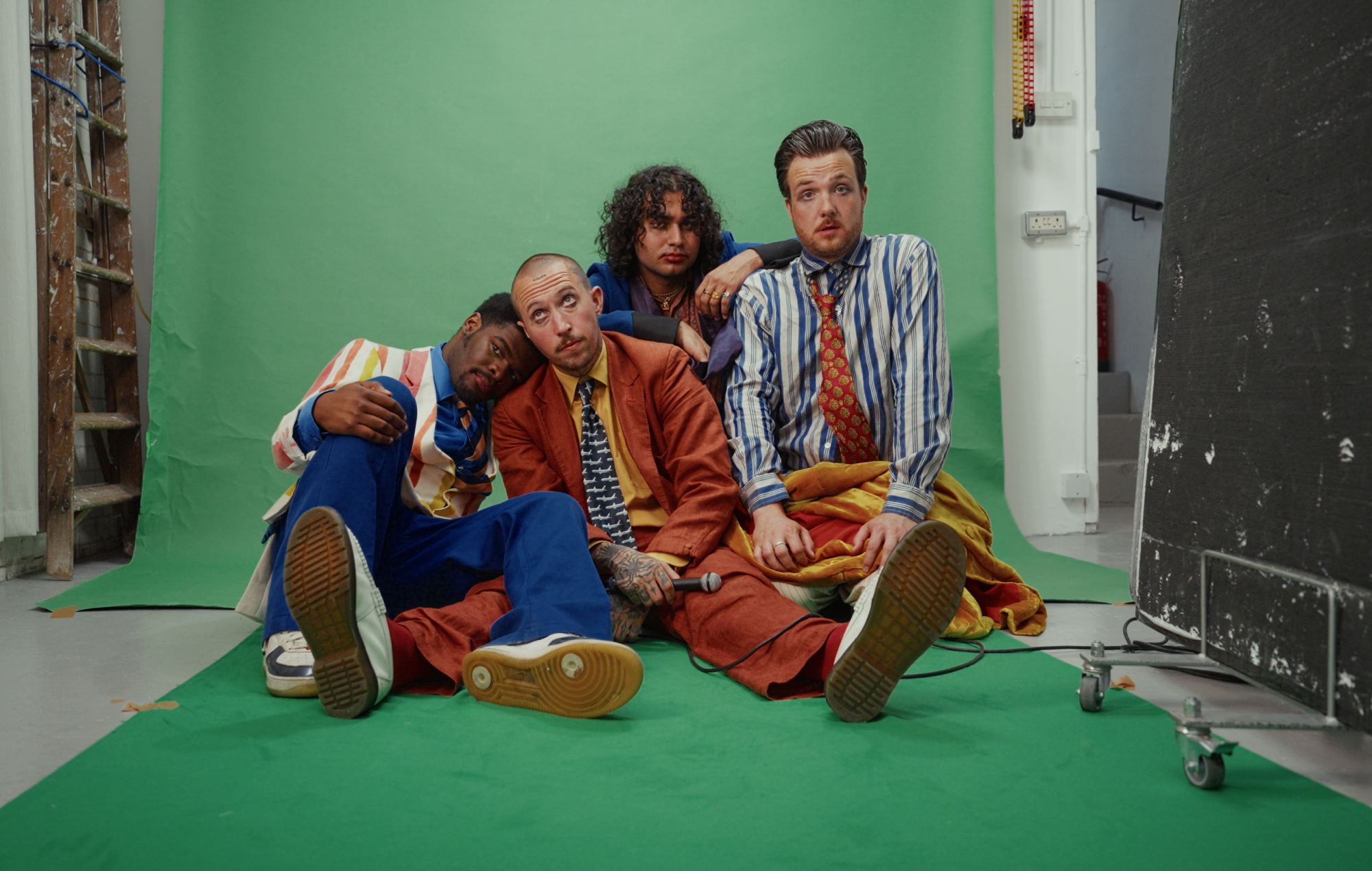
Laurie Vincent has spoken to NME about stepping out of the shadow of Soft Play with a newfound confidence to launch new band Big Truck.
As one half of the Tunbridge Wells punk duo, Vincent helped set the course for the UK rock scene with Soft Play (formerly Slaves), culminating in 2024’s ‘Heavy Jelly’ being their most acclaimed and highest charting album of their career. When a heavy tour schedule was complete, his bandmate Isaac Holman busied himself with making a new record as solo project Baby Dave. With the creative itch, he took his huge bank of demos to drummer Sam Coppin (formerly of Lady Bird) who saw promise in the songs and offered to form a new band.
Together with guitarist Asa Thallon and keyboardist Justin Myles, Big Truck was born – taking in their influences of indie, punk, jazz, soul, metal and R&B to create the album ‘Midday At The Middleway’. Released last week (Friday August 28), it’s a fully-formed and considered debut that’s contains flourishes of The Cure, The Smiths, Pixies and The War On Drugs.
“This is a melting point of influences, different backgrounds and styles,” Vincent told NME. “It shouldn’t work, but it does. That’s the beauty of being in a band.”
The sense of purpose behind the album was also driven by Vincent stepping up in his duties for Soft Play’s last record.
“‘Heavy Jelly’ gave me this real sense of confidence because I had such a part to play with the development of song structure,” Vincent continued. “With old Soft Play albums it would just be ‘verse, chorus, verse, chorus, done’, whereas I really doubled down on the pre-production and working through issues.
“With all the confidence that I found, I thought, ‘How far can I take this?’ I always wanted to have a go at being a frontman. I realised that I had to take that opportunity because it wasn’t going to be given to me.”
Check out the rest of our interview with Vincent before, where he talked to us about creativity, Buddhism, sobriety, and the beauty of new bands doing it the old school way.
NME: Hello Laurie. Becoming a frontman is a whole new mentality. When did you realise that you’d reached that?
Laurie Vincent: “There was a really important part of forming Big Truck, which was that we went out and did gigs before we recorded. We practiced and treated it like we were in a real band. It was like being a kid, putting your gig back on your back and going round your friend’s house to make music when it would have been a lot easier to stay at home.
“It wasn’t like some other projects I’ve done like Larry Pink The Human which was really heavily based in the studio, then you release it all and try and do gigs afterwards. You haven’t allowed that chemistry to brew. I’m not going to lie to you: the first few Big Truck gigs were ropey and there’s a lot that we had to work through to get to where we are now, but because we put that year in of gigging, practicing and playing festivals, now the album is out and I’m like, ‘I know I can do this’. That’s only because I put the work in.”

Did anything about that process take you by surprise?
“It kind of surprised me that I could do it. I always assigned myself to the sideman role and thought, ‘This is as good as I can do’. That’s still great and I’m really proud of all I’ve achieved, but watching people sing my words back or comment on my vocal delivery was great. Lyrics have always been my fascination because I felt that they were so far out of reach. Now the album even has a spoken word song as an interlude, and that feels like it came from a higher place. I’m not sure how we wrote that. When we play it live, it’s always the song that people comment on. It’s delving into poetry and art and taking something so much further than what I thought I was capable of.”
Has opening up that new side of yourself changed you in day-to-day life?
“It has, and my personal life is filtering into the project as well: the confidence I’ve found in the last few years, being a father, going through therapy, going through major traumas, and establishing myself as an adult.
“In Soft Play sometimes it feels like I’m cosplaying my 18-year-old self. It’s challenging tearing your hamstrings doing high kicks because of people’s preconceptions of what your band is, whereas I feel a sense of comfort and confidence with Big Truck. People say to me, ‘This actually sounds like the person I know’.”
What would you say the sonic touch-points of the record are?
“I had this unspoken rule when I was writing demos that every single idea that came out of me was valid and that I should explore it. There’s the phrase ‘writing for the bin’ where you just have to do it to unblock the pipes. Especially being in a heavier band like Soft Play, there’s an idea of what people expect from you. That trapping of genre becomes really tedious. This was a chance to go places I’ve never been before.
“Also, having four members to play four different parts was a liberation. I could actually explore things here and nothing was off the table. When you package it all together it sounds like one band, but Sam got me into jazz, Acer on guitar is a metalhead, Justin is into soul and R&B. Even though I wrote all the songs, it spills into the performances.”
How would you describe the character of the album?
“It’s distinctly British, but it comes from an art background. You know how Blur are deemed ‘the art school Britpop band’? There’s something art school about what we’re doing. It’s angular and the band is bigger than just the songs. It’s got a visual identity with the artwork. I was hugely inspired by how genre-defying The Beatles are too. They don’t just stick to one place. It’s technicolour.”
Finding yourself as a frontman is enough of a challenge, but then there’s finding yourself as a lyricist…
“Yes. I had to unlock the ability to even have words to write, which was a whole challenge. The music that I loved always seemed to come from working class struggle. Something I’ve always wrestled with in Soft Play is that punk is an inherently working class genre, as is rap. What do you talk about when you know that you haven’t struggled as much as other people?
“When so much of the world is choosing to be divisive, but it just all goes back to The Beatles again and talking about love and connection. It makes things so much more simple. The thing that’s really become obvious to me is that the album is about the light and the dark and how they co-exist. It’s about the yin and the yang. We can’t have the joy without the suffering. I noticed that it crops up in the lyrics all the time. You can’t have the band and the family, sacrifices have to be made. What it is to be human is to wrestle with those things.”

The song ‘Surf The Suffering’ is particularly profound in your journey to find peace from “the ugly side” of life. Have you found any answers?
“Like a lot of people in bands, I went through a hedonistic period and then I found years of sobriety. Now I’ve landed in the middle because being sober is just as much of a chain around my neck as drinking. Really, we should be able to walk the middle ground. There’s a Buddhist sentiment about the middle way about earthly temptations and enlightenment. If you’re going to go out and party, then you just get up the next day, accept the consequences, learn something from it and get on with it.
“I’ve got an extreme aversion to victimhood. I’ve learned that human existence ain’t perfect, that’s OK.”
Themes of Buddhism and gratitude seem to pop up through the record a lot…
“Yeah, and there are moments of sheer frustration where you want everything to be different, then when you really look at your reality you realise how much worse it could be. Then you’ve got to find a space where you allow that energy out. We’re just wrestling with all this energy and trying to balance it all the time.”
What else have you gleaned from Buddhism?
“Meditation is just about being a space that is solely centred and where you’re present in the moment. That, and the main goal in Buddhism is to pray for everyone’s happiness. It’s been way more useful for me to frame things in that perspective. For so many years until ‘Heavy Jelly’, I think anger was my main energy, and being pissed off with everyone. It worked pretty well, but after a while it gets twisted. Thinking of other people’s happiness is way more positive.”
That must come easier too with Big Truck being a new band in a very old-school way…
“We’re literally doing everything like that – even signing to an amp company [Marshall Records] and using their studio. Let’s just take it back to basics and be a band. It seems so trite but it’s actually doing us wonders because we’re friends.”
Soft Play came up on the precipice of the social media age become a hateful inferno of doom. How do you feel about new bands having to compete within that?
“I’ve got this romantic belief that the people doing it for the right reasons will cut above, but I’ve seen this trend that the act of being in the band and needing to be seen is making them forget about doing the art. As long as the art is the centre of the whole reason you’re doing it, then I don’t think you can go too wrong.
“I’m noticing a lot of bands that don’t have any music but they’ve got everything else: the look, the attitude, the social media following. But what about the art? Get that right then you can get down with TikTok, because you have to use the tools at your disposal. Would I rather be in the Hendrix era? Sure, but it’s really tricky. The toughest thing now is that there’s no real money in it.
“I actually see the advent of AI as a huge opportunity because people are going to be craving realness again. The slop is actually giving us something to define ourselves against. I don’t know if I’d want to be in a new band right now, but I am in a new band right now and it feels really good.”
Do you foresee this being more than a side project?
“Doing all the press and launching it, I’ve realised that it all comes down to me and rests on my shoulders and depends on how I treat it. People are going to follow my lead. If I went straight back on a Soft Play campaign now they’d be like, ‘Oh, he’s bored with Big Truck now’, but I’ve written album two and we’re going to record it in November. My plan is to try and have the next album campaign starting as we go out on our next headline tour. I love having a bit of a reason to prove people wrong. That does give me some fire under me.”
What’s next in the arc for Big Truck then?
“I remember these pivotal things with Soft Play happening on our way up. I remember playing to 80 people in Islington with people singing our songs and dancing and thinking, ‘This is what it feels like to make it’. Then there are all those pillars along the way with all these real life interactions and the music meaning something to more people. That’s happening really fast for this band so the expectations keep getting bigger and bigger.
“Sonically, I know we’ve got a broader appeal than Soft Play because the music isn’t as ‘intense’ in a heavy way, so I’ve got this self belief that it could be whatever we dream it to be. The reality of your dreams is that you have to work really hard to get them.”
Have there been discussions about the future of Soft Play?
“There’s a Soft Play record that’s half done, but that needs finishing. It’s something that I’m wrestling with, because I feel like I’m a sideman in Soft Play so to go back to that role after this will be tricky. I’m not one for massive breakups, but I am for hiatuses. I think it’s human to take breaks and time off. I’m not in a rush to make something new with Soft Play, but I’d never say never.”
Anything you can tell us about that half a record, or is it quite early days?
“It’s a weird feeling, because in my opinion it’s the best record we’ve ever made but it’s also quite tricky to get it over the line just because of how long we’ve been doing it for. With me feeling like I’m cosplaying and there being less tensions as Isaac and I get on even better when we’re not doing Soft Play, it’s a weird one, man. Soft Play operate on a 90 per cent break even or less rate. So 10 per cent of the time we do really well, but then to go away for 90 per cent of the year where we’re losing money to go to Europe or America, it feels a bit redundant. There are lot of real life struggles that tie into it.”

Are you hopeful about the future?
“I think that we’re at a really exciting time for bands again. When I look at Geese, Wet Leg, Big Thief or Wolf Alice, it’s in pretty good shape out there. There’s a lot of negativity out there, but I’m feeling really excited about all the possibilities and just making art again.”
‘Midday At The Middleway’ is out now via Marshall Records. Vincent is also hosting an art show to celebrate the album at Whistleblower Gallery in Brighton from September 4-19. Big Truck’s upcoming UK tour dates are below. Visit here for tickets and more information.
SEPTEMBER
3 – Brighton, Resident
16 – Hamburg, Reeperbahn Festival
OCTOBER
17 – Manchester, Neighbourhood Festival