
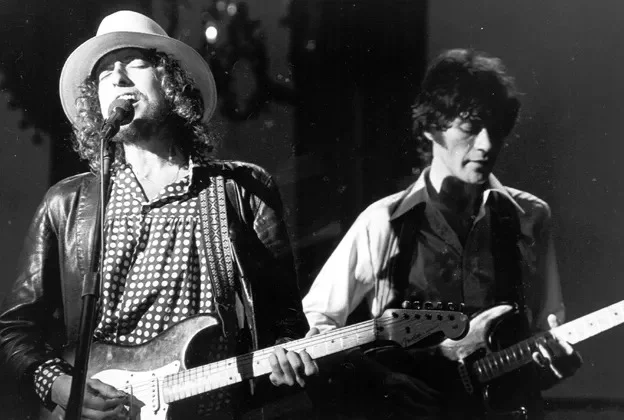
The Rolling Thunder Revue passed by the East Coast and left, leaving behind a climate of enthusiasm and anticipation to understand what Bob Dylan and his companions' next move would be. Both in New Haven and at the Madison Square Garden benefit concert for Rubin “Hurricane” Carter, the tour represented a sincere attempt by some of rock's most important protagonists to make the relationship between musicians and audiences more human. The choral formula of the show, the continuous collaboration between the artists on stage, the itinerary kept secret and the exclusion of most music industry professionals from any role in the organization were all ideas born of Dylan's intelligence and sensitivity. As a whole, the show conveyed a strong sense of adventure and integrity.
But the most interesting aspects of the operation are perhaps the less obvious ones. Dylan, for example, uses the structure of the vaudeville variety show as a tool of criticism. I have always considered Dylan a critic: not in the more common sense of the protest singer-songwriter, but as a critic of the world as a whole. Whatever he does, he conceives it simultaneously as a comment on himself and as an implicit comment on the reality around him. He is always aware of the context and constantly tries to question it. He is not simply different: he consciously chooses to be.
When, in the mid-1960s, Dylan began playing electric music, that choice did not only have an aesthetic value: it was also a criticism of his colleagues on the folk scene and a challenge to respond to them. Later, choosing more essential sounds in John Wesley Hardingclearly distances itself from the nascent psychedelia and monumental productions such as Sgt. Pepper's Lonely Hearts Club Band.
The Rolling Thunder Revue is also a critique of the way rock concerts have become. The band worked to transform the huge spaces of the arenas into a selling point; she never accepted becoming a prisoner of the places where she played.
With the same logic, the show is conceived as a unitary organism and not as a simple succession of numbers. The spontaneous interaction between the artists – Dylan and Joan Baez singing together, Baez on backing vocals for Roger McGuinn, McGuinn alternating with Dylan on the verses of Knockin' on Heaven's Door – creates a spirit of camaraderie that gives unity to an already very long concert.
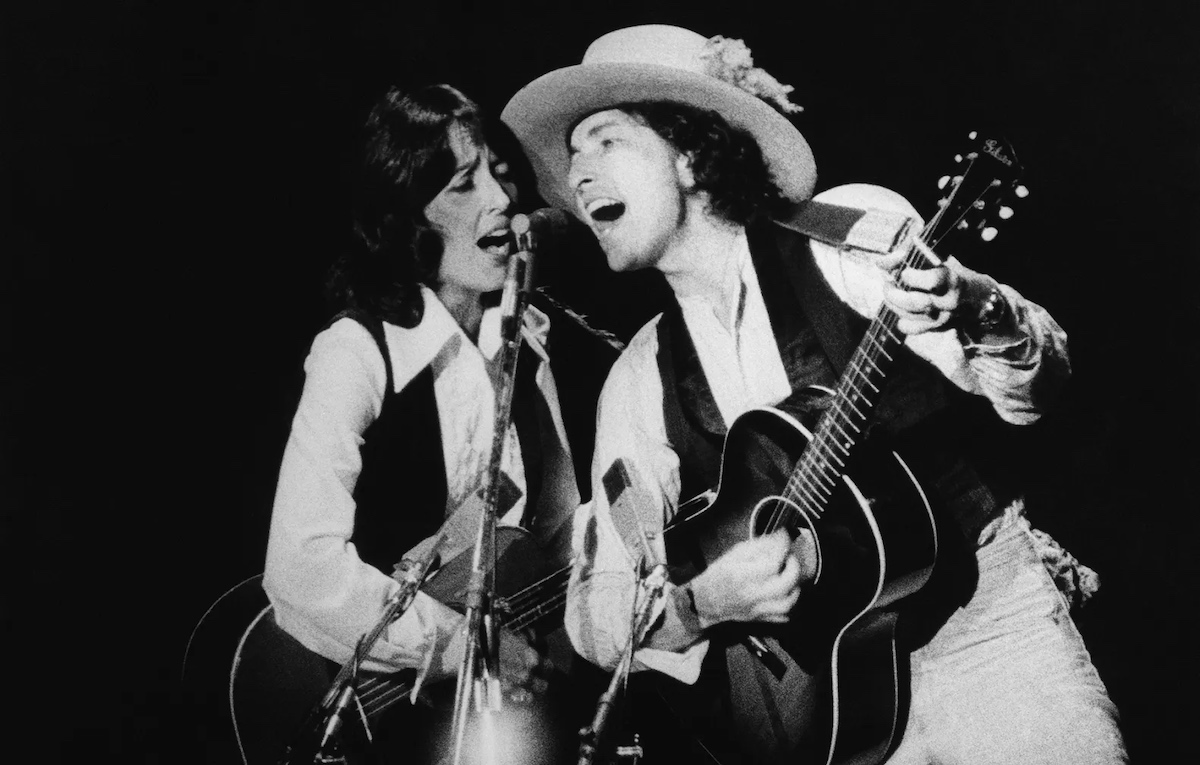
Joan Baez and Bob Dylan on tour in 1975. Photo: AP
In another way, the whole project seems to me to be further proof that Dylan is one of rock's great survivors. In a period in which his music is not growing particularly evidently, Dylan continues to find new and interesting ways to present himself to the public. He has now proven to be, incredibly, the most skilled strategist in rock.
Two years earlier he had toured a hugely successful show. It was the classic long crossing of the United States in the large arenas. At his side was one of the best groups in the history of rock, The Band, and the repertoire included some of the greatest songs ever written: a retrospective of his career, a sort of Bob Dylan's Greatest Hits in Concert.
After a triumph of this magnitude, most rock stars are faced with the problem of having to outdo themselves. Dylan, however, didn't so much seek to surpass that success as to make the public forget what had come before.
Dylan knows very well that the public wants to listen to his great classics, but he also knows that continuing to live by them would mean stagnating. With the Rolling Thunder Revue he forced viewers to expect new songs, and by shifting the focus from himself to the show he prepared them not to listen to individual songs, but to expect a complete experience.
Dylan also knows that The Band is a great group, but that he can't play with them all the time. So he recruited unknown musicians, outsiders of the usual cliques of the scene, people known more for their wit than their technique. In this way he distanced the public from the inevitable comparison with The Band. Indeed, thanks to this creative formula he has managed to circumvent the usual comparisons between what he is doing today and what he did ten years ago.
His experimental idea was so successful that it changed the way the public looked at his concerts, to the point that almost no one felt entitled to demand anything anymore. So even when he built much of the show around the songs from the new album – made all the more exciting by the fact that the album wasn't even out yet – there were very few requests for the oldies. And when he leaves the stage without performing Like a Rolling Stoneno one was disappointed.
From a myth-building perspective, this is extraordinarily effective. A man organizes a short tour of the Northeastern United States, keeps the itinerary a secret, doesn't release a new album, doesn't give interviews, shows open hostility towards the small part of the press that manages to overcome his defenses… and still ends up getting enormous attention and extraordinary acclaim. Dylan is one of the few rock stars to have understood how fundamental mystery is, both to create art and to draw attention to the artist.
In conception, design and myth-building, this tour is a true masterpiece. But, despite having perfectly prepared the ground for a great musical triumph, the Rolling Thunder Revue fails to live up to its ambitions on a strictly musical level.
Dylan looks magnificent, moves with great theatricality, is full of energy. However, his way of singing is often mannered, poorly in tune, shrill and disorderly. The older songs lack the nuances, precision and intensity of the past; in the new ones, however, it ends up adopting a monotonous register.
Neither Dylan nor the show as a whole particularly benefits from the accompaniment of the band, known as Guam. The group does not have the flexibility necessary to sustain more than three hours of concert and the rhythm section often ends up forcing the songs into certain patterns.
Yet the band plays with energy and, when given the right direction, proves up to the task, at times even incisive. It happens especially with Roger McGuinn and Joan Baez. Both represent the counterpoint to Dylan's musical limitations. They are stubbornly faithful to the music, refusing to be distracted by the aura of the event and display performances of the highest professional level that ignite the enthusiasm of the audience. Only they have never lost sight of an essential fact: when you perform in such an extraordinary context, it becomes even more important to keep what you promise in the details, precision and concrete quality of your work.
This article was published in the January 15, 1976 issue of Rolling Stone US.