
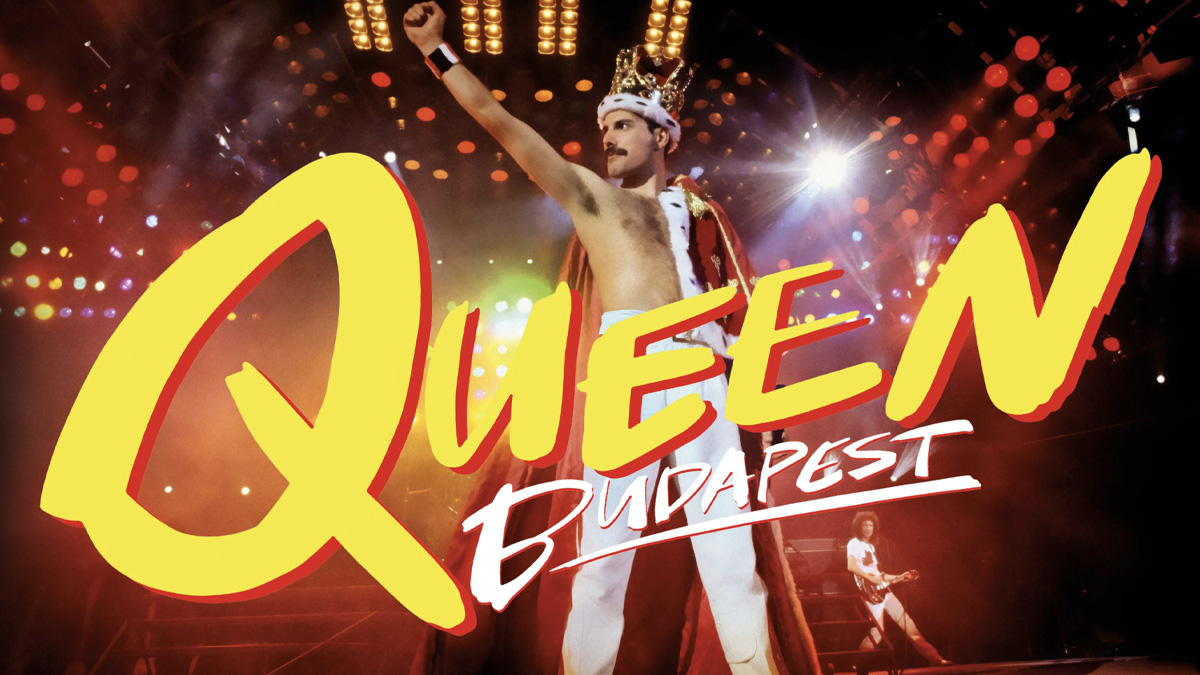
Sony Music Vision is proud to announce that “QUEEN BUDAPEST”the first rock show by a Western band in a stadium behind the Iron Curtain, as well as Queen's last full live performance captured on film, will be shown in cinemas and IMAX theaters around the world starting October 7 with distribution by Trafalgar Releasing. In Italy it will be in theaters from 7 to 11 October distributed exclusively by Nexo Studios.
“Queen Budapest” arrives in theaters on the occasion of 40th anniversary of this fundamental moment in the band's history. The film was meticulously crafted restored in 4K from the original 35mm footage at Sir's Park Road Post Production studios in New Zealand Peter Jacksonwith a new audio mix created from the original multitrack recordings, to deliver the most immersive version of the show yet.
From October 30th “Queen Budapest” will be accompanied by a multi-format edition released internationally by Legacy Recordings, Sony Music's catalog division, and by Hollywood Records in the United States and Canada.
The soundtrackremixed by the Queen studio team, will be released in CD, digital and, for the first time, also in a box set of three vinyls. The formats will also be available from October 30th Blu-ray and DVD.
From today, Monday 27 July, pre-order is active https://queen.lnk.to/Budapest
“Queen Budapest” is a one-of-a-kind cinematic documentary, created for relive the concert over time, make it accessible to everyone and for witness the grandeur of the music able to break down any barriers.
Recorded on 27 July 1986 at the Népstadion in Budapestduring the “The Magic Tour” of the band, the concert represented a revolutionary moment: in a period of profound cultural and political changesQueen became the first Western rock band to perform behind the Iron Curtain. In addition to the 80,000 tickets sold, an estimated 45,000 people listened to the band from outside the stadium; some fans even came from Russia and Poland to attend the concert.
The production was entrusted to Mafilm, directed by János Zsombolyai, which involved the most authoritative Hungarian cinematographerswith cameras located in every point of the stadium and shots taken from the helicopter.
The show was professionally filmed in 35 mm by 17 of the best Hungarian cinematographers. The production employed 17 cameras and approximately 40 kilometers of filmi.e. all that available in the country.
Live performances alternate with images of the band and fans, together with sequences shot in the five days preceding Budapestwhich show Freddie Mercury, Brian May, Roger Taylor and John Deacon experiencing the city in some of its most iconic locations.

The whole operation was approved by the Hungarian government, an unprecedented fact for a communist state.
The new restoration starts from the original multitrack recordings of the concert, preserving not only the music and voices of the band, but also the energy of the over 80,000 spectators present that evening, whose involvement becomes an integral part of the listening experience.
“Queen Budapest” is thethe band's last live performance with Freddie Mercury to be filmed and shows the group at the height of their powers on stage.
The result is a work that combines the power of the live performance with the value of the historical document, telling not only one of the highest moments of Queen's career, but also an event that has entered history.
Given the scale of that undertaking, it would have been impossible to imagine that Queen would only play 5 more concerts, ending their live activity with Freddie forever just a month later. In fact, the last show took place on August 9, 1986 at Knebworth Park, England.
The film immortalizes the performance of iconic songs such as “We Will Rock You”, “We Are The Champions”, “A Kind Of Magic”, “Crazy Little Thing Called Love”, “Under Pressure”, “Who Wants To Live Forever”, “Hammer To Fall” And “Bohemian Rhapsody”as well as an acoustic arrangement of the traditional Hungarian folk song “Tavaszi Szél Vizet Áraszt”.
The film also features one of the most memorable performances of “Radio Ga Ga”available on YouTube with newly improved images and audio of the Budapest performance.
An edited version of the show was broadcast in December 1986 throughout the communist bloc, including China, Poland, Czechoslovakia, East Germany, Yugoslavia and Mongolia. On 1 January 1987 it was also screened in 59 Hungarian cinemas, once again marking a record for a Western rock band.
For Brian May and Roger Taylor of Queen, the Budapest concert was not simply another stop on what was a massive tour for the band: it had a much deeper meaning.
Brian May: «For years, fans living behind the Iron Curtain had been able to listen to Queen's music only through illegal cassettes. Listening to rock bands like ours was forbidden, so seeing us perform live would have been unthinkable. This concert, during which they could finally come to see us in person and interact with us, was a moment of enormous emotional intensity for them, and it was for us too. We had the feeling that it was something really important: there was an incredible energy. There will never be an event like this again. Perhaps the most memorable moment of all was the performance of that beautiful Hungarian folk song, which Freddie and I had learned for the occasion. There wasn't a single dry eye!'
Roger Taylor: «We liked to think that music could overcome politics and political barriers. That was part of our philosophy: to really engage the audience in the show and make them feel part of it. I know Freddie had tried to learn that popular song, but he had written the words phonetically on the back of his hand. When the audience spontaneously began to sing, we realized that, yes, music can truly become a great force capable of uniting people.”
Brian May: «Peter Jackson's team have done a magnificent job in restoring the original footage in the highest resolution ever achieved: the images are perfect and the quality is breathtaking. I think you will like it very much. Even on the sound front we were able to carry out a restoration job of the highest level. Now, in IMAX theaters and theaters, it will be the most realistic experience of Queen in our golden years yet. I believe that the public will be completely transported, almost to the point of forgetting that they are watching a film.”
«Queen Budapest represents an extraordinary moment in both the history of music and culture» said Tom Mackay, president of Sony Music Vision. «The film not only documents an exceptional performance, but also the bond between the band and an audience that, at that time, was overcoming real barriers. The restoration allows us to relive that moment with an immediacy and relevance capable of speaking to today's public too.”
Peter Jackson added: «As long-time Queen fans, we were thrilled when they asked us to restore footage of the Budapest concert at Park Road Post. It was a rare privilege to be able to breathe new life into such an iconic moment in music history. We can't wait for a whole new audience to take part in the original lineup's final live performance immortalized on film. They'll make you tremble!”.
The 4K restoration of “QUEEN BUDAPEST” will be presented in world premiere on September 15th at the Budapest Classics Film Marathonorganized by the National Film Institute of Hungary, as part of the festival program dedicated to restored and rediscovered cinema.
The UK premiere will take place in London on September 30th; further details will be communicated later.
The 4K digitization of the original negatives was carried out by FilmLab of the Hungarian National Film Institute in Budapest. The original film materials have been preserved since 1986 in the film archive of the National Film Institute in Budapest.
Daniel D`Amico for SANREMO.FM