
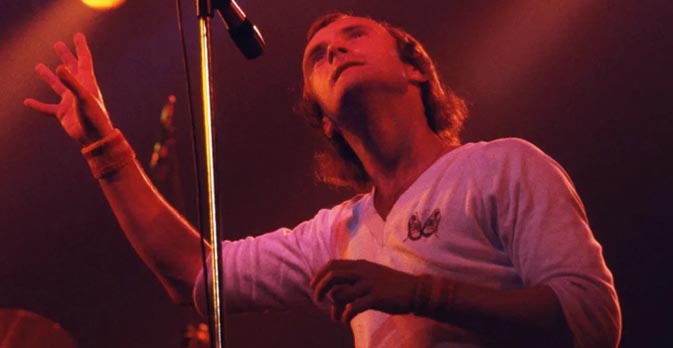
The official vulgate wants the history of Genesis to be divided into two eras: the progressive one led by Peter Gabriel and the more pop one with Phil Collins as singer. A distinction which, however, as we have also tried to underline in this special, risks diminishing the contribution that Collins gave to the band both before and after becoming its leader. frontman.
Having joined Genesis in 1970 as drummer, Collins was in fact one of the architects of the group's sound during the golden years of progressive music. His technical, powerful and creative style contributed significantly to the creation of fundamental albums such as “Nursery Cryme”, “Foxtrot” and “The Lamb Lies Down On Broadway”, works which still today represent the absolute pinnacle of Seventies rock.
The global success achieved in the 1980s with hits such as “Sussudio” and “Against All Odds” ended up obscuring, in the eyes of many, his past as an extraordinary drummer at the service of the band. Collins, however, has always reiterated that he has never pursued a pop star career: drums have always been his true point of reference and even Genesis' pop hits – from “That's All” to “Invisible Touch” – have always been the result of the work of the whole band.
Among the records of the first phase of Genesis, “Foxtrot” occupies a special place, even in Phil Collins' hierarchies. The album released in 1972 – among other gems – also contains “Supper's Ready”, the monumental suite of over twenty minutes considered by many to be the group's absolute masterpiece. Inside, in particular, there is “Apocalypse in 9/8”, one of the most famous pages of the band's repertoire, built on an unusual rhythmic subdivision that has become a point of reference for progressive rock enthusiasts. A section that for Collins represents “one of the pinnacles” of the English band's experience.
Yet, that very section, apparently so elaborate, was born almost by chance. “When I came back,” Collins said, “Mike Rutherford and Tony Banks had written 'Apocalypse in 9/8'. Tony had composed it without thinking about the rhythmic subdivisions. I played it maybe once or twice and didn't think about it too much. It was one of those moments where the recorder was on and we were able to just capture what was happening. It was probably one of our best spontaneous moments.”
Collins' memory returns an image different from that commonly associated with progressive rock, often considered a genre constructed with almost mathematical precision. If many bands of the time planned every detail of their compositions, Genesis instead managed to transform even the most complex ideas into something natural thanks to the understanding between the musicians.
For a drummer, tackling 9/8 time represents a considerable challenge. Collins, however, had already developed a great familiarity with irregular rhythmic structures, also thanks to the experience gained with Brand X, and was thus able to interpret that passage with surprising naturalness. This is also why “Supper's Ready” continues to be considered one of the fundamental works of progressive rock. Behind the complexity of the composition there was not only sophisticated writing, but also Genesis' ability to leave room for instinct. For Phil Collins, the recording of “Apocalypse in 9/8” still remains proof that some of the band's best moments were born simply by playing together, without calculations and without pre-established patterns.
One of Genesis' most representative compositions, “Supper's Ready” holds you captive for over twenty minutes with everything you expect from progressive music: intensity, technique that is never an end in itself but rather at the service of the composition and always well contained by it, articulated complexity, but above all ideas, ideas to sell, without sterile masturbations. From the living room to the apocalypse and back, the suite recounts the second advent of Christ on earth, the fight against the Antichrist and his defeat, and therefore the definitive conquest of the new Jerusalem for humanity, all obviously seen as a metaphor for the fight of good against evil. Musically there is an enormous variety of ideas and accents: from classical, to hard rock, to almost cabaret-like and childish pop, to odd time signatures (“Apocalypse in 9/8”), and a martial rhythm that leads to the conclusion of an almost unsustainable orchestral intensity. Everything conspires to be exaggerated, but it isn't: it's music that amazes, but without unnecessary frills.
In the last repetition of the theme, Phil Collins' snare drum gradually enters, accompanied by the solemn atmospheres of the mellotron. The harmonic progression changes direction and leads the song towards its culminating moment: “Apocalypse In 9/8”. The section opens with the powerful and almost declaimed voice of Peter Gabriel, supported by the rhythm guitar, the organ and the incisive accents of the drums, before leaving room for the extraordinary instrumental interlude born from a collective improvisation by Tony Banks, Mike Rutherford and Phil Collins. Tony Banks recounted the genesis of that passage thus: “Mike wanted to create an alternation between guitar and bass and began to play, albeit in a rather instinctive way, while Phil tried to build a rhythmic pattern on top of it. At that point I suggested he limit himself to three notes, E, F sharp and B, on which I could develop any chord, both in major and minor keys. In minor, the music can be both melancholic and bright at the same time, so I had complete harmonic freedom without having to worry of the pace. The result really surprised us.”
(Contributions by Marco Simonetti)
Daniel D`Amico for SANREMO.FM