
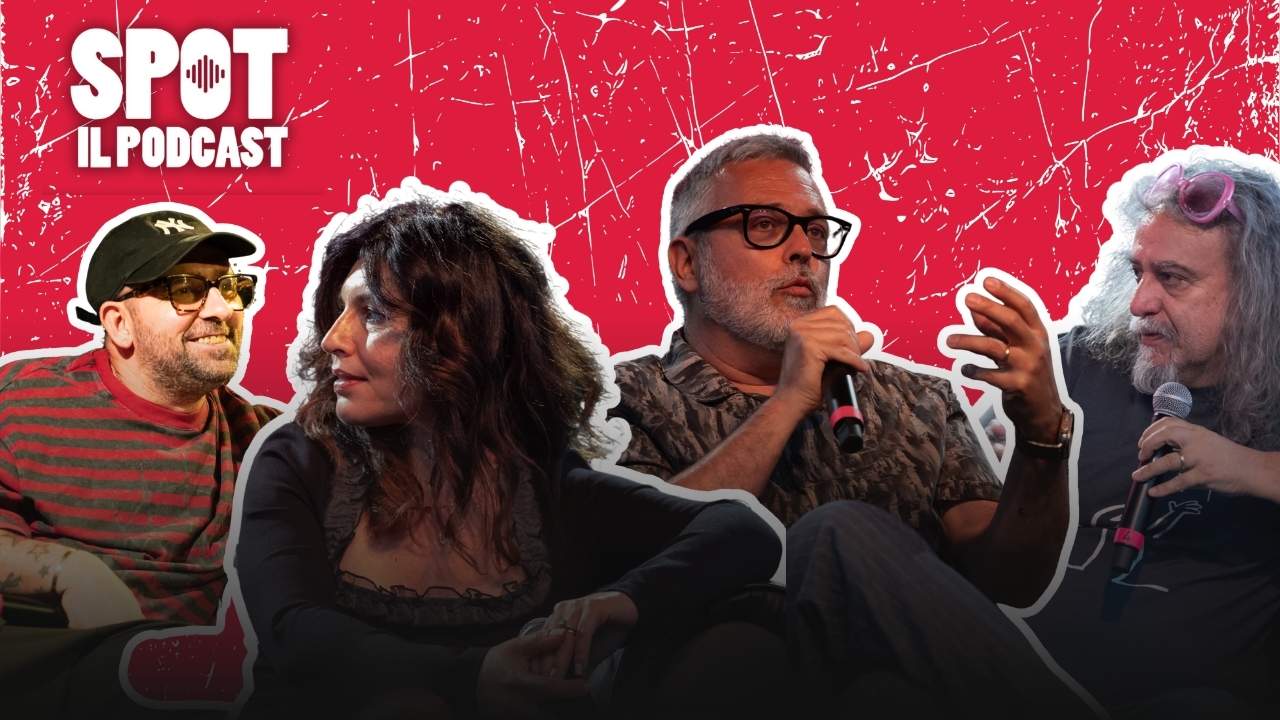
Giusy Ferreri And Frankie hi-nrg mc they were guests together of SPOT – The Podcastthe program that Michele Monina And Massimiliano Longo they record live at the Spot Music Fest in Bareggio, in front of the audience of the young artists of the festival.
Two opposite and parallel paths, the singer-songwriter who has gone through summer and rock hits and the rapper who in thirty years has published seven records choosing to disappear between one project and another, who find themselves in agreement on several things. Starting from artificial intelligence.
“Those who think well” was born from four seconds of audio
Frankie hi-nrg he tells how sampling really works, that of the origins of hip hop: you open the fridge and look at what's inside, he explains, that is, the records that were in the house as children, those of parents or older brothers. From there you extract pieces, a drum beat, a bass note, two or three piano notes.
The Edge Case is his best-known song. The sounds they compose Those who think well it's less than four seconds of audio: one, two, three, four, and the material is finished. From there a piece was born which, he says with a hint of amazement, ended up in some anthologies of literature for high schools, which leaves him with the responsibility, he says, of being a classic. Even if, he points out, little remains compared to the Sepolcri or Orlando Furioso.
Giusy Ferreri's diamond disc was born as a game
Giusy Ferreri to date holds the last Italian diamond record for a single. But that result, he says, started almost by chance: he was in the studio working on an album when the proposal came Rome Bangkok with Baby K. He listened to it, said it didn't have much to do with his world, then decided to do it anyway. He never imagined the outcome.
From there came the subsequent collaborations, with Takagi and Ketra already present in production. And Ferreri has no regrets in that regard: the public appreciated that lightness, he says, and evidently every now and then there is a need for it. In the meantime he continued to do other things, from rock to Bloom with Max Zanotti to the more introspective songs, because life only happens once and nowhere is it written how an artistic journey should go.
“Vamos a la playa is about nuclear explosions”
One of the most interesting passages concerns the songs that seem like a hymn to disengagement but instead hide something else. Frankie quotes Let's go to the beachwhich talks about nuclear explosions experienced on a beach in humanity's last summer, a piece that when analyzed from this perspective, he says, is tough. With Johnson Righeira, with whom he has been a friend for over thirty years, he agreed on the importance of concealing important issues.
How record companies have changed
The rapper describes a paradigm shift in the craft. Once upon a time there was the figure of A&R, artist and repertoire, who listened to demos, looked for artists and authors and brought them together, an almost alchemist's job. Today, he claims, an artist is expected to make it on his own, to build a fan base and a spending audience as an independent, and only at that point does the money arrive to turn a small success into a big success. With the next step to point everyone in the same direction.
Ferreri confirms from his point of view as an independent artist today: when he took the path Bloom he did it also due to this deficiency, because the idea of creating an album with different nuances within it had disappeared. And he adds a date to that change: the request to lighten everything, he says, has become stronger after Covid.
The fear of talking about death, illness and fragility
Hence the more political part of the conversation. Frankie hi-nrg he says that he came out in November 2020 with a record that spoke of that moment, in contrast with a discography that had stopped and with radio networks that preferred to re-record old hits. The comparison it brings is with American television series, which told about Covid live, while in Italy they preferred to hide the body under the carpet.
The theme broadens to the cultural removal of death, illness and disability, which are hidden, disguised or made cute. Ferreri brings the same point to the younger ones, who in the masterclasses seem scared of the idea of describing pain in songs. If you turn away, observe, the pain is still there.
“I'm Giusy Ferreri”: the entry filed against the AI
The final part is dedicated to artificial intelligence. Ferreri is among the first cases in Europe to have registered his vocal identity to protect against cloning: he only had to pronounce the phrase “I am Giusy Ferreri”, because doing so while singing would have generated rights to the songs, and he also sent a photograph for facial recognition. A seat belt, he defines it, in a future of cloning.
Longo then submits to both of them the answers that the artificial intelligence gave about them, and the machine is clear: that deposit is used to go to court later, not to prevent cloning before. Ferreri replies that an artificial voice will never be able to convey what the soul and experience put into an interpretation. Frankie, who has been using generative AI for years, identifies the structural limit: the machine only works on what has already existed. If you give her the entire Battisti discography, she says, she will make you variations of Battisti, but for a new Battisti song you need Battisti.
All Music Italy