
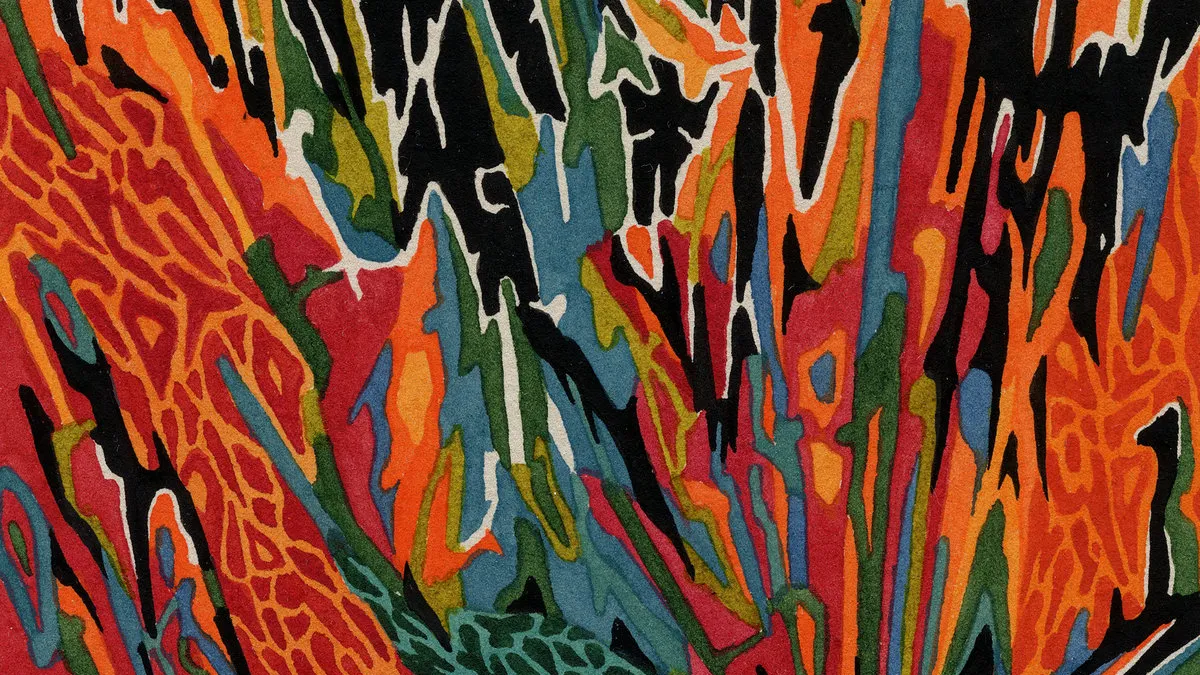
In the lush opening moments of Terra Incognita, composer Pascal Bideau’s new album as Akusmi, it’s as though he were swinging a giant magnet, drawing in every sound that fascinates him. Low piano notes gather tentatively; sostenuto woodwinds hover just above ground level; a rainstick adds contour and shading. As the piano arches into a sparkling glissando, a harp follows suit, carving out space for a light, airy synthesizer drone to materialize. The elements all curl around each other into a blissful tangle; listening feels like tracing a stream widening as it cuts into a mountainside. As the nearly 11-minute track floats along, it slowly coalesces, its ambient haze glomming on to a gentle but steady rhythm that emerges halfway through. The touchstones are plentiful—Harmonia’s cyclical drift, Alice Coltrane’s stargazing elegies, gamelan’s hypnotic shimmer—but the song is strange and unpredictable. More than just a record collector’s skillful collage, it’s the thesis statement for Bideau’s utopian musical vision.
Over the next 38 minutes, the London-based Bideau and his ensemble, which includes tabla maestro Sarathy Korwar, Senegalese multi-instrumentalist Dudú Kouate, harpist Marysia Osu, and composer Daniel Brandt, put forth a groove-focused, genre-agnostic collection, drawing inspiration from any and everywhere. Bideau’s debut, 2022’s Fleeting Future, hinted at the explorations of Terra Incognita, its complex electroacoustic grids opening into ever-expanding crescendos. The liner notes cited Jon Hassell’s term “Fourth World” to describe that record, and it’s tempting to invoke it again here. But this time, instead of manipulating known instruments into the alien textures of some imagined, faraway continent, Bideau sets the action right in front of us, in a borderless Pangaea where sounds and ideas from all over connect into something recognizable but wholly new.
No score yet, be the first to add.
Jazz is the most identifiable launchpad here, as Bideau, who plays saxophone on every cut, frequently channels the expansiveness Gary Bartz and Wayne Shorter brought to McCoy Tyner’s Extensions. His serpentine phrasing on “Club Subterranea” squiggles atop the angular bed of synths, balafon, and metronomic hi-hats that he and Mattias Mimoun lay down, destabilizing the pulse like gusts of wind through tall grass. Later, on “Drongo’s Flute,” his sax leads through a thicket of flutes and harp, slicing a path for Kouate and Korwar’s polyrhythmic percussion. As the track builds into a towering matrix, Bideau’s sax joins the ranks, becoming just another shape in its thousand-piece puzzle.
Other pieces are more indebted to various forms of trance music found around the globe. “Rain Dance” fuses the circular repetition of Moroccan gnawa with Berlin School synthesis into a swirling, earthen kosmische that is equally overwhelming and mesmerizing. The squirming saxophones on “Pleine Lune” threaten to burst apart and splatter across the stereo field, but Kouate’s timekeeping cymbals keep everything sufficiently locked together, creating an inviting, captivating push-pull. As the mille-feuille of Kouate’s vocals surfaces near the end of the closer “Dawning Dusk,” its beatific churn becomes that much more ecstatic, replicating the joy and power of singing in a group.
