
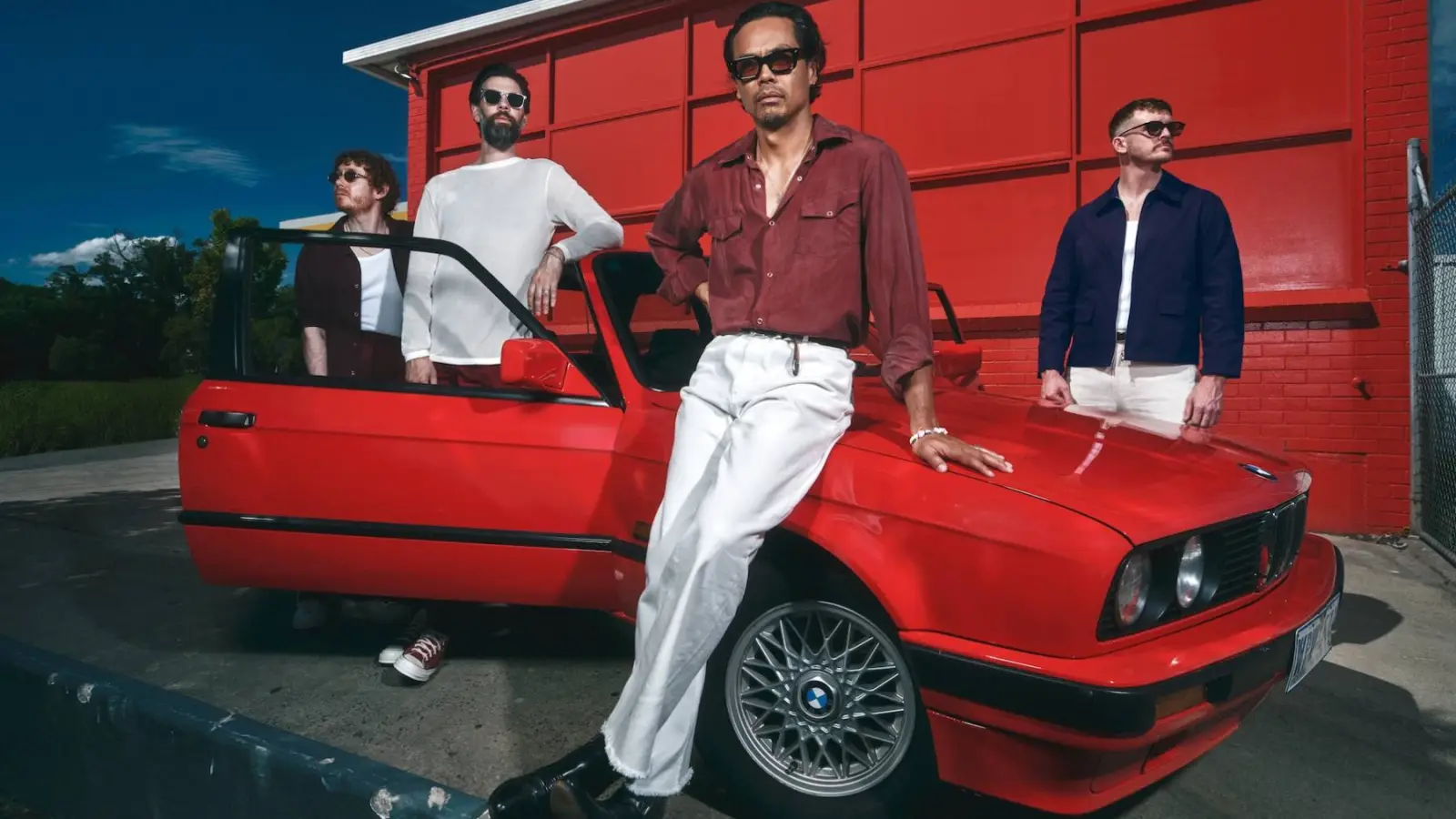
The Temper Trap burned out, took a break, and now are back with their first album in a decade. “I felt like I needed to step away and explore other musical adventures and try to find that fire again,” says lead singer Dougy Mandagi.
Not everything has changed, however. “I still haven’t grown up in my head, you know,” he adds. “I’m still trying to capture the sound of youth, even though I’m definitely not a young buck anymore.”
In the late aughts, the Australian band unleashed their 2009 debut album, Conditions, delivering the euphoric millennial anthems “Sweet Disposition” and “Love Lost.” The fervor for their music launched Mandagi, bassist Jonathon Aherne, drummer Toby Dundas, and guitarist Lorenzo Sillitto onto the charts and stages across the world. After nearly two decades and two more albums later, the relentless touring and industry expectations for another “Sweet Disposition” took a heavy toll on the band.
In 2013, Sillitto walked away from the group, which had picked up Joseph Greer on keyboards and guitar along the way. Five years later, the remaining members collectively decided to go their separate ways. Mandagi packed up and moved to Berlin, surrounding himself in the city’s electronic music culture before relocating to his home country, Indonesia. Dundas established his own recording studio and began composing film scores; Aherne headed to the United States and released a solo project; and Greer became a teacher.
The time apart allowed the band to come back on their own terms. Now, their fourth album, Sungazer, is here. It’s a searing testament to the Temper Trap’s ability to capture joy and grief alongside propulsive rhythms and Mandagi’s devastating vocals. The band is also on a tour In an interview with Rolling Stone, Mandagi and Dundas reflect on their hiatus, return to the studio, and creating an album free of expectation.
How did it feel coming back to the studio 10 years after releasing Thick as Thieves?
Mandagi: I think we were a little bit unsure when we first got together again. We were definitely just wanting to test the waters before diving into it. But the first day we were in the studio, we worked on “Kuru,” which is the last song on the record — so that was the first song that we worked on, which is cool. It instantly felt great. The chemistry was there, the ideas were fresh, and we got excited again. So, we decided to do more days, and that led to almost three years making this record, but it’s been really enjoyable and fun.
Some of the scheduling was a bit difficult. That’s why it took so long, but every time we were together, it was really inspiring.
To be away from each other, after being so close on tour, must have a big change.
Dundas: We went into it with no expectations — hopeful that sort of creative energy between the four of us would still be there, but, after such a long time away from each other, there’s no guarantee.
When we worked on “Kuru” there instantly was that buzz that something cool was happening. A lot of the things that came from that song spread to the rest of the work and we walked away from that day with a real sense of what was possible — if we knuckle down, put the work in, and ride that creative beast that you’re always trying to catch in songwriting, we could come up with was something worthwhile to say.
With the band split across different continents, how has your songwriting process evolved since your last album?
Mandagi: Working remotely is a new thing that we’ve been doing. In the past, we allocated “x” amount of time for us to all get together in the studio and jam out these songs. But as we’re all living in different continents, we don’t have that luxury. We have gotten together a bunch of times, different members have flown into Melbourne, and there were times when all of us would be in there in the studio. Then there were times when only two of us would be in the studio with our producer [Styalz Fuego], and the rest of the time, we worked remotely, coming up with ideas and sending tracks over to each other.
That’s a new thing that we didn’t do on the previous albums, and maybe that’s one of the reasons why it took quite a while to do it. But, in hindsight it’s actually a real luxury to be able to do that — to write and record something, and then go away and sit on it for a month and let the idea percolate. Looking back now, it’s probably a good thing that we had all this time to really let the ideas simmer and mature.
Dundas: Yeah, and being able to road test a lot of the songs live really shines a light on what bits of songs are good and have an instant connection to the audience, and which bits don’t. Like Dougy was saying, you get space to make the right decisions and do the best thing for the song. It was something we always did on the first album, and maybe not so much on the other two.
Mandagi: In fact, I think it is “Into the Wild” that was already mixed and ready. Then we got together for a gig, and we were just practicing, and I played a different chord, and I went, “Wait a minute, that’s the right chord.” Then we had to dig up the song again and re-record that just to put that chord in. I mean, a bunch of people were probably pissed off about that, to be honest, but it’s the fact that we got to do it, and now the song really feels right, and it feels better.
We wouldn’t have been able to do it had we not had, like Toby said, the opportunity to road test songs. The song will inform itself when you play it live, it tells you what it wants. It’s a different environment in the studio to the energy when there’s an audience in front of you.
You’ve talked about experiencing burnout after touring so much and having this expectation of releasing another “Sweet Disposition.” Can you walk me through what that pressure felt like at the time?
Mandagi: The pressure was the main catalyst to burning out, just talking about me personally. I still enjoyed the tour life and hanging out with the boys — that was fun back then, and it still is — but there was always this cloud hanging over me and over the band to reach the success of “Sweet Disposition” again. It sort of took over the creative process, and whether it was intentional, or subconsciously or consciously, I felt like all the ideas were stale. It’s probably because we were all trying to chase that and prioritizing writing another “Sweetest Disposition” over making art. You know, doing something genuine and creative.
Did being in Berlin help?
Mandagi: That helped. I mean, my time there also opened my eyes to a completely new genre of music. It wasn’t completely unknown, of course. I was aware of electronic music, but I wasn’t that interested in it. I think the type of electronic music that I was exposed to prior to moving to Berlin was pretty bad, pretty cheesy stuff. After moving to Berlin and being introduced to really quality electronic music, making music with people there, and doing my solo project, which was also electronic based, opened my mind more to different types of music and a different way of working.
How did working in Berlin, and for you, Toby, creating film scoring on your own, come together to create this new sound on the album?
Dundas: There was this space from creating in the box that is the Temper Trap … Slowly, walls get built up over your career and that can be hard to break out of it. You’ve got your labels and management really seeming to be hyper-focused on quite a narrow path and on one song in our careers.
Taking the time away and working on other projects, working with other people — in my case doing some like film scoring and things like that — felt like a complete reset of those creative impulses. So, when we were back together, I feel like the other three guys equally were coming at it from that place. We could naturally chase down these ideas and instincts that turned into the songs that became the album without second guessing: “Is this what the label is going to like?” or “Does this sound enough like ‘Sweet Disposition’? Can we only write in these tempos or keys?”
All that stuff is gone, you know. I think we would all say that creative process felt the most like making the first album, where there was no expectation.
Toby, it’s interesting you got into music scoring. At times, the Temper Trap’s sound is quite cinematic. How would you describe Sungazer as a film?
Mandagi: I don’t why, but Paris, Texas just came to mind. I don’t even remember what the movie is about, to be completely honest but [there’s] the idea of some guy wandering, stumbling through life.
Dundas: Doug and I were talking about this the other day. There’s often a lot of imagery about moving from place to place, moving through a landscape and things like that.
Actually, in “Halfway,” there’s a line about ,”next stop, Paris” and a line about “next stop, Texas,” as well, right?
Mandagi: I think so yeah [laughs]. Maybe it’s an Australian thing as well. I definitely feel like that cinematic, open space journey through the desert thing is also a bit of an Australian thing thematically. It’s a metaphor for a lot of things in life.
A lot of the new album tackles these big life moments. How did you approach the songwriting for this record?
Mandagi: Writing lyrics doesn’t come naturally for me. It’s something that I’ve worked on a lot. Writing music is not difficult for me. When the music is finished enough for me to then go write lyrics … I dread that moment all the time.
It’s never been something that has come naturally for me, and I guess there were times in my life when I was going through a break, or I was feeling lonely, or in London and living on my own, and feeling a bit isolated, and I was going through a lot of stuff. So, there was still a well of inspiration, but now I feel like I’m in a really good place in my life and I’m definitely not about to suffer for the art, for the sake of it.
So, then I’m kind of stuck. I’m thinking I don’t know what to write about, so then I end up making up characters, only to realize that character was me five years ago. Maybe I just needed to put myself through self therapy and get it all out.
Would you consider Sungazer a form of therapy or simply you looking back?
Mandagi: It’s not just therapy, it’s like therapy and debriefing yourself through life. A lot went on during the pandemic, you know. We all experienced a lot — some heavy shit, some good stuff. Some of us became parents during that time. It’s a lot to debrief: that time I got burnt out, and we kind of split up for a little bit, and went our separate ways.
It wasn’t like I said, ‘Hey, guys, I need some time off,’ and then everybody was just like, ‘Yeah, cool, sweet, man.’ It was a bit of a heavy thing. I guess we never really discussed it, how we felt and whatnot. So, maybe some of that was poured into the songs — excitement about being back together. I feel like a lot of my lyric writing can be melancholic, but I like to think there’s light, some hope at the end of the tunnel as well.
Dundas: I feel like Dougy’s best lyrics often come from a melancholy place, but there’s [also] a sense of yearning to reach for something better from that.
Did you guys ever talk about that break in person?
Mandagi: No. [Laughs.]
Well, welcome to this session. [Mandagi and Dundas laugh.]
Mandagi: I don’t think we even need to, to be honest. I think maybe we didn’t realize that at the time, but now we’re all probably kind of happy that it happened. Because, like we said at the start of this interview, we needed that time to really unlock these creative blocks forged throughout the rest of the albums, and the success of “Sweet Diisposition,” and trying to recreate that.
You fall into patterns and you think there is no other way outside of these patterns. ‘This pattern will lead to success’ — which is bullshit. … People can see if you’re genuine, and if you actually like what you do. And there’s an attraction in that.
If you’re trying to write a hit, people see through that as well. So, you may as well be genuine, and I’m sure enough people will come along for the ride.
Did you guys always think that you’d come back together?
Dundas: I mean, for me, I wasn’t sure. Back about around that time when we were deciding to take that break, I think if we hadn’t done that — if we’d stayed on the path we were kind of heading down in 2018 — that frustration with the creative process would have eventually spilled over into our personal relationships. And I think that would have been something that would be much harder to come back from. The break was absolutely what we needed, and that was the thing that got us here.
So, for me, no. I think there was probably a few years where I wasn’t sure that we would have anything new worth getting back together for. That was the shadow of how things were feeling towards the end, and it just took three, four years to give enough space to reset and see what was possible again.
Mandagi: We may have gotten back a lot sooner if it wasn’t for the pandemic. That’s totally possible, but yeah, we definitely needed that time off.
Mandagi: I mean, yeah. I always had that feeling, because it wasn’t like, ‘I quit,’ you know? It wasn’t like that at all. It was definitely just, ‘Hey, guys, I kind of need a break. Can we have a break?’ So, I knew that it was something that was there, it had just been put on the shelf, but it was there in my peripherals.
As a band, what keeps bringing you back together?
Mandagi: It’s a feeling of: I’ve got unfinished business to do. There’s still a bit of ‘I need to prove myself’ attitude in me. So, there’s that, but there’s also just the genuine love of making music, and making music with people that you’ve known for so long, you have such a deep relationship with.
We’ve toured with a lot of bands, and it’s crazy to watch bands playing together and touring together. And they might be more successful than us, but they hate each other. We’re so lucky that we actually like each other. We genuinely have fun going on tour and being together. All those reasons are a driving force behind why I do it, and why I’m still here with the Temper Trap.
Dundas: Yeah, there’s a certain something in the air when the four of us get in the room and work on music that I haven’t experienced in any other combination of people or situation. When it’s on, it’s a bit of a bit of a drug. It’s just an amazing feeling, and you’re always chasing that.